
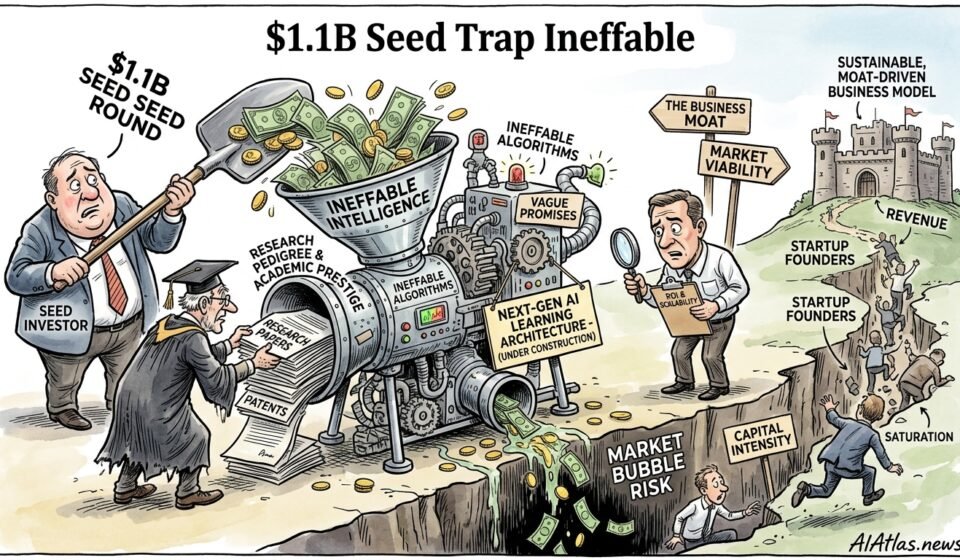
The $1.1B Seed Trap: Why Ineffable Intelligence Needs More Than Research Pedigree to Win
The Contrarian Thesis
David Silver’s staggering $1.1 billion seed round for Ineffable Intelligence has sent undeniable shockwaves through the European venture ecosystem. In our experience, such astronomical early-stage valuations typically signal dangerous market exuberance. However, peering beneath the financial headline reveals a fundamental and necessary pivot in artificial intelligence architecture. Silver is not building another data-hungry foundation behemoth; he is betting entirely on experiential learning to bypass the very bottlenecks strangling his competitors.
We believe this marks a critical inflection point for the industry. For the past two years, the consensus dictated that hoarding massive capital reserves to scrape the internet was the only viable route to artificial general intelligence. We argue the exact opposite: an over-reliance on static, historical data is rapidly becoming a structural vulnerability. Ineffable Intelligence’s mandate to utilise experiential models—systems that learn dynamically from active environments rather than static text—forces us to fundamentally re-evaluate what genuinely constitutes a defensible commercial moat in this sector.
Flaws in Current Market Assumptions
What we are seeing in boardroom after boardroom is a dangerous conflation of capital expenditure and competitive advantage. Investors and founders currently operate under the flawed assumption that whoever burns the most compute on the largest proprietary dataset inevitably wins the market. Yet, as hyperscalers drain the remaining dregs of high-quality human-generated text, the marginal utility of adding more historical data to traditional architectures is plummeting dramatically.
Furthermore, enterprise executives are slowly realising that foundation models trained purely on static inputs struggle severely with novel, context-heavy reasoning. They falter when faced with dynamic commercial realities and edge cases that were not explicitly detailed in their training corpora. The assumption that sheer scale will magically resolve these architectural deficiencies is deeply misguided. When $1.1 billion is allocated merely to reach the starting line of compute parity, the underlying business models cannot scale sustainably without achieving monopoly pricing—a scenario European regulators are acutely poised to prevent.
The Structural Shift
The transition Ineffable Intelligence proposes is fundamentally about moving from academic memorisation to active, goal-oriented reasoning. European deep tech has historically excelled in rigorous academic research but has frequently stumbled when commercialising against Silicon Valley’s brute-force capital deployment. By pivoting aggressively to experiential learning, the European AI landscape is finally playing to its distinct strengths in algorithmic efficiency, advanced reinforcement learning, and rigorous operational logic.
This shift irreparably alters the unit economics of startups in the space. Instead of front-loading billions into singular initial training runs with faint hopes of recouping costs through generic API access, experiential models spread compute costs across continuous, active deployment phases. The commercial implication is profound: exponential value now accrues to systems that can autonomously navigate complex environments—whether those are financial markets, global supply chains, or autonomous robotics—rather than systems that merely regurgitate heavily compressed internet data.
Decision Framework for Capital Allocation
For investors evaluating market saturation, the framework for capital allocation must evolve immediately beyond counting parameters and assessing graphic processing unit cluster sizes. We strongly advise focusing capital on algorithmic elegance and environmental data autonomy. A viable, investable startup must now clearly demonstrate how it limits reliance on third-party data licensing and entirely circumvents the looming copyright bottleneck that threatens legacy models.
Founders must also present a clear, unimpeded path from technical capability to a sustainable commercial product. In our due diligence evaluations, we actively look for startups that treat compute as a marginal cost of goods sold rather than an insurmountable fixed infrastructure tax. If a model requires active experiential interaction to refine its outputs, the allocation of capital should heavily favour proprietary deployment infrastructure, secure simulation environments, and deep customer integration pipelines over raw server farms.
Risk Assessment Table
Transitioning toward experiential architectures introduces entirely new categories of commercial and technical risk. While bypassing static data bottlenecks solves one immediate crisis, it invariably creates novel challenges regarding predictable outputs and initial model bootstrapping. We must evaluate these trade-offs rigorously to protect and grow deployed capital.
The table below outlines our comparative assessment of the primary risk vectors associated with both traditional data-heavy architectures and these emerging experiential models. By mapping these specific operational risks, enterprise leaders and operators can better hedge their long-term integration strategies.
| Risk Vector | Traditional Static Models | Experiential Learning Models | Commercial Impact | Mitigation Strategy |
|---|---|---|---|---|
| Data Scarcity | High vulnerability to text depletion | Low, generates own feedback data | Determines long-term viability | Invest in synthetic generation pipelines |
| Compute Economics | Massive upfront sunk costs | Ongoing operational inference costs | Dictates margin scalability | Optimise edge-deployment hardware |
| Predictability | Prone to untraceable hallucinations | Risk of erratic exploration behaviours | Impacts strict compliance auditing | Implement rigid reward-bounding |
| Defensibility | Weak, easily replicated with capital | Strong, built on proprietary interaction | Protects enterprise market share | Lock in exclusive enterprise pilots |
| Regulatory Burden | High copyright infringement risk | Moderate autonomous safety scrutiny | Could force regional service shutdowns | Proactive engagement with EU regulators |
Visualised Impact Matrix
To properly contextualise this industry shift, we employ a standard positioning matrix to evaluate where current architectures sit relative to their long-term commercial viability. We categorise these emerging systems based on their structural dependency on external human data against their inherent financial scalability within modern enterprise environments.
What we are seeing is a decisive, irreversible migration from the bottom right quadrant—representing high data dependency and low margin scalability—towards the top left quadrant, where low data dependency meets high experiential adaptability. The matrix below visualises this strategic migration, offering a stark visual warning to founders trapped in the legacy compute-heavy paradigm.
Ineffable Intelligence, Active RL Agents
Incumbent LLMs, Heavy Hyperscalers
Theoretical RL, Unscaled Lab Models
Static RPA, Legacy Narrow AI
Strategic Recommendations for Leaders
Enterprise executives must immediately conduct a rigorous audit of their active vendor dependencies. If your core business operational processes rely heavily on foundation models that face severe marginal cost curves due to imminent data scarcity, you are structurally exposed. We strongly recommend piloting experiential learning models in bounded, high-value commercial environments—such as algorithmic supply chain routing or dynamic resource allocation—where the model can safely learn through continuous, measurable environmental feedback.
For founders navigating the current capital markets, the message from our desks is exceptionally clear: pivot your investment pitch from sheer data volume to proprietary feedback loops. The era of raising hundreds of millions simply to rent processing power and scrape generic internet repositories is rapidly closing. Your commercial moat must be the proprietary simulation environments or the unique customer interaction loops that allow your product to learn faster and cheaper than a monolithic, well-funded competitor.
Future-Proofing the Business Model
Navigating this complex market transition requires a highly sober assessment of where commercial value truly resides in the technology stack. We maintain that the ultimate financial winners in the next decade of development will not be those who successfully indexed the internet, but those who engineered architectures capable of intelligently navigating dynamic reality. Ineffable Intelligence’s massive seed valuation is merely the opening bell for this ruthless new phase of competition.
Our judgement is that deeply sustainable business models will emerge strictly from integrations where the system acts, observes, and refines autonomously, creating a compounding loop of proprietary intelligence that no competitor can replicate by simply purchasing more compute. To aid business leaders in executing this transition, we have compiled our most frequent boardroom advisory queries below.
Frequently Asked Questions
- How does experiential learning actually reduce long-term capital intensity?
- It eliminates the need to license or constantly scrape trillions of static text tokens. By learning dynamically from interactions within an operational environment, the model generates its own high-quality training data at a fraction of traditional procurement costs.
- Are traditional foundation models entirely obsolete for enterprise use?
- They are not obsolete for basic linguistic tasks, document summarisation, or standard semantic search. However, they will rapidly become commoditised utilities, losing their premium pricing power as enterprise value shifts toward models capable of complex reasoning and active problem-solving.
- What specific metrics should VCs use to evaluate these new startups?
- Investors must scrutinise environmental interaction efficiency and reward-function robustness. The defining metric is no longer parameter count, but rather the speed at which the model achieves optimal performance within a novel, unstructured commercial environment.