
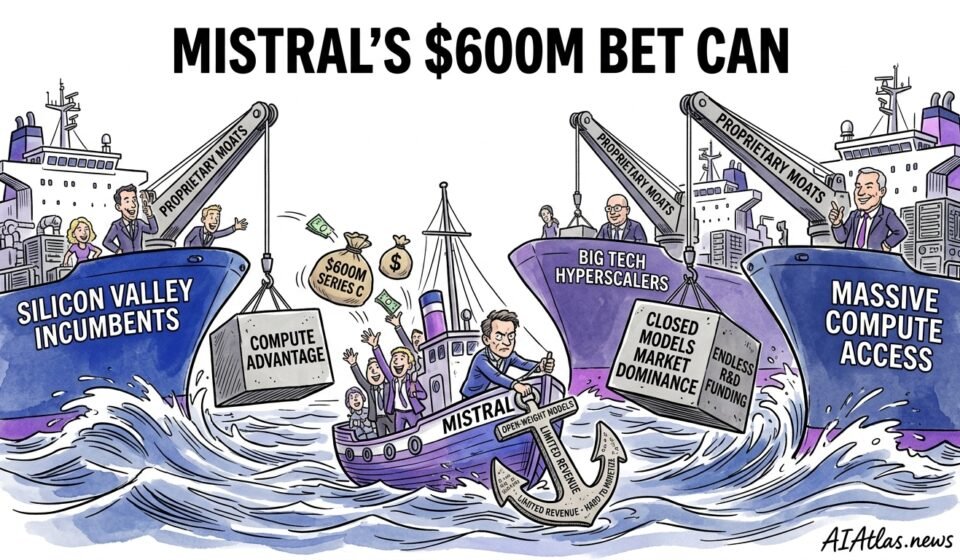
Mistral’s $600M Bet: Can European Sovereignty Scale Against Silicon Valley?
The Contrarian Thesis
Mistral AI’s recent $600M Series C funding round is frequently mischaracterised by Silicon Valley commentators as a mere European vanity project, propped up by regional protectionism. In our experience, this view entirely misses the commercial reality. We see this capital injection as a highly strategic wedge into the closed-ecosystem dominance established by OpenAI and Anthropic. Mistral is not simply building another large language model; they are actively commoditising the baseline intelligence layer that US incumbents rely upon for their inflated valuations.
The prevailing narrative dictates that open-weight models represent a commercial race to the bottom, inherently lacking a defensible margin structure. What we are seeing on the ground, however, tells a different story. The true long-term moat does not reside in hoarding proprietary model weights. Instead, it lies in offering deployment flexibility, capturing enterprise sovereign data budgets, and positioning oneself as the foundational infrastructure for highly regulated industries. Mistral’s open-weight approach is a calculated assault on the API tax imposed by closed architectures.
Flaws in Current Market Assumptions
Major technology incumbents operate under the assumption that vast scale, massive parameter counts, and heavily gated architectures will indefinitely secure pricing power. This compute-centric philosophy assumes that enterprise buyers will happily offshore their most sensitive corporate data to black-box APIs forever. We are witnessing a starkly different reality taking shape among European institutions, banking sectors, and defence contractors, where data sovereignty is non-negotiable.
Furthermore, the market assumes that achieving frontier-class performance necessitates bleeding-edge, proprietary infrastructure with unsustainably high training costs. Mistral has consistently invalidated this thesis. By demonstrating that extreme algorithmic efficiency and leaner parameter counts can handle the vast majority of enterprise use cases, they have exposed the fundamental inefficiency of using massively oversized models for routine corporate tasks. Enterprises are beginning to realise they do not need a trillion-parameter behemoth to summarise internal compliance documents.
The Structural Shift
We are observing a profound structural shift away from singular vendor dependency towards sophisticated, multi-model orchestration. Chief Information Officers are actively de-risking their technological portfolios by refusing to tie their product roadmaps to a single US-based provider. This fragmentation of the inference market is accelerating, driven by the need for cost control, reduced latency, and strict compliance with emerging frameworks like the European AI Act.
Mistral’s $600M war chest will serve to accelerate this exact market fragmentation. By aggressively funding their infrastructure scaling and talent acquisition, they are providing highly performant, open-weight alternatives that force Anthropic and OpenAI to compete on secondary features—such as enterprise tooling, managed privacy, and ecosystem integrations—rather than relying solely on raw intelligence as their unique selling proposition.
Decision Framework for Capital Allocation
For investors, startup founders, and enterprise technology executives, allocating capital in this rapidly fragmenting environment requires a surgical approach to vendor and architectural selection. We consistently advise our partners to evaluate model adoption based primarily on two metrics: internal data gravity and regulatory exposure. Blindly purchasing closed API credits is no longer a viable long-term strategy for data-rich organisations.
When a workload demands extreme data privacy, low-latency edge deployment, or deep fine-tuning on proprietary corporate knowledge, open-weight models currently offer vastly superior unit economics. Conversely, for peripheral tasks requiring complex, multi-step reasoning over massive, unstructured datasets, paying the premium for closed, frontier models remains justifiable. Capital must be deployed to build a routing architecture that dynamically directs tasks to the most cost-effective model.
Risk Assessment Table
Assessing the competitive landscape requires a clear-eyed view of the operational trade-offs between adopting European open-weight contenders versus relying on established US closed-model providers. We have developed the following assessment to guide your strategic planning and procurement processes.
This comparison highlights the fundamental tension facing enterprise leaders today: the choice between immediate, out-of-the-box performance capabilities and securing long-term architectural control over their core data assets.
| Commercial Factor | Mistral AI (Open-Weight) | OpenAI / Anthropic (Closed) |
|---|---|---|
| Data Sovereignty | Total control; self-hosting enables strict compliance. | Reliance on vendor privacy agreements and cloud regions. |
| Inference Margins | High upfront infrastructure cost, marginal cost approaches zero. | Zero upfront infrastructure cost, linear scale API taxation. |
| Vendor Lock-in | Minimal; weights can be migrated across diverse hardware. | Severe; product features tightly coupled to proprietary APIs. |
| Customisation Depth | Deep parameter-level fine-tuning and adaptation available. | Limited to vendor-provided fine-tuning endpoints and RAG. |
| Ecosystem Maturity | Rapidly growing, reliant on open-source community tooling. | Highly mature, deeply integrated into enterprise platforms. |
Visualised Impact Matrix
To effectively map these commercial dynamics, we categorise the current foundational models based on their degree of architectural openness and the level of enterprise control they afford the buyer. This allows technology leaders to visualise where their deployments currently sit on the risk spectrum.
The matrix below illustrates exactly where Mistral is carving out its highly defensible market niche, contrasting sharply with the volume-driven, low-control strategies heavily deployed by Anthropic and OpenAI.
High Cost / High Control
Optimal Sovereign Deployment
Max Convenience / Max Lock-in
Low Security / High Flexibility
Strategic Recommendations for Leaders
We strongly urge business leaders to initiate pilot programmes using open-weight models for internal, highly data-sensitive workloads immediately. Committing your entire generative architecture to a single closed API provider is a profound operational risk. The introduction of robust European models offers a vital bargaining chip during enterprise contract negotiations with US vendors.
Furthermore, technology executives must invest in building an abstraction layer between their user-facing applications and the foundational intelligence models. Designing your system to be fundamentally model-agnostic ensures you can seamlessly swap out an expensive OpenAI endpoint for a lean, self-hosted Mistral model when unit economics, latency requirements, or jurisdictional compliance dictate a necessary change.
Future-Proofing the Business Model
Ultimately, Mistral’s $600M capital injection proves that the commercial battle for artificial intelligence is far from a settled, unassailable monopoly. The overarching lesson for founders and investors is that the baseline intelligence layer will eventually become commoditised. As this intelligence becomes a standard utility, the enduring business moat shifts away from the models themselves.
What we are seeing is that the companies destined to win the next decade will be those that fiercely protect their proprietary datasets, master complex workflow integrations, and execute flawlessly on operational delivery. Securing European sovereignty in this space through open-weight alternatives ensures that the market retains the necessary competitive tension to foster genuine commercial innovation.
Frequently Asked Questions
- Why does Mistral AI focus on open-weight models rather than closed APIs?
- Mistral utilises open-weight models as a strategic wedge to attract enterprise clients who require strict data sovereignty. This approach undercuts the API pricing power of US incumbents while establishing a highly defensible, developer-centric ecosystem.
- How will the $600M Series C funding impact Mistral’s commercial trajectory?
- The funding will be heavily allocated towards scaling compute infrastructure and accelerating research into more complex reasoning models. In our view, this allows them to bridge the performance gap with GPT-4 while maintaining their lean, open-architecture appeal.
- Should enterprise leaders completely abandon closed models like OpenAI?
- No, but they should eliminate single-vendor dependency by adopting multi-model architectures. We recommend routing highly sensitive or repetitive tasks to cost-effective open-weight models, reserving premium closed models solely for complex reasoning workloads.