
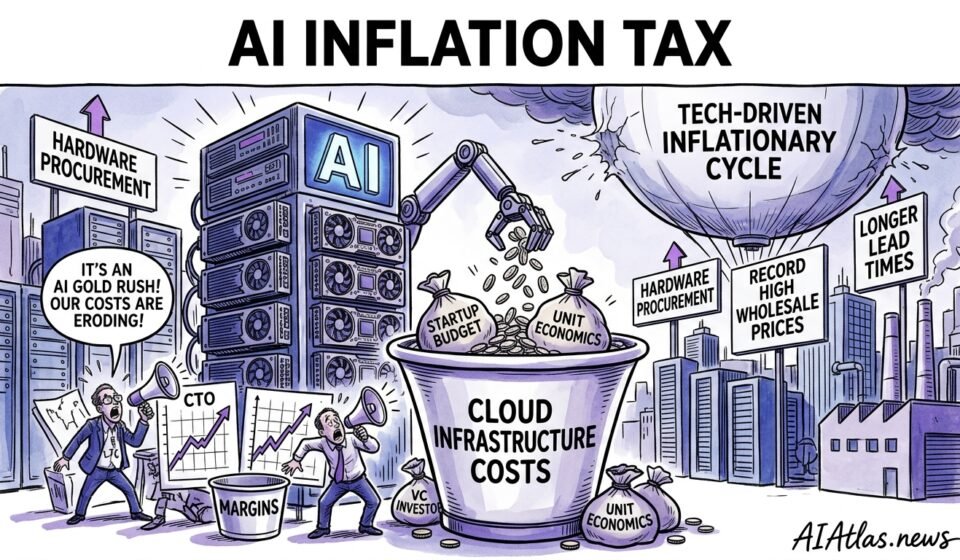
The AI Inflation Tax: Why Your Infrastructure Costs Are Skyrocketing
The Headline Truth
The prevailing narrative in tech enclaves and financial districts has long been that artificial intelligence would act as an immediate deflationary force. We were told automation would strip out labour costs, streamline complex operations, and widen profit margins by default. Yet, fresh market data presents a harsh contradiction: a staggering 28% year-over-year increase in electronic component wholesale prices. Rather than making commercial technology cheaper, the initial phase of the AI boom is forging a tech-driven inflationary cycle that is catching many operators entirely off guard.
In our experience, this represents a fundamental misreading of the physical infrastructure required to build modern computational systems. We are watching founders and chief technology officers struggle as the physical building blocks of their platforms become prohibitively expensive. The supposed operational cost-savings of artificial intelligence are currently being entirely offset by the spiralling premiums of the silicon, memory, and networking components required to compute them.
Context Others Missed
The mainstream business press has fixated almost entirely on software valuations, largely ignoring the physical supply chain that underpins this technological shift. Building and training large models demands massive, contiguous clusters of graphical processing units and specialised memory modules. While the software layer presents a façade of infinite scalability, the hardware stratum is fiercely finite. Foundries like TSMC and Samsung have absolute production ceilings, and expanding fabrication capacity takes years, not months.
What we are seeing is a textbook supply-and-demand squeeze, exacerbated by panic-buying. Hyperscalers are hoarding components, which creates severe scarcity further down the supply chain. This scarcity drives wholesale prices up by 28%, eroding the structural margins for early-stage startups that rely on heavy compute. Smaller firms simply cannot secure the volume discounts enjoyed by mega-cap technology companies, placing them at a severe structural disadvantage before they even launch their core products.
The Commercial Ripple Effect
This hardware inflation is trickling down to dramatically alter unit economics across the entire sector. Venture capital investors are seeing their portfolio companies burn through seed capital just to secure necessary server space and basic hardware components. The cost of goods sold for consumer and enterprise intelligence applications is ballooning. A startup that budgeted a specific amount for compute infrastructure twelve months ago is now finding that same budget yields roughly thirty percent less capacity.
For enterprise operators, the situation is equally precarious. CTOs are tasked with integrating advanced learning models into legacy systems to show immediate return on investment. However, managing budget allocations for these deployments has become a nightmare of moving targets. When the underlying processing costs rise by nearly a third, the projected profitability of enterprise integration models evaporates, leaving technology leaders to defend programmes that look increasingly unviable on paper.
Stakeholder Impact Analysis
The current market dynamics have exposed a sharp misalignment between the creators, funders, and purchasers of artificial intelligence. Founders are caught in a classic margin squeeze, attempting to price their software competitively while their backend expenses multiply. We note that many are resorting to degrading model performance or capping user limits simply to stop bleeding cash, which inherently damages their product’s market fit.
Meanwhile, venture capitalists are quietly revising their return expectations. The capital required to reach profitability has increased, meaning series A and B rounds are suffering severe dilution. Investors are now scrutinising operator-level compute efficiency rather than pure top-line user growth. CTOs, acting as the ultimate buyers, are pausing ambitious integrations, demanding that vendors prove absolute cost certainty before signing multi-year enterprise contracts.
Strategic Comparison Table
To fully grasp the commercial trade-offs occurring in the market, we must map out how different stakeholders are being forced to pivot. The initial expectations set during the initial hype cycle are now clashing violently with macroeconomic realities. We have tracked how business leaders are modifying their strategies in response to the 28% component price surge.
The table below outlines the shifting priorities across the ecosystem. It highlights how participants are moving from aggressive expansion towards defensive, margin-protective postures. This realignment is critical for anyone managing an active deployment budget or navigating a fresh funding round.
| Stakeholder | Initial Expectation | Current Reality | Strategic Adjustment |
|---|---|---|---|
| Early-Stage Founders | Cheap, limitless cloud compute. | 28% higher infrastructure costs. | Rationing compute; smaller models. |
| Venture Capitalists | Rapid scale and user acquisition. | Deteriorating unit economics. | Funding physical hardware assets. |
| Enterprise CTOs | Deflationary IT budget trends. | Unpredictable deployment costs. | Delaying broad integration plans. |
| Component Wholesalers | Steady, predictable order flow. | Panic buying and hoarding. | Implementing strict quota systems. |
| Hyperscale Providers | Margin expansion via software. | Massive capital expenditure needs. | Passing hardware costs to users. |
Visualised Market Response
The transition from a deflationary expectation to an inflationary reality did not occur overnight. Over the past twelve months, we have observed a clear sequence of events that pushed wholesale prices upward. Tracking this progression provides essential commercial context for why budgets are failing today, and why procurement teams must abandon outdated forecasts.
Our timeline below illustrates the four-quarter progression of this tech-driven inflationary cycle. It demonstrates how early enthusiasm swiftly transformed into a supply chain bottleneck, culminating in the severe margin erosion currently afflicting the startup ecosystem.
Critical Market Risks
The most immediate risk is the materialisation of a funding winter for companies that cannot solve their unit economic equations. If wholesale component prices remain elevated, businesses functioning as thin wrappers over existing proprietary models will simply burn out. We judge that the market will severely punish operators who rely on the assumption that compute costs will naturally fall in the near term.
Furthermore, this inflationary cycle threatens to centralise innovation. When the physical requirements of technology become too expensive for seed-stage companies, development becomes the exclusive domain of trillion-dollar corporations. This consolidation limits competition and reduces the commercial opportunities available to independent founders, fundamentally altering the venture capital model that has driven tech growth for the past two decades.
Conclusion and Future Outlook
The 28% spike in component wholesale prices is not a temporary blip; it is a structural reality of the new computational economy. We advise our operator network to immediately discard any financial models predicated on deflationary infrastructure costs. Success in the coming years will belong to those who ruthlessly optimise their hardware efficiency and possess the pricing power to pass elevated costs onto the end consumer.
Ultimately, the industry must transition from an era of unchecked expansion to one of disciplined commercial viability. Navigating this tech-driven inflationary cycle requires a sober judgement of supply chain realities, not blind faith in automation narratives. Leaders who recognise this shift will safeguard their margins; those who ignore it will find their budgets swiftly consumed by silicon premiums.
Frequently Asked Questions
- Why are AI component prices rising instead of falling?
- Prices are surging due to immense, concentrated demand from hyperscalers outstripping the fixed fabrication capacity of silicon manufacturers. This scarcity creates a supply-and-demand squeeze that drives wholesale costs upward.
- How does this inflation impact early-stage startup funding?
- Rising infrastructure costs erode unit economics, forcing startups to burn through capital faster just to host their products. Venture capitalists are subsequently demanding more stringent proof of profitability before deploying capital.
- What should CTOs do to manage deployment budgets effectively?
- CTOs must audit their compute efficiency and delay large-scale integrations that lack guaranteed cost structures. Prioritising smaller, highly optimised models over massive, generic networks will help protect enterprise margins.