
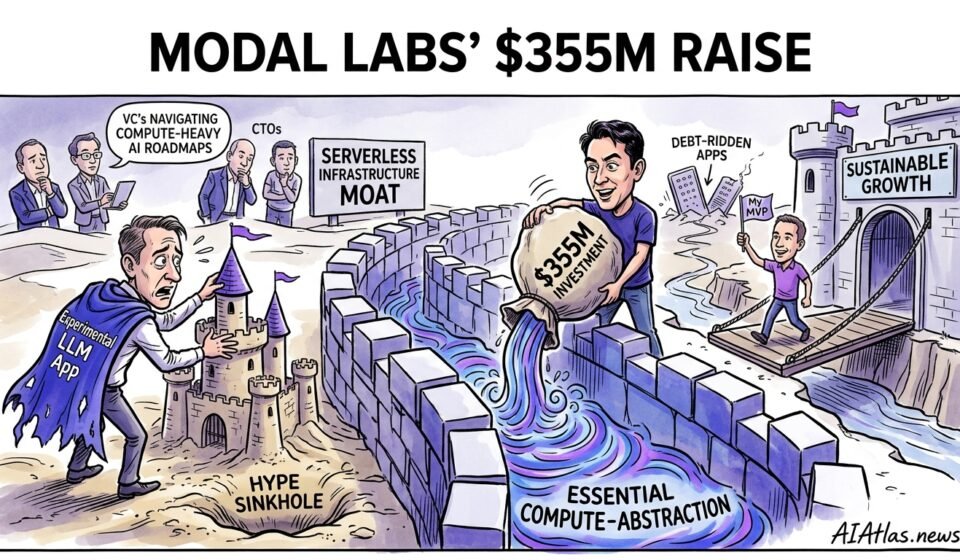
Modal Labs’ $355M Raise: Why Serverless Infrastructure Is the New Moat
The Contrarian Thesis
When Modal Labs secured $355 million at a staggering $4.65 billion valuation, the wider market reacted with the usual breathless enthusiasm for large numbers. In our experience, however, this funding event signals something far more profound: the application layer of artificial intelligence is rapidly commoditising, and the genuine enterprise margin is relocating down the stack. We are observing smart capital decisively abandoning superficial software wrappers in favour of the gritty, foundational mechanics of compute orchestration.
The contrarian thesis we are putting forward is straightforward. The true bottleneck to commercial scaling is no longer model intelligence; it is silicon logistics. Evaluating the shift from application-tier excitement to essential compute-abstraction infrastructure provides the only sustainable framework for technology investment. Startups and established enterprises alike will not differentiate on which foundation model they query, but on how efficiently they can provision, scale, and suspend the hardware executing those queries.
Flaws in Current Market Assumptions
A prevalent assumption among enterprise CTOs is that renting static GPU instances from major cloud providers constitutes a viable long-term operational strategy. We see technical leaders committing to massive upfront contracts for A100 or H100 clusters, believing that raw compute possession equals competitive advantage. This ignores the severe provisioning friction and exorbitant idle-time costs that plague static cloud architecture. Hardware sitting idle between bursts of inference is effectively incinerating venture capital.
Furthermore, venture capital firms often operate under the flawed belief that unique datasets or clever user interfaces will defend a startup’s margins. This simply does not reflect operator-level reality. As intelligent capabilities become universally accessible, operational survival depends entirely on compute efficiency. If an enterprise AI roadmap dictates managing individual Kubernetes nodes and container life cycles, that roadmap is already functionally obsolete. Competitors utilising abstracted, serverless infrastructure will iterate faster and possess drastically superior unit economics.
The Structural Shift
We are witnessing a fundamental migration away from rigid hardware environments towards elastic, serverless compute platforms. Modal Labs directly addresses the friction of cloud-compute provisioning by allowing engineering teams to run code on high-end GPUs without the burdensome DevOps tax. This structural shift allows enterprise deployments to scale from zero to tens of thousands of containers in seconds, completely reshaping the speed at which commercial products reach the market.
For startup founders, this evolution alters the required composition of early-stage teams. The necessity for deeply specialised infrastructure engineers is reduced, allowing capital to be redirected towards product engineering and commercial execution. This is not merely a technical refinement; it is a profound reallocation of operational resources that separates businesses capable of dynamic scaling from those trapped beneath the weight of their own server maintenance.
Decision Framework for Capital Allocation
For venture capitalists and corporate strategists navigating heavily compute-dependent roadmaps, capital deployment must reflect this new architectural reality. We advise evaluating technical investments strictly through the lens of compute efficiency and infrastructure agility. If a startup’s operational expenditure scales linearly with user growth because of static cloud instances, we view that as a critical systemic vulnerability rather than a minor inefficiency.
Capital should be aggressively channelled into platforms and teams that reduce latency and lower the barrier to complex orchestration. When assessing potential portfolio companies or internal projects, the primary question must be how the architecture handles variable workloads. The ability to burst compute capacity instantaneously without incurring punishing baseline costs is the primary determinant of long-term commercial viability.
Risk Assessment Table
Before committing millions to either infrastructure procurement or startup funding, leaders must thoroughly weigh the architectural trade-offs. We have compiled an assessment comparing traditional static deployments against modern serverless abstraction layers. Understanding these factors is vital for any CTO or investor attempting to accurately forecast technical debt and operational scaling hurdles.
The comparison detailed below highlights the operational, financial, and strategic risks inherent in both architectural models. In our view, holding onto legacy deployment strategies in a high-velocity market represents an unacceptable level of commercial risk.
| Evaluation Metric | Traditional Cloud Provisioning | Serverless Abstraction (e.g., Modal) |
|---|---|---|
| Cost Structure | High baseline costs; paying for idle GPU time. | Pay-per-millisecond; zero cost when idle. |
| Scaling Speed | Minutes to hours for node allocation. | Instantaneous scale-up and scale-down. |
| DevOps Overhead | Requires dedicated infrastructure engineers. | Minimal; abstracted away from the core team. |
| Operational Agility | Rigid; bound by instance availability and geography. | Highly flexible; routes dynamically to available silicon. |
| Capital Efficiency | Low; large portion of funding consumed by bare metal. | High; capital preserves focus on product and growth. |
Visualised Impact Matrix
To accurately map the current technological ecosystem, we rely on a quadrant approach that categorises investments by their strategic necessity against their implementation complexity. We frequently use this framework in boardrooms to quickly dispel the allure of technically complex but strategically empty initiatives.
This visualisation places compute orchestration squarely where it belongs. Platforms abstracting compute offer high strategic value by aggressively defending margins, while simultaneously lowering the technical barrier to entry. Conversely, attempting to maintain bare-metal clusters yields low strategic differentiation while demanding vast technical resources.
← High Strategic Value
Infrastructure
Foundation Models
Layer Wrappers
Hardware Clusters
Strategic Recommendations for Leaders
For technical executives, the mandate is unambiguous: halt the procurement of raw hardware until you have thoroughly evaluated the modern compute-abstraction layers available. Building an internal orchestration system to manage GPU workloads is a catastrophic waste of top-tier engineering talent. Your best engineers should be focused on product differentiation and customer experience, not fighting container orchestration tools to keep latency acceptable.
For venture capitalists, the directive is equally clear. Stop funding thin software wrappers that lack structural moats. During due diligence, focus intensely on a startup’s unit economics regarding inference at scale. If a company cannot clearly articulate how they abstract hardware complexity to maintain margins during traffic spikes, they are fundamentally unprepared for commercial reality. Smart money is flowing into the picks and shovels of the infrastructure tier for good reason.
Future-Proofing the Business Model
The longevity of any enterprise software strategy today depends entirely on its adaptability to unpredictable compute constraints. Abstraction serves as the ultimate defensive mechanism against supply chain shocks in the semiconductor market. By decoupling application logic from the underlying hardware procurement, businesses gain the flexibility required to survive turbulent market cycles.
Adopting serverless orchestration insulates commercial operations from rapid hardware depreciation and stifling operational friction. In our analysis, this architectural agility is not simply a technical preference; it is the bedrock of enduring market success. Companies that master compute efficiency will inevitably outmanoeuvre those still treating hardware as a static asset.
Frequently Asked Questions
- Why is compute abstraction driving such high valuations in the current market?
- Investors recognise that managing GPU infrastructure is the primary bottleneck for commercial scaling. Platforms that eliminate this friction capture immense value by allowing businesses to scale immediately without burdensome operational overhead.
- How does serverless infrastructure impact early-stage startup hiring?
- It drastically reduces the need to hire expensive, specialised DevOps and infrastructure engineers early in a company’s lifecycle. Founders can instead allocate that capital towards hiring product developers and sales professionals.
- Is traditional cloud provisioning completely obsolete for technical deployments?
- While continuous, 24/7 training workloads may still justify dedicated bare-metal clusters, inference and variable enterprise workloads are vastly more efficient on abstracted infrastructure. Traditional provisioning is rapidly becoming a niche requirement rather than the default standard.