
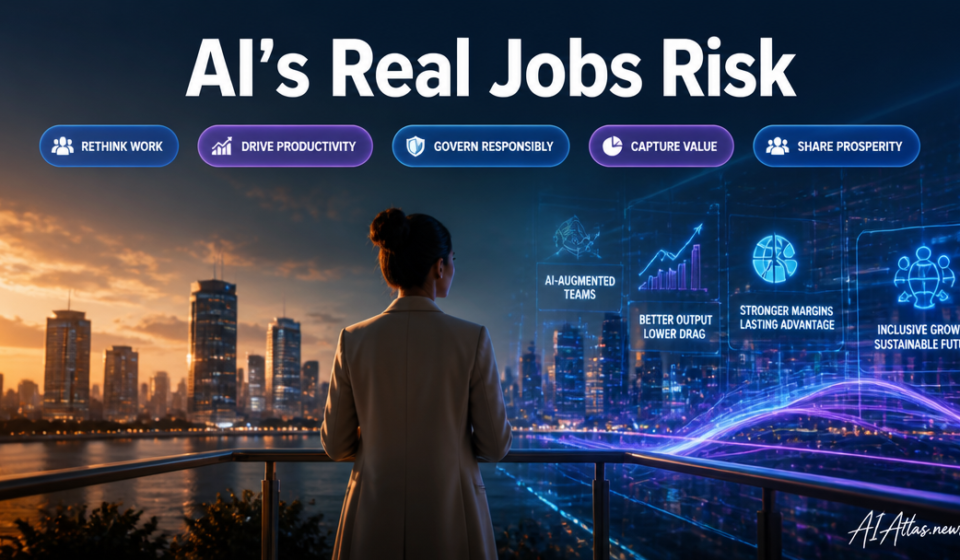
AI’s Real Jobs Risk Is Not Mass Layoffs — It Is Who Captures the Productivity Dividend
The Contrarian Thesis
We’ve read the May 27, 2026 cycle coverage that leans on a European Parliament report: AI’s long-run economic impact is not predetermined. That’s the uncomfortable truth for executives who prefer forecasts with clean job-loss narratives. In our experience, the debate has been framed as a capacity question—how many roles get automated—when the commercial question that actually decides winners is distribution: who captures the productivity gains.
When gains concentrate with capital owners and dominant technology platforms, three things tend to follow. First, wealth concentration accelerates. Second, income and productivity gaps widen between firms, regions and worker cohorts. Third, the labour-linked tax base erodes if value migrates into capital returns and platform rents faster than governments can adapt tax design. The Parliament’s emphasis on policy and corporate governance choices isn’t academic; it’s the playbook.
Flaws in Current Market Assumptions
What we’re seeing across boardrooms is a quiet but persistent assumption: “AI will change headcount, therefore we must manage workforce exits.” It’s not that such modelling is useless; it’s that it’s directionally incomplete. The market treats employment displacement as the primary risk, yet the strategic risk for enterprise operators, investors and founders is value capture—how AI changes pricing power, bargaining leverage, and internal allocation of the gains.
Another common mistake is confusing productivity with profit. Yes, AI can raise throughput per worker. But where that uplift lands depends on governance choices: pricing discipline versus margin extraction, how firms redesign workflows, whether they share gains through pay, hours or profit participation, and whether they invest in redeployment rather than permanent labour substitution. Even competition policy matters: if AI consolidates market power, productivity gains can be monetised as rents rather than wages.
Finally, the market often underestimates institutional latency. Tax systems, training finance, labour market regulation and procurement frameworks don’t update at the speed of model releases. If tax and competition frameworks lag, the business model that “wins” may be the one that benefits from regulatory friction—an outcome that can be politically unstable and commercially fragile.
The Structural Shift
The structural shift isn’t that AI “replaces humans”. It’s that AI makes work orchestration cheaper and faster than traditional management capacity. That changes how firms assemble value: tasks get decomposed, standardised, routed to tools, and reassembled into customer-facing services. In parallel, the identity of the bottleneck moves. Historically, labour availability and payroll cost were central constraints; increasingly, model access, data rights, integration capability and platform reach become the constraints.
This reframes workforce strategy. If AI reduces the cost of producing outputs, firms can compete on price, differentiation, or speed. But the “who gets paid” answer depends on bargaining structures. Workers may benefit if productivity translates into more hours, steadier jobs, wage growth tied to performance, or credible pathways into higher-skill roles. Workers may lose if AI concentrates control of scheduling, quality assurance, and customer relationships inside dominant platforms or capital-heavy production systems.
So the board-level economics lens is unavoidable. The long-run outcome—concentration or broad-based improvement—hinges on whether governance treats workforce investment as a cost centre or as risk management. It also hinges on whether dominant platforms lock customers and workers into extractive contracts. In our view, those choices will shape both social stability and commercial sustainability.
Decision Framework for Capital Allocation
If you’re allocating capital, we recommend shifting from “how many roles will disappear?” to “how will value be captured, priced and shared?” The starting point is an internal value chain audit that maps AI-enabled changes to four levers: unit economics, customer bargaining power, labour bargaining power, and competitive access.
Practically, we look for indicators that productivity gains are being distributed, not merely generated. Where do the margins land? Is the firm extracting margin through platform fees and switching costs? Are redeployment pathways funded, reskilled employees retained, and new workflows staffed with human oversight? Are suppliers and partner firms being squeezed in ways that later destabilise delivery?
For investors and founders, the same framework applies. Ask whether the startup’s advantage scales by increasing customer lock-in, bundling, and data capture—or by expanding labour capacity, shortening time-to-value, and lowering total operating costs without concentrating rents. A company can be technically excellent and still be commercially fragile if it builds a business model dependent on regulatory arbitrage.
Risk Assessment Table
The fastest way to get this wrong is to treat workforce strategy as a standalone HR programme. We treat it as a monetisation strategy with regulatory consequences. The table below compares five common AI workforce postures and the associated value-capture and risk profile.
| AI deployment pattern | Likely value capture | Workforce effect | Market-power risk | Mitigation lever |
|---|---|---|---|---|
| Wholesale replacement of roles | Capital owners first; platform rents second | Sharp headcount contraction, skills vacuum | Moderate—unless data/control consolidates | Redeploy to oversight roles; publish transition metrics |
| Workflow redesign with redeployment | Mixed: wages/hour growth potential; margins steady | Lower hours per output, but role transformation | Lower—competition based on service quality | Fund reskilling; link incentives to adoption outcomes |
| Platform bundling + switching-cost creation | Dominant platform captures most uplift | Employee bargaining weakens; contractors expand | High—lock-in drives pricing power | Design fair data/portability; avoid opaque fee stacking |
| Gigification and task fragmentation | Capital and intermediation layers | Employment stability drops; training diluted | High—fragmented labour reduces countervailing power | Guarantee minimum hours/quality standards; invest in upskilling |
| Employee gain-sharing / profit participation | Wages and returns shared with workforce cohorts | Higher retention; fewer exits through internal mobility | Lower—reduces political and labour-risk drag | Adopt measurable gain-sharing; governance board oversight |
Visualised Impact Matrix
The core diagnostic we use is a two-by-two: on one axis, how strongly AI productivity is shared with workers; on the other, how resilient the firm’s labour-linked tax and institutional base remains under the new model. The key commercial insight is that sharing and resilience are not “nice to have” ethics; they change cost of capital, regulatory risk, and long-term demand stability.
Strategic Recommendations for Leaders
We would like leaders to stop outsourcing this to HR or a “workforce transformation” vendor deck. The board needs an economics statement, not an internal comms plan. Define where AI changes value creation and where it changes control. Then set explicit targets for distribution: redeployment rates, time-to-productivity for transferred staff, and a transparent method for linking productivity gains to workforce outcomes.
Second, redesign your workforce economics model. Treat training and redeployment as capital formation, not discretionary expenditure. When AI shortens task cycles, you can’t rely on traditional hiring waves; you need internal labour markets that respond quickly. The most investable enterprises we see are building workflow ownership structures: teams that own adoption, quality, and customer outcomes, with workers included as co-designers.
Third, tighten procurement and partner governance. If your supply chain or platform partner captures the uplift while you bear service degradation and reputational risk, you’ve built a fragile distribution model. For startups, this means product strategy: don’t assume you can win indefinitely by extracting switching costs from customers while shifting risk onto labour markets.
Finally, align taxation and competition awareness with corporate strategy. Even if you’re not lobbying, you should be modelling how reforms could affect your unit economics: changes to labour taxes, capital taxation, platform fee regulation, and competition enforcement against dominant bundling.
Future-Proofing the Business Model
In our experience, the firms that survive long-run AI disruption won’t just be the ones with the best models. They’ll be the ones with the most durable “bargain” between productivity, distribution and legitimacy. That’s why future-proofing is less about chasing the newest model release and more about building governance capable of withstanding policy and workforce realities.
Build a value-capture dashboard that your CFO can defend: margins by workflow, switching costs, wage and redeployment metrics, training throughput, and the contractual allocation of risk across platforms and suppliers. If you can’t measure where gains are landing, you can’t manage distribution. And if you can’t manage distribution, you’re exposed to both political constraint and human-capital instability.
For investors, we would adjust diligence accordingly. Look beyond technical capability and ask: does the company’s operating model share uplift with the people who absorb adoption friction? Does it reduce labour market stress or shift it downstream? Does it build market power in ways that invite enforcement? The answers to those questions will increasingly predict returns as much as revenue growth does.
Frequently Asked Questions
- The long-run impact of AI is not predetermined because policy, corporate governance, taxation, and competition rules shape how productivity gains are distributed. Two firms can deploy similar AI and achieve radically different outcomes depending on where value capture lands.
- Workforce strategy is a board-level economics issue because it determines future demand stability, regulatory risk, and the firm’s cost of capital. Redeployment, training investment, and incentive design affect both labour bargaining power and legitimacy.
- To assess whether AI benefits workers, track redeployment rates, time-to-productivity in new roles, and how productivity maps to pay, hours, or gain-sharing. If margins rise without measurable workforce uplift, value capture is likely concentrating elsewhere.