
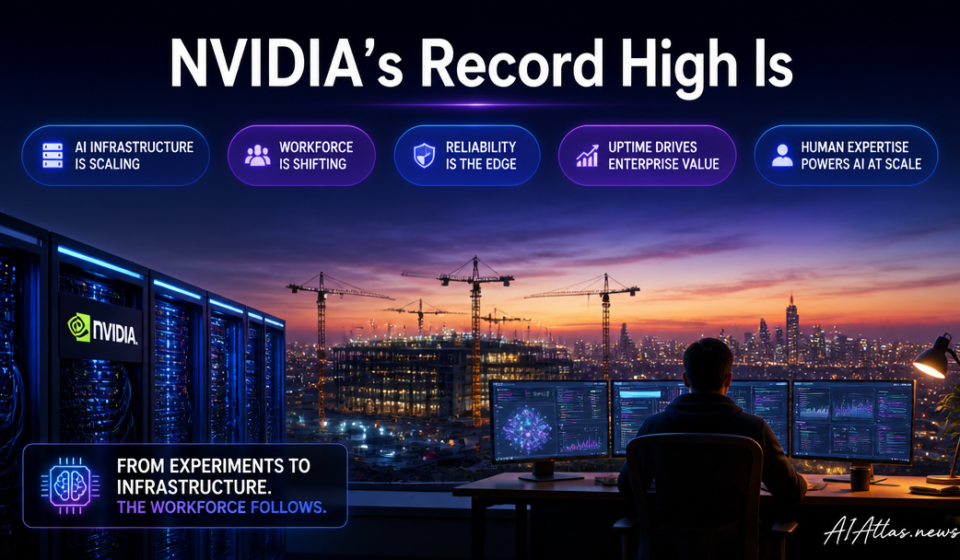
NVIDIA’s Record High Is Really a Labor Market Signal
The Contrarian Thesis
When we see NVIDIA hitting a new record high alongside reports that global AI data centre investment has reached an all-time high, we’ve learned not to treat it as another semiconductor victory lap. In our experience, markets only misread this kind of signal when they focus on the shiny product rather than the procurement reality behind it.
Our view is that this surge is the clearest indicator we’ve had yet that AI spending is moving from software experimentation into infrastructure deployment. That matters commercially because it changes what buyers prioritise: fewer resources get allocated to proof-of-concepts that “might” scale, and more get allocated to uptime, capacity planning, energy procurement, systems integration, and operational leverage. In parallel, labour demand shifts accordingly—toward infrastructure engineering, hardware maintenance, data centre operations, networking, and AI systems reliability roles—rather than the simplistic narrative of job elimination.
Flaws in Current Market Assumptions
We constantly run into three flawed assumptions in boardrooms and fundraising rooms. First, the assumption that AI budgets are primarily “software spend with a compute add-on”. The procurement data points the other way: enterprises are buying the physical backbone—GPUs, racks, interconnect, storage, power, cooling, and the operational capability to run them continuously.
Second, we see investors assume that the workforce story is mostly about replacement—machines versus people—when the real trade-off is closer to augmentation. Enterprises are redesigning labour around operational throughput: faster incident response, tighter change control, automated capacity orchestration, and reliability engineering. The “new roles” don’t arrive fully formed; they are built inside organisations (and inside suppliers), which creates a bottleneck—and a funding opportunity—for capability.
Third, there’s the comforting belief that capex cycles in data centres are always short and reversible. We disagree. Even when model demand fluctuates, the infrastructure deployment decisions lock in for years. That turns a headline about today’s GPU demand into a multi-year systems and services market—one where the winners earn margin from operations, not just from supply.
The Structural Shift
What we are seeing is a structural shift in how AI value is realised. Early adopters could rent compute, run notebooks, and iterate on prompts. Now the dominant constraint is running production workloads at scale: sustaining performance while controlling costs per inference, controlling latency, and keeping systems stable across deployments.
This is why NVIDIA’s record isn’t merely a stock-market story—it’s a procurement roadmap. Enterprises now need fewer people doing repetitive “keep the proof-of-concept alive” work, and more people doing high-leverage operational tasks. That includes infrastructure engineering, hardware lifecycle management, networking performance tuning, observability, and AI reliability engineering (the discipline of making model-serving behave like a mature production system rather than a lab demo).
For founders, this is the moment when a startup’s differentiation should be tested against operational reality. If your product only looks great in a demo but doesn’t reduce incident rate, improve deployment cadence, or shorten time-to-capacity, you’re probably building against yesterday’s adoption curve.
Decision Framework for Capital Allocation
Our rule of thumb is simple: capital should follow the constraint. If the current constraint is compute availability, you’ll fund procurement enablement, platform tooling, and supply-chain resilience. If the constraint is power, you fund energy-aware scheduling, heat management, and site optimisation. If the constraint is reliability, you fund observability, automated recovery, and change management.
To make this operational, we use a signal-to-investment mapping. Below is the comparison table we’ve been using internally to spot where the spend is actually landing and what that implies for founders and enterprise buyers.
| AI Adoption Phase (What buyers feel) | Primary Constraint | Likely Buyer Budget Line | Labour Reallocation Pattern | Startup/Investor Bet That Fits |
|---|---|---|---|---|
| Experimentation | Model iteration speed | Tooling + rented compute | More data scientists; lighter ops staffing | Experiment orchestration, evaluation harnesses |
| Infrastructure buildout | Capacity availability | Capex + integration services | Hiring shifts to infrastructure engineering | Deployment automation, capacity planning software |
| Production deployment | Latency + throughput stability | Platform operations + managed services | Networking and systems reliability roles expand | Inference optimisation, traffic shaping, autoscaling |
| Cost optimisation | Cost per token / per workload | FinOps + performance tuning | Operational leverage roles become central | Unit-economics monitoring, scheduling optimisation |
| Scale governance | Risk, security, compliance | Security + policy + lifecycle management | Reliability + governance engineering grows | Model deployment governance, auditability tooling |
The investment implication is that “AI infrastructure” is not just a hardware category; it’s an operating model category. Funding the right layer—observability, orchestration, lifecycle management, and reliability—can earn recurring revenue even when raw GPU supply normalises.
Risk Assessment Table
Infrastructure buildout creates opportunity, but it also creates predictable failure modes. When budgets accelerate, buyers rush contracts; when contracts rush, reliability and integration risks often lag behind. We treat these as first-class investment risks, not footnotes.
| Risk | How It Shows Up | Commercial Impact | Mitigation We Recommend |
|---|---|---|---|
| Demand volatility | Workloads shift faster than capacity planning | Unused capacity, margin pressure | Design for elastic scheduling and measurable utilisation |
| Supply-chain bottlenecks | Interconnect, memory, power components delayed | Project delays and penalty clauses | Multi-sourcing, modular deployment plans, buffer strategies |
| Energy and permitting constraints | Power caps or cooling failures | Throughput shortfalls, escalation costs | Energy-aware orchestration; early engagement with facilities teams |
| Model commoditisation | Accuracy improvements move to “standard” models | Pressure on differentiation | Differentiate via reliability, latency guarantees, and cost controls |
| Operational fragility | Incidents spike during scaling events | Churn, reputational damage | SLAs built on monitoring, automated rollback, and capacity safeguards |
For investors, the question isn’t “Will AI spend continue?” It’s “Which layer will be judged by enterprises when something breaks?” The spending surge makes reliability a procurement criterion, not an engineering afterthought.
Visualised Impact Matrix (div)
To clarify where we see the most durable commercial advantage, we map four quadrants using a simple operator lens: (1) how operationally dependent the business is on infrastructure reality, and (2) how much value it creates through uptime and measurable leverage.
The point is tactical: if your product relies on brittle assumptions or only improves metrics in a lab environment, you’ll struggle as deployments scale and buyers become more exacting.
Strategic Recommendations for Leaders
For executives, the mistake is to keep treating AI as a software procurement exercise. We recommend aligning workforce strategy with infrastructure reality. That means mapping roles to the new bottlenecks: reliability engineering, observability, network performance, hardware lifecycle, and AI systems operations. If you don’t, you end up with “model competence” but operational fragility—an expensive combination.
Operationally, leaders should demand evidence that their AI initiatives can survive production stress. That includes incident frequency targets, mean time to recovery, change failure rates, and cost-per-workload tracking—not just model benchmarks. The enterprises winning in this spending cycle are building operating playbooks, not accumulating demos.
For entrepreneurs and investors, look for startups that reduce operational entropy. In practice, that means products that automate deployment, enforce reliability guardrails, provide transparent cost accounting, and integrate with data centre constraints rather than ignoring them. When budgets are capped by power, cooling, and networking realities, the best companies become the ones that make those constraints programmable.
Future-Proofing the Business Model
The recurring theme behind AI data centre investment highs is that value shifts toward the layers that last: operations, governance, and lifecycle management. Hardware will always be part of the story, but the margin story increasingly belongs to companies that turn infrastructure into dependable output.
We see a future where enterprise buyers prefer subscription plus service models tied to outcomes: SLAs for uptime, commitments around cost efficiency, and governance for auditability. That creates a higher bar for startups—your offering must integrate deeply enough to be accountable, and generic enough to avoid becoming an engineering dead-end. In other words, durability becomes the product.
Finally, we expect labour strategy to keep evolving. Augmentation doesn’t just apply to “tasks”; it applies to organisational design. Teams will be structured around operational leverage—engineering for uptime, automation for scale, and instrumentation for control. The winners will treat these capabilities as competitive advantages, not overhead.
Frequently Asked Questions
- FAQ 1: Does NVIDIA’s stock record prove AI demand is unlimited?
- No. It signals sustained infrastructure spend, but demand can still shift by workload type and procurement constraints. The more relevant question is which layer enterprises keep paying for when priorities change.
- FAQ 2: How should a business leader adapt hiring during this infrastructure phase?
- Move beyond “more ML talent” as the default. We’ve seen better outcomes when hiring targets reliability, networking, operations, and hardware lifecycle capability—roles that reduce downtime and improve throughput.
- FAQ 3: Where are the highest-probability startup opportunities right now?
- Opportunities cluster around reliability, cost governance, orchestration, and energy-aware scheduling—areas where buyers can measure operational leverage. Products that only impress in demonstrations struggle once deployments hit production constraints.