
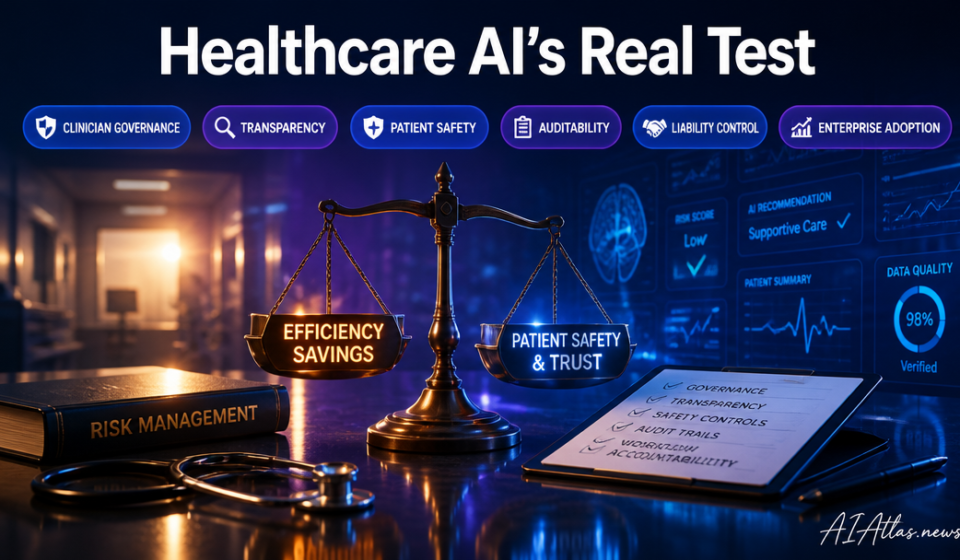
Healthcare AI’s Real Test Is Liability, Not Efficiency
When we see healthcare AI headlines framed as an ethical debate, we think we’re being sold a false choice. The clinicians’ warning coming from nursing and healthcare ethics leaders—about transparency, equity, clinician participation, and strict oversight—is not a moral sermon. It’s a commercial risk-management memo. If hospitals and payers deploy clinical automation without governance that patients and clinicians can trust, the cost is not theoretical: it lands in compliance spend, procurement friction, reimbursement delays, reputational damage, and preventable harm.
Our contrarian view is straightforward: safety infrastructure is not a brake on growth. In healthcare AI, it’s the infrastructure that makes growth defensible—enabling adoption at enterprise scale, protecting revenue, and reducing the probability of catastrophic “stop-the-rollout” events. The companies that treat oversight as a checkbox are the ones that will discover, late, that trust is not optional.
The Contrarian Thesis
We believe the market is drifting toward the wrong operational strategy. Too many vendors and operators are optimising for visible efficiency—shorter length of stay, reduced administrative time, faster triage—while treating governance as paperwork that can be appended after procurement. That approach is commercially fragile. In our experience, when safety and ethics are not embedded at design time, the “fix it later” bill arrives as harder questions: auditability, explainability expectations, bias monitoring, escalation pathways, and clinician sign-off.
The contrarian thesis, then, is that oversight is not cost; it is enabling infrastructure. A well-governed clinical AI deployment produces cleaner acceptance criteria for procurement, smoother integration into clinical workflows, faster contracting with payers, and more credible claims to patients and regulators. It also gives executives a defensible basis for performance reporting—something investors increasingly demand once pilot programmes transition to funded rollouts.
Flaws in Current Market Assumptions
We see three assumptions repeatedly baked into strategy decks. First, that model performance metrics translate directly into clinical performance without governance “translation layers”. Second, that transparency can be satisfied with a generic disclosure statement instead of operational mechanisms—documentation, decision trails, and monitoring that clinicians can actually use. Third, that clinician participation is a slow, optional ingredient rather than the fastest path to safe workflow adoption.
These assumptions fail in practice because healthcare organisations buy outcomes, not abstractions. If a system influences triage, risk scoring, discharge timing, or escalation decisions, it enters a chain of accountability. That chain cannot be held together by efficiency narratives alone. We also challenge the implicit belief that equity risks are addressed after deployment. Disparities emerge from data history, local patient mix, documentation patterns, and clinical practice variations—so equity work must be iterative, local, and measurable.
The Structural Shift
What we’re seeing across provider groups, payers, and healthtech operators is a structural shift in how AI procurement will be evaluated. The centre of gravity is moving from “Does it work?” to “Can we govern it?”. That change reflects an expanding set of operational expectations: traceability from input to decision, defined human oversight, clear escalation routes, and post-deployment surveillance for drift and subgroup impacts.
Once governance becomes a procurement criterion, the commercial implication is immediate. Vendors that can demonstrate robust clinical oversight capacity—tools, processes, reporting, and clinician involvement—will win longer contracts. Those that cannot will face expanding integration costs and repeated renegotiation cycles. In our view, this is where AI oversight stops being a debate and starts becoming a market structure: the market will bifurcate into systems that can be safely scaled and those that will remain confined to pilots.
Decision Framework for Capital Allocation
For entrepreneurs and investors, the question is no longer whether oversight exists, but whether you can fund it predictably and deliver it repeatably. We recommend a capital allocation framework that treats governance as part of the product’s operating system. Start with a “clinical accountability map”: where does the system intervene, who is accountable, what is the acceptable error posture, and what is the escalation trigger?
Next, build a “trust evidence pipeline”. This is not a marketing document; it’s a structured set of artefacts: performance monitoring plans, subgroup analyses, change-control processes, user training materials for clinicians, and transparency features that match how clinicians interpret risk. Finally, stress-test adoption assumptions. Ask procurement and clinical leadership upfront what would cause them to delay or halt deployment. If you can’t answer those questions with evidence, you’re not de-risking—you’re merely delaying risk recognition.
Risk Assessment Table
Below is how we model the trade-off between “speed to deployment” and “governed scale”. Notice what changes: not just regulatory comfort, but contracting velocity, audit readiness, and the ability to survive scrutiny when outcomes underperform for specific cohorts.
| Risk (where it bites) | Efficiency-first assumption | Governance-first requirement | Commercial impact if ignored | Mitigation that supports adoption |
|---|---|---|---|---|
| Opacity in decision pathways | Users accept a high-level explanation | Decision trails, documented rationale, and auditable logs | Procurement delays, clinician rejection, audit failures | Embed explainability aligned to clinical workflow and review |
| Equity drift post-deployment | Fairness testing is a one-off release step | Ongoing subgroup monitoring and retraining governance | Reimbursement disputes, trust erosion, reputational costs | Local bias baselines and measurable correction mechanisms |
| Insufficient clinician participation | Training replaces co-design | Clinician sign-off on thresholds, escalation, and workflow integration | High override rates, poor outcomes, adoption collapse | Co-design governance and performance feedback loops |
| Unclear human oversight and escalation | Automation “stands in” for judgement | Defined responsibilities, triggers, and escalation protocols | Liability exposure and forced rollbacks | Escalation playbooks with measurable safety endpoints |
| Data quality mismatch across sites | A single model generalises everywhere | Site-level validation, drift checks, and change-control | Failure to generalise, contract termination | Validation gates and drift response plans before scale |
Visualised Impact Matrix (div)
We use a simple lens: governance maturity determines whether upside becomes repeatable revenue or transient pilot value. Move governance upstream and you shift risk from “public failure” to “managed engineering”, which is exactly what boards and investors want.
Impact matrix: where enterprise value tends to land
Faster procurement, cleaner contracting, measurable safety evidence, lower rollout volatility.
Quick pilots and headline wins—until audits, equity checks, or clinician feedback force rework.
Stalled adoption, higher override rates, recurring risk escalations, and short-lived value claims.
Possible, but usually a sign of mis-scoped use cases or insufficient operational leverage.
Strategic Recommendations for Leaders
If you’re a hospital executive, payer operator, or healthtech vendor, we’d treat clinician governance as a deployable capability, not a committee. Appoint clinical owners for use cases, define review cadences, and require a safety case that includes equity testing, monitoring, and escalation. Make transparency “operational”—so clinicians can see what matters, how the system behaves in edge cases, and what changes when the model is updated.
If you’re an entrepreneur or investor, we’d stop funding governance as “compliance theatre”. Instead, budget it as product development: decision logging, monitoring pipelines, human oversight UX, and subgroup analytics that support procurement questions. The commercial upside is not vague trust; it’s reduced sales friction, fewer contract reversals, and the ability to expand from a single site to multi-site deployments without a full rebuild each time.
Future-Proofing the Business Model
The long-term winners won’t be those who say the right ethical words; they’ll be those who can demonstrate repeatable safety infrastructure under real-world constraints. That means offering enterprises a governance package with clear responsibilities: who maintains monitoring, who runs bias checks, who signs off on threshold changes, and how incidents are handled. In revenue terms, governance becomes part of the unit economics—an implementation cost that reduces churn and extends contract lifetimes.
We expect procurement standards to mature quickly: clinician participation will be treated as a validation requirement, transparency as an audit capability, and equity as an ongoing monitoring obligation. Companies that build these capabilities early will defend pricing and avoid the “cheap pilot, expensive rewrite” trap. In other words, oversight will stop being a cost centre and start becoming a durable differentiator—especially for businesses seeking defensible revenue rather than short-lived operational savings.
Frequently Asked Questions
- How does clinical governance affect the commercial sales cycle?
- Governance evidence reduces procurement uncertainty, so deals move faster once your safety case is clear and auditable. We’ve seen clinics accept deployment sooner when clinicians can see escalation and monitoring mechanisms, not just model metrics.
- Is transparency really required for enterprise adoption?
- In practice, enterprises need transparency that supports auditing and clinical review, not a generic disclosure. The more your logs, rationale trails, and monitoring are tied to workflow, the less friction you face during contracting.
- What should investors look for beyond benchmarks and demos?
- We suggest you scrutinise the governance pipeline: monitoring, change control, subgroup performance tracking, incident response, and clinician involvement. Teams that can operationalise these elements are far more likely to scale without costly rollbacks.