
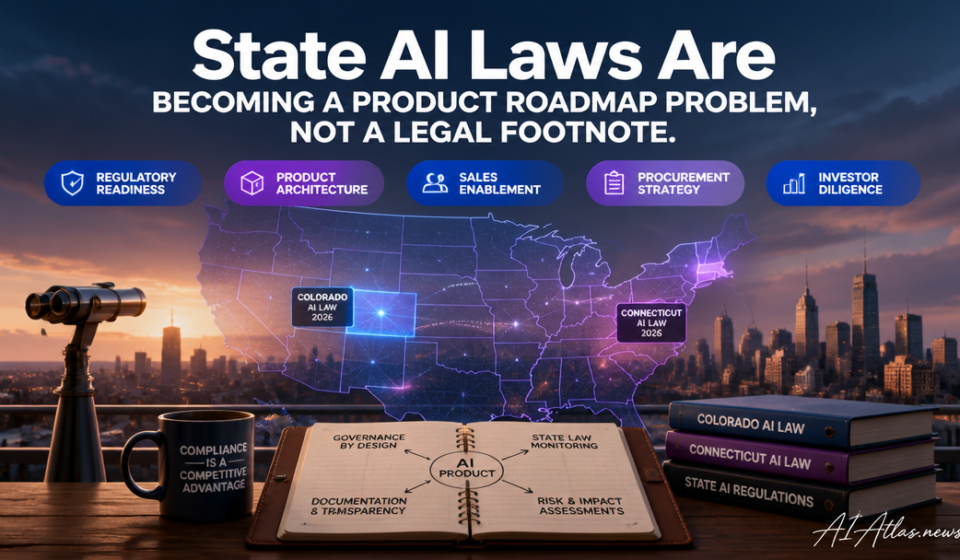
State AI Laws Are Becoming a Product Roadmap Problem, Not a Legal Footnote
The Contrarian Thesis
We think the most important signal in Colorado and Connecticut’s May 2026 AI legislation isn’t what each statute says—it’s what the market will do next. In our experience, state lawmakers are now issuing “operationally enforceable” rules for common product patterns: automated decision-making, consumer disclosures, AI companion bots, and even whistleblower protections. The effect is a shift from a federal waiting game to state-by-state operating constraints.
So here’s the contrarian take we’re increasingly hearing from operators and investors: compliance work will not be a one-off legal sprint. It will become a core product function—budgeted like safety engineering, measured like uptime, and embedded into enterprise sales workflows. If you sell the same model, same UX, or same decision pipeline across multiple states, you’re already in the compliance business, whether your team calls it that or not.
Flaws in Current Market Assumptions
We keep seeing teams assume that “no comprehensive federal framework” means “low certainty, so move fast.” That assumption is outdated. Even when federal rules are pending, state enforcement can still turn vague risk concepts into concrete duties—especially when a product touches automated decisions, consumer claims, or tightly scoped high-impact use cases.
Another common flaw is the memorisation mindset: “Let’s track the latest statute and assign counsel to interpret it.” That approach fails under multi-state scaling because the operational reality is the same across jurisdictions: you must prove what your system does, what users were told, and how humans intervene when outcomes matter. Statute-by-statute reading helps lawyers; it rarely helps product leaders build repeatable controls.
The Structural Shift
Colorado and Connecticut are effectively telling AI businesses: if your product behaves like a decision system or a persuasive consumer interface, expect regulator-grade expectations around notice, oversight, and accountability. Automated decision-making triggers scrutiny because outcomes can be difficult for users to challenge. Companion-bot design triggers scrutiny because it can blur lines between assistance, influence, and dependent interaction.
Whistleblower protections are the quiet accelerant. They signal that regulators want internal accountability mechanisms, not just external disclosures. That matters commercially: it changes how enterprises evaluate vendor maturity, and it raises diligence standards for investors who previously treated governance as a checkbox.
What we are seeing, bluntly, is compliance fragmentation becoming a go-to-market tax. If you launch once and then expand state by state, you’ll either (a) accept rework, or (b) build a compliance architecture upfront. The winners will treat that architecture as a scaling advantage, not a cost centre.
Decision Framework for Capital Allocation
We advise leaders to stop thinking in “legal requirements” and start thinking in “controllability”. Capital should flow to the parts of your stack you can instrument, document, and change without rebuilding the product. The cheapest compliance is the kind you can switch on per risk tier, per jurisdiction, and per deployment channel.
In practice, we recommend a five-step sequencing model. First, map AI use cases by risk: automated decision-making, companion interaction, consumer-facing claims, and any system that could materially affect individuals. Second, create a decision-system record (inputs, prompts/policies, outputs, intended use, and known limitations). Third, design escalation and human review paths with clear triggers and timeliness targets. Fourth, prepare customer-facing disclosures that are truthful, timely, and specific enough to be operationally defensible. Fifth, build whistleblower-aligned internal workflows so governance is auditable, not aspirational.
For capital allocation, use a simple principle: fund what reduces worst-case outcomes fastest. Multi-state compliance tends to fail at the edges—marketing pages, onboarding flows, admin dashboards, and partner integrations. If your budget covers only model accuracy and not the surrounding product surfaces, you’re underfunding the risk.
Risk Assessment Table
Below is the comparison we use internally to turn “new legislation” into “operational priorities”. It’s not meant to replace legal interpretation; it’s meant to help product, compliance, and revenue teams speak the same language when time and money are tight.
| Regulated touchpoint | Likely trigger (Colorado / Connecticut) | Operational lift | Key evidence to retain | Business consequence if missed |
|---|---|---|---|---|
| Automated decision-making | Systems producing materially consequential outcomes without meaningful user contestability | Escalation rules, human review workflow, logging, contest process | Decision records, model/policy versions, override outcomes, review SLAs | Enforcement risk and enterprise deal friction |
| AI companion bots | Interaction designs that can influence or mimic relational dependence | Content boundaries, safety prompts, user protections, documentation of intent | Conversation policies, refusal/redirect examples, safety evaluation reports | Consumer complaints, app store risk, reputational drag |
| Consumer-facing disclosures | When users interact with or are marketed to as if decisions or content are “human-like” | UI/UX updates, disclosure copy controls, localisation/testing across states | Release notes, disclosure text versions, A/B proof, user journey capture | Regulatory scrutiny and refund/chargeback exposure |
| Whistleblower protections | Governance expectations for internal reporting and accountability mechanisms | Clear reporting channels, case management, retaliation controls, training | Policy docs, incident logs, remediation evidence, training completion | Governance downgrade in enterprise procurement and audits |
| Cross-state deployment governance | Same product, different state constraints applied after launch | Feature flags, jurisdiction routing, vendor contract controls, escalation mapping | Jurisdiction logic, config history, partner integration controls | Rework costs, slowed expansion, stalled pipeline |
If you want one practical lesson: most teams can update the model; fewer can update the decision trail and user disclosures fast enough to scale. That’s where compliance budgets must land.
For investors, this is the diligence lens. We now look for evidence of documentation discipline and workflow maturity—not just benchmarks—because that’s what predicts multi-state survivability.
Visualised Impact Matrix
We use this 2×2 to decide what to fix first. The goal isn’t perfection; it’s reducing the probability of high-impact incidents while preserving revenue velocity.
The operational truth is that controllability is a product property. It’s about whether you can trace, intervene, and communicate at the point of user impact. If your workflows are manual, your logs are incomplete, or your disclosures are hard-coded in marketing templates, you’re living in the red quadrant.
Conversely, teams that invest early in decision records, configurable user journeys, and escalation tooling will find compliance becomes faster with each new state. That compounding advantage is what we want founders and boards to recognise.
Strategic Recommendations for Leaders
We recommend treating compliance readiness as a launch gate for revenue, not an aftermath task for legal. Start by mapping AI use cases by risk tier and deployment surface: model endpoints, admin tools, content generation, and customer onboarding. Then document the decision systems with enough specificity that a reviewer can reconstruct why an outcome happened and what the user experienced.
Next, create escalation and human review processes that are measurable. Define triggers (what conditions force review), roles (who decides), and timeliness (how fast you respond). If your “human in the loop” is a best-effort inbox, regulators and enterprise buyers will both read it as non-functional.
Finally, prepare disclosures as a product artefact. We’ve seen too many teams draft disclosures in spreadsheets, only to discover they can’t keep them consistent across states, partners, and UI variants. Build a disclosure governance layer—versioned text, controlled rollout, and user-journey tracking—so sales teams can expand without re-litigation.
Future-Proofing the Business Model
We don’t think “federal framework” will arrive soon enough to save budgets. Instead, assume state-level requirements will keep accumulating and converge only partially. The business model that wins will be the one that can switch constraints on and off without rebuilding core product logic.
That means building a compliance-ready architecture: decision trails, jurisdiction routing, internal reporting workflows, and customer-facing messaging that is kept consistent with product behaviour. In our experience, this also becomes a commercial asset—enterprise procurement increasingly wants proof of governance, not a promise of good intentions.
For startups and scale-ups, the investment implication is straightforward. Allocate funding to documentation discipline and workflow engineering at the same level you allocate to model performance and user growth. If you do, you’ll reduce churn in enterprise sales, improve investor diligence outcomes, and turn regulatory complexity into a moat rather than a tax.
Frequently Asked Questions
- Do companies need to memorise every state statute to operate safely across the US?
- In our view, no. Focus on building reusable operational controls (documentation, escalation, disclosure governance) that can be mapped onto each state’s expectations.
- What’s the fastest path to “multi-state readiness” for an AI product team?
- Start with risk mapping by use case and deployment surface, then implement decision-system records and human review triggers you can prove with logs and release evidence.
- How should investors assess governance maturity in AI startups now?
- Look for auditable workflows, not just model benchmarks. Strong teams can show consistent decision trails, controlled disclosures, and whistleblower-aligned internal processes.