
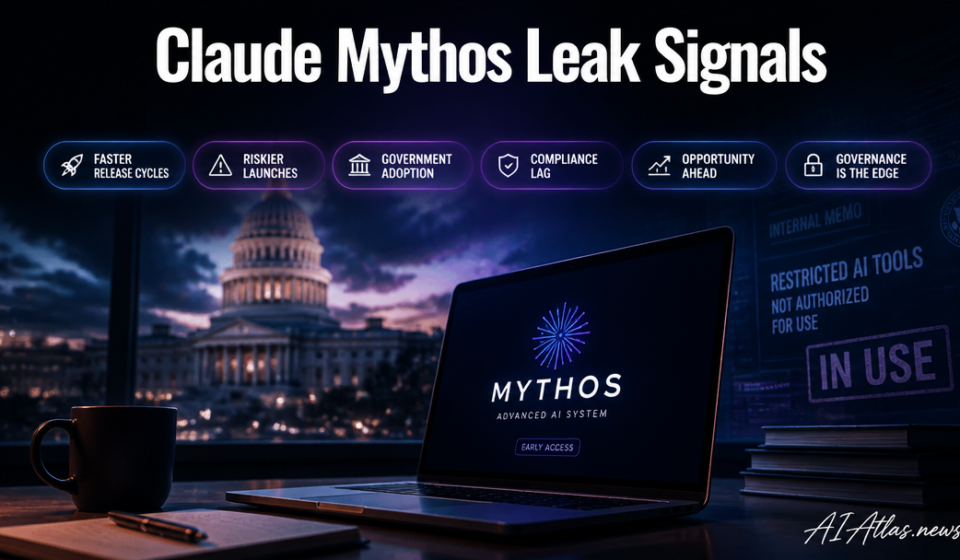
Claude Mythos Leak Signals a Faster Anthropic Launch Cycle — and a Messier Government AI Market
The Headline Truth
We see two linked developments that investors and founders are treating as separate stories, but they’re really one signal: frontier model release cycles are outrunning governance, while institutional demand keeps moving anyway. On one side, leaked code preparations point to Anthropic’s Claude Mythos 1 potentially landing earlier than expected. On the other, reports suggest US intelligence agencies are still deploying Claude models even after a recent blacklist tied to national security concerns.
In our experience, the temptation is to over-interpret any leak as a timetable. We don’t. We treat the Mythos leak as directional—evidence of pressure on engineering and deployment sequencing—rather than a confirmed product strategy. But the combination is commercially meaningful: it implies capability, developer adoption, and procurement reality are advancing faster than policy documents can keep up.
Context Others Missed
The industry keeps arguing about what “should” happen, yet the operational record shows what is happening. The most telling angle is not whether Claude Mythos 1 launches on a specific date. It’s that leaked preparations suggest vendors are being forced into earlier, riskier release windows—then scrambling to align safeguards and messaging after the fact.
Meanwhile, the intelligence deployment story reads like a governance mismatch. A blacklist signals heightened risk, but it rarely eliminates usage immediately—especially in environments where continuity, integration, and existing workflows are already in place. What this tells us is that buyers don’t treat policy as an on/off switch; they treat it as a risk-managed constraint that can coexist with continued adoption, alternative routing, or model version selection behind closed doors.
The Commercial Ripple Effect
For commercial teams, the market message is blunt: the lag between model capability and governance enforcement is becoming a competitive advantage for whoever can ship faster—and still pass audits. If Mythos-related work is indeed moving ahead of schedule, that accelerates the “time-to-pilot” equation for enterprise buyers who want better reasoning, tool use, or workflow reliability before procurement cycles complete.
At the same time, the intelligence-side persistence implies that compliance is evolving into a workflow layer, not a pre-launch gate. That should reshape funding priorities. We’re increasingly interested in companies that build around secure deployment, compliance automation, monitoring, and procurement-ready evidence—because that’s where budget flow will concentrate when model vendors move quickly and policy bodies move slowly.
Stakeholder Impact Analysis
Entrepreneurs and founders should read this as permission to plan for faster adoption curves, but not for easier governance. The opportunity is not simply “sell more chatbots”. The opportunity is to provide deployment primitives: secure model routing, permissioning, red-team style evaluation pipelines, audit trails, and compliance automation that maps directly to procurement language.
Investors should expect near-term confusion in the market—headlines will argue about rumours while buyers quietly update roadmaps. We’d position diligence around operational readiness: can a startup demonstrate evidence generation, policy-to-controls mapping, and post-deployment monitoring? When frontier vendors move in leaps, the winners are often the vendors of control planes.
Enterprise and public-sector buyers will keep using what works, then wrap it with governance. If federal procurement responses tighten, they’ll likely tighten the evidence requirements and risk documentation rather than instantly banning specific model families. Competitors will pivot too: expect faster “productised” safety posture, narrower feature sets, and tighter enterprise packaging to reduce buyer friction.
Strategic Comparison Table
To make sense of the commercial chessboard, we compare the likely posture of key actors—not just what they say, but what they’ll do when cadence and governance collide.
| Actor / Strategy | What it signals commercially | Primary buyer pull | Key risk to watch |
|---|---|---|---|
| Anthropic: Claude Mythos 1 cadence (leak → earlier prep) | Engineering pressure and faster iteration windows; governance likely patched post-release | Enterprises seeking improved reasoning + tool workflows | Trust gaps if safety claims lag deployment evidence |
| US intelligence usage (blacklist ≠ immediate cessation) | Procurement and policy operate as risk management layers, not hard bans | Institutions needing continuity and integration stability | Uneven model routing can create hidden compliance exposure |
| Competitors: faster “enterprise wrappers” | Safety and governance packaged as configuration, not research narrative | CIOs who need procurement-ready documentation | Feature trade-offs that reduce real-world performance |
| Open-source and fine-tuning ecosystems | Demand shifts to controllable variants when governance tightens | Teams optimising cost + compliance control | Fragmentation and evaluation quality variability |
| Compliance automation & secure deployment layers | Budget shifts toward control planes: monitoring, evidence, and policy enforcement | Public sector and regulated industries | Slow integration cycles if tooling can’t map to existing controls |
Visualised Market Response (div)
This is how we expect the market to react over the next few quarters if the directional signals hold—where the “real work” moves earlier than governance.
Blacklist narrative surfaces
Mythos prep leak accelerates speculation
Enterprises expand pilots + procurement drafts
Federal procurement/evidence requirements tighten
Competitor pivots + compliance tooling spend rises
What matters for strategy is not whether the week numbers are perfect—it’s that enterprise pilots will likely start behaving like product launch events. When capability indicators move, teams re-open architecture decisions: routing, evaluation frameworks, and vendor risk scoring. That’s when startups offering secure deployment and compliance automation see demand spikes.
We also expect community fork activity to accelerate in parallel. Even if Mythos is proprietary, the ecosystem learns from leaked work patterns: tooling interfaces, prompt formats, evaluation approaches, and integration points. That in turn affects competitor roadmaps because “developer adoption” becomes measurable faster than official policy language.
Critical Market Risks
First, the risk of false certainty. Leaks are not roadmaps, and premature conclusions can misallocate capital. Founders who build around an assumed launch date may lose momentum if Anthropic’s official timing shifts—or if safety and licensing conditions tighten in ways that change integration economics.
Second, the governance whiplash risk. If model usage continues in classified or managed contexts while the public procurement posture tightens, the market can fracture into two realities: what works operationally behind secure walls, and what sells commercially under compliance scrutiny. Startups that only optimise for one environment will get hurt when buyer expectations converge.
Third, the “control-plane tax” risk. Compliance automation is valuable, but it can become expensive and bespoke. In our view, the winners will be teams that standardise evidence pipelines and integrate smoothly with existing identity, logging, policy frameworks, and procurement processes—rather than creating a new compliance stack that only works in one customer’s environment.
Conclusion and Future Outlook
We think the real story is cadence mismatch: frontier capability is moving faster than governance frameworks, while institutional demand continues through imperfect policy alignment. The leaked Mythos preparations suggest vendors feel pressure to shorten release timelines. The intelligence deployment reports suggest buyers maintain continuity and apply risk management, not abandonment. Together, these forces will pull the market towards faster pilots, earlier evaluations, and growing spend on security and compliance automation.
For investors and founders, the watchlist is clear: Anthropic’s official launch timing; community fork activity that signals real developer traction; federal procurement responses that reveal what evidence is now mandatory; competitor product pivots that show how safety narratives are being re-packaged; and funding activity around secure AI deployment, compliance automation, and public-sector AI infrastructure. In the next cycle, the competitive advantage won’t just be model quality—it’ll be operational readiness.
Frequently Asked Questions
- The leak indicates prep work, not a guaranteed launch. We treat it as a cadence signal that can still be overturned by Anthropic’s official timeline and safety gating.
- If intelligence agencies are still deploying Claude despite a blacklist, it implies policy is applied as risk management rather than instant cessation. For buyers, that usually means evidence, routing, and monitoring matter more than headlines.
- For startups, the best investment angle is often the control plane: compliance automation, secure deployment, audit trails, and evaluation pipelines that map to procurement requirements.