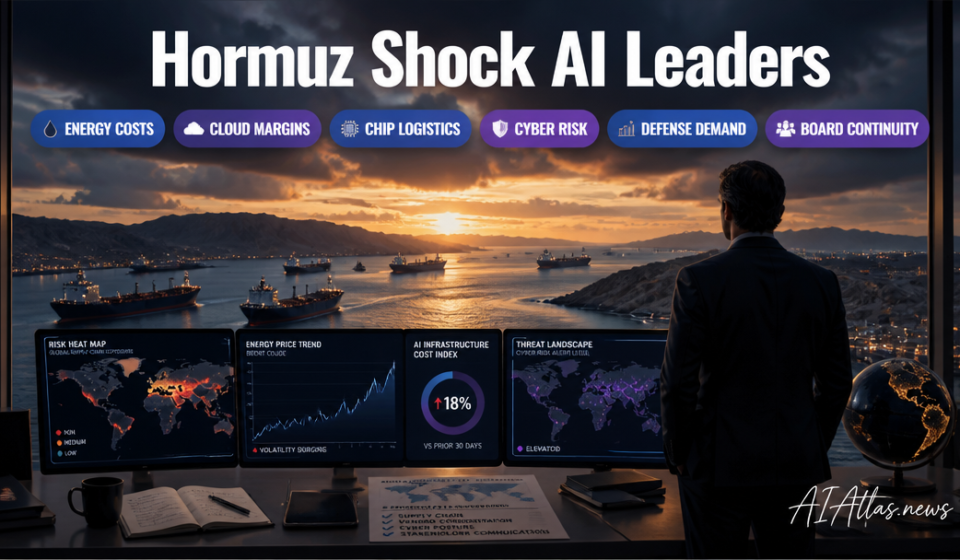
Hormuz Shock: Why AI Leaders Should Treat U.S.-Iran Escalation as an Immediate Supply Chain and Risk Pricing Event
The Headline Truth
We don’t treat the reported U.S. “self-defence” strikes near the Strait of Hormuz as a mere geopolitical footnote. In our experience, any kinetic action around a critical energy and shipping chokepoint triggers a fast, commercial repricing—often before markets fully price in the second-order effects.
What matters is the operating environment AI businesses depend on: power availability and price, maritime logistics reliability, insurance and security costs, and the willingness of enterprise buyers to accelerate or delay spend. When Tehran accuses Washington of violating ceasefire efforts and retaliation threats return to the centre of negotiations in Qatar, the risk premium rises for more than defence equities.
Context Others Missed
Most coverage fixates on the “where” and the “what was targeted”. We focus on the “what changes for budgets and supply chains” once the Strait’s perceived risk increases. Even without sustained escalation, the expectation of escalation is enough to alter shipping routes, lead times, and the cost of insuring cargo—inputs that ripple straight into data centre build-outs, server replacements, and mission-critical cloud operations.
Then there’s the negotiation layer. When ceasefire talks are framed as contested and threatened retaliation is part of the public narrative, companies don’t wait for certainty. They shift from steady-state planning to scenario planning: additional inventory buffers, dual sourcing, more conservative procurement calendars, and increased cybersecurity and physical security spend. That is how geopolitical uncertainty turns into P&L impact across the AI economy.
The Commercial Ripple Effect
We are seeing a classic pattern: operational risk moves first, financial risk follows. The immediate commercial channels are energy and logistics. If shipping insurance tightens and freight reroutes, the landed cost and arrival predictability of specialised equipment can worsen. That hits semiconductor-related logistics, data centre hardware deliveries, and the maintenance cycles that keep AI workloads running.
Energy is the other lever investors too often underweight. AI inference at scale is increasingly constrained by power pricing and grid reliability. In periods of heightened geopolitical risk, energy markets become more volatile; operators respond by hedging, adjusting load, contracting power capacity differently, and—critically—raising the hurdle rate for new capex. For cloud margins, higher electricity costs and more frequent outages risk compressing the “steady” unit economics that many AI infrastructure business cases assume.
Stakeholder Impact Analysis
Entrepreneurs and AI operators: the most actionable move is not to “watch the news” but to stress-test your supply and security assumptions. We typically recommend mapping every dependency that touches constrained logistics (specialised components, replacement parts, network gear) and then quantifying the impact of delayed arrivals on uptime and SLAs. If your deployment roadmap assumes clean lead times, start revising now—especially if you sell to regulated or defence-adjacent customers who will demand stronger continuity guarantees.
Venture investors and enterprise buyers: expect procurement cycles to lengthen and risk controls to tighten. Enterprise customers often pause discretionary expansions during uncertainty, but they do spend when they can justify it: security uplift, resilience tooling, and compliance. This creates a bifurcation—some AI infrastructure categories stall, while security, observability, and resilience demand accelerates. Investors should look for businesses that can quantify ROI under volatility, not just those that can talk about “scaling”.
Defence-tech, cybersecurity, and critical infrastructure vendors: escalation around a major trade corridor tends to increase attention on both digital and physical attack surfaces. That doesn’t only mean more budgets for traditional defence. It also means more contracts for supply-chain security, incident response readiness, maritime-adjacent risk services, and systems that can prove continuity to enterprise customers.
Strategic Comparison Table
Below is how we expect the commercial shock to propagate across the AI ecosystem under an escalation risk scenario—using practical indicators rather than headline narratives.
| Stakeholder | Primary commercial lever | Short-term effect | What to watch | Investment / operator judgement |
|---|---|---|---|---|
| Cloud providers & hyperscalers | Power price volatility + regional procurement timing | Unit economics wobble; tighter capex gatekeeping | Spot-to-contract mix, outage frequency, margin guidance language | Prioritise workload placement and resilience SLAs over pure growth |
| Data centre operators | Energy contracts + hardware delivery reliability | Higher landed costs; slower refresh cycles | Capex deferrals, maintenance spend, inventory buffer policies | Back generators, power procurement sophistication, and uptime assurance |
| Enterprise AI buyers | Risk appetite + security/compliance budget reallocation | Procurement delays for expansion; acceleration for controls | Security addenda, contract continuity clauses, longer evaluation timelines | Sell resilience outcomes with measurable continuity KPIs |
| Semiconductor & logistics nodes | Shipping insurance, routing changes, lead times | Freight unpredictability; higher buffer costs | Incoterms revisions, lead-time disclosures, regional rerouting patterns | Differentiate on reliability and visibility, not only cost |
| Cybersecurity & defence-adjacent tech | Threat modelling urgency + incident readiness spending | Demand lift for resilience and response | Expansion into critical infrastructure accounts; faster budget approvals | Win with risk reduction proof, not speculative “growth stories” |
Our bias as analysts is to treat “uncertainty” as a measurable input into planning. When routing risk rises, the winners are rarely the cheapest vendors—they’re the ones who can absorb volatility while maintaining continuity for customers.
Visualised Market Response (div)
To make this tangible, we model the expected risk repricing path as a simple index that reflects operational pressure on energy, logistics, and buyer confidence. This is not a claim about exact figures; it’s a directional framework for decision-making.
0–72h
Week 1–2
~30 days
Budget cycle
▲ Margin sensitivity
▲ Inventory buffers
▲ Contract add-ons
▼ Longer diligence cycles
The commercial signal we take from this is not fearmongering—it’s timing. Risk repricing reaches budgets through contract language, procurement processes, and security uplift demands before it shows up in headline economic indicators. If you run an AI infrastructure business, that window is when customers quietly change their buying criteria.
For founders pitching investors, this matters: when geopolitical risk rises, the market rewards clarity on operational continuity. Show how your service remains performant under supply delay scenarios, power volatility, and elevated incident probability. Otherwise you’ll compete on “vision” while buyers compete on “survivability”.
Critical Market Risks
First, cost uncertainty can become cost irreversibility. Once insurers, carriers, and utilities price risk into contracts, it can persist even if the crisis cools. AI operators that assumed “temporary volatility” may find that their planning costs remain elevated for longer than the initial news cycle suggests.
Second, procurement re-ordering creates demand whiplash. Buyers may delay new AI capex, but they bring forward spending on security, monitoring, and resilience. That creates a crowded field for vendors positioned as “must-have” during uncertainty, while others see pipeline evaporation. Investors should watch for a split between resilience budgets (sticky) and expansion budgets (fragile).
Third, routing and lead-time disruptions can undermine reliability claims. If your product depends on rapid hardware turnover or predictable replacement cycles, any logistics shock threatens service continuity. In the AI enterprise market, that’s reputational risk that can be hard to unwind—especially when contracts start demanding continuity proofs rather than “best efforts”.
Conclusion and Future Outlook
We expect negotiations in Qatar to remain the battleground narrative—until either a credible ceasefire framework hardens or retaliation spirals. But for AI investors and operators, the key point is already settled: a spike in perceived risk around the Strait of Hormuz changes the cost of running compute, sourcing hardware, and proving resilience. The resulting risk repricing will show up in unit economics, contract terms, and procurement timing.
Our practical outlook is selective. Resilience-first categories—cybersecurity, supply-chain visibility, incident readiness, uptime engineering, and power-aware infrastructure planning—tend to gain budget share. Meanwhile, high-valuation, long-payback AI infrastructure bets with weak continuity narratives face capital scarcity. In uncertain geopolitical windows, the market funds credibility, not optimism.
Frequently Asked Questions
- The main commercial impact is risk repricing, not just military outcomes. For AI businesses, that means higher sensitivity to energy costs, logistics lead times, and security and continuity requirements.
- Enterprise buyers usually delay expansion but accelerate resilience spending. Expect more contract add-ons around continuity, monitoring, and incident response readiness during periods of escalation risk.
- Founders should stress-test supply and uptime assumptions against delayed deliveries and power volatility. If you can quantify continuity under stress scenarios, you will stand out in diligence and procurement cycles.