
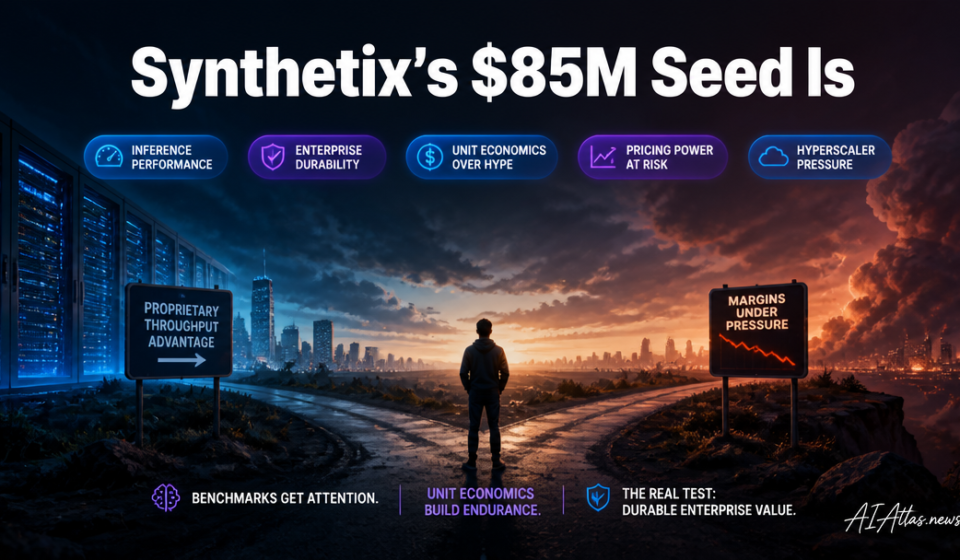
Synthetix’s $85M Seed Is Less About Benchmarks Than Survival Math
Synthetix’s $85 million seed round arrives with the kind of investor signal that rarely comes with nuance: record benchmark results for proprietary, high-throughput inference infrastructure—and now fresh capital to scale it, and sell it into enterprises. On paper, this is renewed appetite for the boring-but-deadly part of generative AI: throughput, latency, and cost per token at scale.
In our experience, however, the market often funds the measurement before it funds the margin. A seed round is a stress test for whether inference performance can survive the long commercial walk from lab benchmarks to enterprise purchasing, procurement cycles, and pricing power—especially as hyperscalers keep compressing differentiation.
The Contrarian Thesis
We think this round is less a celebration of “better inference” than a probe of the current AI infrastructure funding cycle. Investors are rewarding a specific type of technical claim—high-throughput inference—that maps cleanly to unit economics. But the hard commercial question is whether proprietary throughput becomes a durable enterprise advantage before hyperscalers commoditise it, or before model architecture shifts make the original optimisation partially irrelevant.
In other words: the benchmark is the opening statement. The real hearing is whether Synthetix can turn throughput into pricing power, defend against big-tech distribution, and clear enterprise adoption friction faster than buyers can evaluate “good enough” managed alternatives.
Flaws in Current Market Assumptions
The first assumption we see is that benchmark superiority automatically converts into margin superiority. Benchmarks are usually run under controlled conditions: specific model versions, fixed batching strategies, idealised workloads, and environments where the benchmark runner controls the variables. Enterprises don’t buy under those constraints. They buy under noisy, heterogeneous workloads—different models, unpredictable traffic patterns, compliance requirements, and integration complexity.
The second assumption is that “enterprise adoption” is a linear path once performance is proven. In our experience, enterprise adoption is often the opposite of linear: procurement requires referenceable customers, security reviews can drag for months, and internal champions need tools that plug into existing data pipelines. Even if the infrastructure is technically superior, sales friction can erase the margin case—particularly for seed-stage companies without a mature go-to-market motion.
Third, investors tend to underweight the implications of burn rate when the story is compelling. Scaling inference infrastructure is not cheap. Data-plane operations, observability, reliability engineering, and customer-specific integration work can create a burn curve that looks manageable at pilot scale and becomes punishing at production scale. A seed round that funds “infrastructure and adoption” can still hide a dangerous mismatch between capital intensity and near-term revenue realisation.
The Structural Shift
What we are seeing in the market is a structural re-rating of infrastructure. After a phase where capital chased model innovation and generic tooling, investors are now gravitating towards components that directly influence cost-to-serve: inference throughput, batching efficiency, routing, and fleet optimisation. Synthetix’s positioning against Vertex AI and other hyperscale services tells us exactly where the perceived value lives—at the point where enterprises pay every time a token is generated.
But structural shifts cut both ways. Hyperscalers have the distribution, procurement relationships, and economies of scale to absorb performance improvements quickly. They can also bundle inference optimisation into broader platform contracts. That means the proprietary inference stack must offer more than speed; it must offer commercial leverage: predictable cost envelopes, clear savings against an incumbent, and a migration pathway that doesn’t collapse under integration risk.
Decision Framework for Capital Allocation
When we analyse infrastructure investments like this, we force ourselves to connect technical claims to a commercial chain: throughput → unit economics → measurable savings → procurement confidence → pricing power → durable customer lock-in. If any link is weak, the story may still win deals, but it won’t win compounding returns.
So we look for five evidence points before we accept the margin thesis:
1) Burn realism: Is the burn linked to deployment milestones (not “capacity growth” alone)? We want to see runway mapped to production revenue conversion.
2) Defensibility beyond benchmarks: Throughput can be replicated; what matters is whether the advantage survives model churn, traffic variability, and workload heterogeneity. Proprietary optimisation must be coupled to operational learnings, not just clever kernels.
3) Enterprise adoption motion: Do they have solution architects who can integrate, or do customers do the integration? Enterprise sales friction is often an unpriced cost that hits the P&L.
4) Pricing power clarity: Can Synthetix price on value delivered (cost saved, SLA achieved), or will it compete on headline performance against hyperscale “good enough” tiers?
5) Big-tech exposure plan: If Vertex AI closes the gap, what remains? We expect at least one wedge that hyperscalers can’t bundle away quickly—such as specialised workload guarantees, contractual commitments, or a unique operational layer.
Risk Assessment Table
To make the trade-offs explicit, here’s a compact risk comparison of five common paths enterprise buyers evaluate when they consider “proprietary inference” versus alternatives.
| Option (5) | Burn-rate risk | Defensibility risk | Enterprise sales friction | Pricing power risk | Big-tech competition exposure |
|---|---|---|---|---|---|
| Synthetix-style proprietary inference platform | High (infra scaling & integration) | Medium (depends on operational moat) | Medium–High (security + migration) | Medium (must prove savings fast) | High (hyperscalers copy + bundle) |
| Hyperscale managed inference (Vertex/AWS/GCP) | Low (customer absorbs ops) | Low (fast commoditisation) | Low (procurement familiarity) | High (buyer has less switching cost) | Low–Medium (distribution advantage) |
| Self-hosted stack (open source & internal ops) | Very High (teams, reliability, capex) | Medium (depends on engineering depth) | High (integration & ownership burden) | Low (buyers negotiate like IT vendors) | Medium (buyers own the compute path) |
| Model routing/gateway layer | Medium (software scale + observability) | Low–Medium (easy to replicate) | Medium (needs workload instrumentation) | Low–Medium (often cost-plus) | High (hyperscalers offer routing) |
| Systems integrators / managed service providers | Medium (delivery margin pressure) | Medium (process moat, not code) | Low (buy via trusted partners) | Low (limited direct pricing control) | Medium (can use hyperscaler underlay) |
Our view: Synthetix’s success hinges on converting performance into repeatable cost envelopes that procurement teams can defend internally—while keeping burn and integration load under control.
Visualised Impact Matrix
Below is a simple 2×2 to frame where we believe companies like Synthetix can win—or where they get pulled into a commodity lane.
High commercial tractability
Expected profile: throughput-led savings + fast integration
Score: 4/5 throughput, 4/5 tractability
Low commercial tractability
Expected profile: great demos, expensive production, slow procurement
Score: 4/5 throughput, 2/5 tractability
High commercial tractability
Expected profile: bundles, reliability guarantees, quick adoption
Score: 2/5 throughput, 4/5 tractability
Low commercial tractability
Expected profile: commodity tooling + fragile margins
Score: 2/5 throughput, 2/5 tractability
Strategic Recommendations for Leaders
If you’re an enterprise buyer, don’t treat this as “a better inference engine” story. Treat it as a decision about cost of ownership. Ask for workload-specific pricing models, not generic token pricing. Demand evidence that throughput gains persist under concurrency spikes, model mix changes, and real latency sensitivity.
If you’re a founder or investor, be equally unsentimental. An $85 million seed round is an opportunity to industrialise—yet it can also tempt the company into premature scaling. Your priorities should be: ship repeatable deployment playbooks, reduce time-to-value, and build a defensibility narrative grounded in operational learnings (SLA outcomes, reliability metrics, and cost variance), not just one-off benchmarks.
In our experience, the highest-performing infrastructure startups focus on a narrow wedge first (a workload class or buyer persona), then expand. The risk is spreading too quickly across “enterprise adoption” as a vague category, which can inflate burn and dilute integration effectiveness.
Future-Proofing the Business Model
The long-term test for Synthetix is whether it can stay commercially relevant as models evolve. Throughput advantages can be invalidated by changes in model architecture, context length economics, or vendor runtimes. So the business model must be resilient to technical churn—either by making the inference layer adaptable, or by aligning with a contractual mechanism that preserves value even as the underlying models change.
That means future-proofing should show up in the revenue design: multi-year commitments tied to service levels, clear unit economics guarantees, and an integration framework that reduces switching costs. Without that, the company risks being priced like a commodity improvement—while hyperscalers leverage distribution to win the default position.
Ultimately, this seed round tells us investors want inference performance to matter again. Our bet is that the next competitive frontier won’t be the benchmark chart—it will be the enterprise margin chart.
Frequently Asked Questions
- What does an $85 million seed round for inference infrastructure signal to investors?
- It signals a renewed preference for funding components that directly affect cost-to-serve, not just model novelty. But it also raises the bar for proving unit economics fast enough to justify continued capital intensity.
- What should enterprise buyers validate before switching from Vertex AI or similar services?
- Validate workload-specific throughput, cost variance under concurrency, and integration time-to-value. You should also assess security, observability, and SLA enforcement in production—not just benchmark outcomes.
- Where is the biggest risk for companies like Synthetix after a strong seed round?
- The biggest risk is scaling infrastructure and sales effort without generating durable pricing power. If throughput advantage doesn’t translate into enterprise margins, hyperscaler bundling can quickly erode differentiation.