
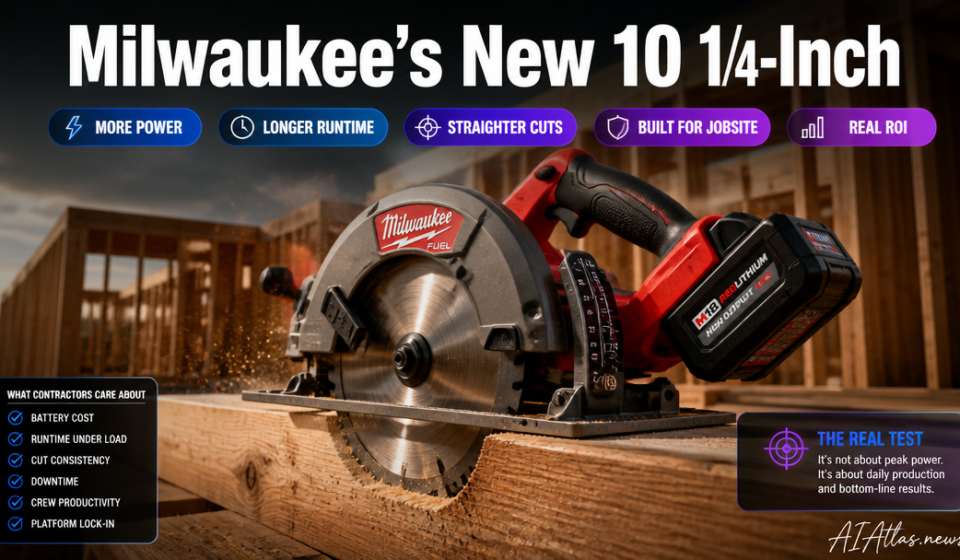
Milwaukee’s New 10 1/4-Inch Rear-Handle Circular Saw Raises the Cordless Bar, But the Real Test Is Jobsite ROI
The Contrarian Thesis
We’ve heard the early tool-review chatter: Milwaukee’s latest 10 1/4-inch rear-handle cordless circular saw is being praised for slicing through 4x lumber in a single pass, with contractors quietly treating it as a new benchmark for cordless cutting power. That’s precisely where the scepticism needs to start. Cutting one more board “on camera” is not the same thing as lowering cost-per-job, improving crew throughput, and reducing downtime over the lifespan of the tool and its batteries.
Our contrarian thesis is simple: this launch should be evaluated less like a product story and more like a total cost of ownership and speed-to-value story. If the saw genuinely reduces passes, speeds up framing workflows, and performs consistently across battery states, then it matters. If not, it’s another incremental power step that locks buyers into expensive battery ecosystems—while leaving productivity gains hostage to recharge logistics.
Flaws in Current Market Assumptions
The most common assumption in the enthusiast cycle is that “more cutting power” automatically translates into better jobsite economics. But jobsite reality is messier: cuts happen under varying board density, blade condition, alignment pressure, and operator technique. Even a strong one-pass claim can be diluted by how often crews need a second attempt due to bind, inaccurate starts, or blade heating. We’ve seen this pattern across many construction tool migrations—where the marketing moment looks clean, but the operational graph is jagged.
The second flawed assumption is that cordless platforms are now “good enough” to replace corded saws for heavy framing as a default. That only holds if the platform’s energy delivery stays stable under load, not merely at the point of maximum draw. Batteries are not static assets; they’re a consumable layer in the supply chain. When battery performance degrades, the tool “feels” weaker, runtime shortens, and the crew starts planning around charging rather than around the work.
The Structural Shift
What we’re really seeing—beneath the saw headlines—is a structural shift in how contractors think about power tools. Cordless has always promised convenience, but it has also carried hidden friction: battery management, spares inventory, charger throughput, and the time cost of “waiting for energy”. The milestone isn’t simply whether the motor can win a one-pass test; it’s whether the system (battery + charger + workflow) can keep output predictable across a full day, not just a controlled cut.
There’s also a market-level pattern worth borrowing from the AI world. In AI, we’ve watched compute move from a luxury to a managed platform: performance depends on more than the model, it depends on the full stack—hardware, memory, and orchestration. Tool platforms are converging for the same reason. Milwaukee is effectively asking contractors to treat batteries as the new “compute layer”. That’s a strategic proposition, and it deserves the same commercial interrogation we’d apply to any infrastructure upgrade.
Decision Framework for Capital Allocation
Before anyone writes a cheque, we recommend a disciplined test-and-compare approach that mirrors how you’d pressure-test a new production workflow. Start by identifying the crew’s critical path: how many cuts per hour, how often the saw is the limiting step, and whether the team already owns compatible batteries and chargers. Then validate the claim that “4x lumber in one pass” yields measurable time savings for your crew, not for the reviewer.
We also encourage buyers to translate performance into business metrics: cost per cut, downtime minutes per shift, and battery swap frequency. If the saw reduces blade passes but increases battery churn, you might break even on time but lose on inventory and overhead. In our experience, the best decisions happen when contractors model TCO at the crew level—because batteries are shared assets, not personal gadgets.
| Evaluation factor (what matters on jobs) | Milwaukee cordless (new 10 1/4) — what to verify | Rival cordless platforms — typical trade-offs | Why this changes TCO |
|---|---|---|---|
| One-pass reliability on real boards | Confirm across twists, knots, and blade wear after repeated cuts | Often “works” until blade/board variance triggers second passes | Second passes erase the time advantage and increase battery draw |
| Runtime under sustained load | Measure cuts per battery until performance noticeably drops | Some platforms sustain peaks but sag quickly in long runs | Battery runtime determines effective labour capacity per shift |
| Charger throughput vs crew demand | Audit whether your charge setup matches your cut cadence | Upgrades in chargers and spares can offset tool savings | Charging bottlenecks create downtime, even when batteries exist |
| Battery replacement curve | Price out replacements for the battery sizes you’ll actually run | Different chemistry/family designs change long-term costs | Hidden ownership cost shows up at 1–3 year mark |
| Platform reuse across tools | Count how many team tools share the same battery family | Some buyers overpay when cross-platform compatibility is low | Economics improve only if batteries serve many tools, not one |
Risk Assessment Table
If we’re going to be serious about this saw as a business decision, we need to name the risks that aren’t captured by “power” metrics. Below is the risk map we’d use for a contractor pilot—because most cordless failures aren’t mechanical, they’re operational and financial.
We’re particularly focused on battery logistics, inconsistent runtime, and the chance that the crew learns to “work around” the tool rather than through it.
| Risk | What it looks like on site | Likelihood | Impact | Mitigation |
|---|---|---|---|---|
| Charging bottleneck | Waiting for batteries during continuous framing days | High | High | Right-size charger fleet; rotate spares; run a full-day test |
| Runtime shortfall vs claim | More swaps than planned; crews slow down | Medium | High | Measure cuts per charge under your board mix and blade state |
| One-pass inconsistency | Second passes due to bind/starting technique | Medium | Medium | Blade spec checks; training; ensure correct depth and line-up habits |
| Hidden inventory cost | Battery spares expand budget quietly | High | Medium | TCO model including batteries over 2–3 year usage |
| Platform lock-in | You end up “buying into” a battery family you don’t fully use | Medium | Medium | Audit current tool portfolio and chargers before committing |
| Blade and service economics | Blade cost and downtime undercut time savings | Low–Medium | Medium | Track blade life in your material; plan spares and service intervals |
Visualised Impact Matrix
This is how we’d frame the saw’s commercial promise: not “does it cut 4x?”, but “does it improve throughput without increasing the ownership friction?”. The matrix below positions the decision by two axes we see repeatedly in contractor outcomes—productivity gain and TCO risk.
Use it during a pilot: if your saw lands in the wrong quadrant, don’t stretch the rollout just because the headline sounds impressive.
Strategic Recommendations for Leaders
Here’s where we get decisive. If your organisation already runs the same battery ecosystem across impact tools—drills, impact drivers, circular saws, and site lights—then the incremental step up in power can reduce corded dependency with lower marginal risk. If, however, this would be your first serious battery commitment at the framing level, treat it like an infrastructure investment: run a pilot, track time-and-motion, and model batteries as a recurring cost, not a one-off purchase.
For jobsite supervisors, the operational checklist is blunt: measure cuts per charge, blade swaps per shift, and downtime created by charging or battery availability. For tool buyers, insist on clarity around battery size strategy (which packs you’ll actually use) and charger capacity. And for trades-focused entrepreneurs pitching faster crews to clients, be wary of promising “one pass” outcomes without a cost-per-job model—because the crew’s reality is what determines whether you win work or donate margin.
Future-Proofing the Business Model
The investors and market watchers among our readers should notice the strategic pattern: cordless platforms are becoming less like product categories and more like supply-chain ecosystems. Batteries and chargers are the infrastructure layer; tools are the application layer. That’s exactly why AI hardware competition feels familiar—capability advances matter, but economics decide who scales. A saw that performs is not automatically the winner; the winning platform is the one that makes replacement cycles predictable and ownership costs tolerable.
Our advice for future-proofing is to buy in a way that keeps optionality. Avoid over-indexing on a single SKU unless it unlocks a measurable throughput advantage across your typical jobs. Build a battery plan that supports multiple tool types and a charger plan that matches your crew cadence. If you can’t justify the total cost over a realistic service window, you don’t have a productivity upgrade—you have a headline purchase.
Frequently Asked Questions
- Is the “4x in one pass” claim enough to justify buying a new cordless saw?
- No. We’d treat it as a starting hypothesis and validate it with your boards, your blade condition, and your crew’s cutting technique. The business case depends on minutes saved per shift and whether charging logistics stay ahead of demand.
- What hidden costs should contractors model for cordless high-output tools?
- Battery replacement timing, spares inventory, charger throughput, and downtime from swapping. We often see the TCO shift from the tool price to the energy subsystem over 12–36 months.
- How can we compare Milwaukee’s saw to rivals without relying on marketing benchmarks?
- Run a controlled pilot that measures cuts per charge, time-per-cut (including second passes), and labour disruption. Then compare the platform’s reuse value: how many other tools your fleet can run on the same batteries.