
Reliance’s AI Entertainment Push Is Really a Distribution Power Play
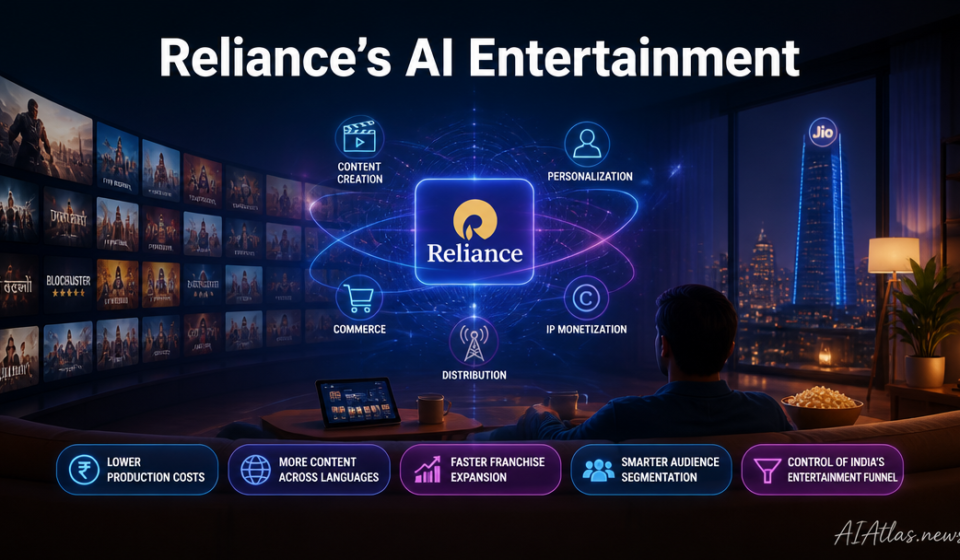
We have seen too many AI announcements in media that read like technology demos dressed as strategy. Reliance Industries’ move—led by Mukesh Ambani and embedded across media and entertainment—looks different. It is not simply adding AI to production; it is building an end-to-end operating system for Indian attention, where content creation, personalisation, localisation, and monetisation start behaving like a single workflow.
Our contrarian read at AI Atlas News is simple: treat this as a commercial integration bid, not a model upgrade. When distribution scale, consumer data, digital platforms, and content assets are brought under one AI orchestration layer, the cost curve and the value capture mechanics change—often faster than competitors can respond.
The Contrarian Thesis
In our experience, the biggest mistake operators make is to evaluate AI adoption in media as if it were a “better way to make the same thing”. Reliance’s deep integration across entertainment operations is closer to collapsing several businesses into one: the studio, the recommender, the localiser, and the transaction layer. That shift matters because media economics are not driven only by production costs; they are driven by distribution efficiency, retention, and repeat monetisation.
What we are seeing is an attempt to win India’s entertainment destination race by reducing friction between “what the audience wants” and “what gets produced and sold”. AI becomes core infrastructure for the loop: sense demand → generate and adapt content → match it to individuals and contexts → convert → learn. If you run a rival studio, a creator platform, or an investor-backed media startup, you should assume this loop will be engineered for scale and speed, not merely for novelty.
Flaws in Current Market Assumptions
Most market talk around generative AI in entertainment focuses on output quality—better scripts, more realistic voices, faster edits. We think that lens is incomplete. The operator-level trade-off is whether AI shortens the iteration cycle without breaking brand safety, IP integrity, and audience trust. High output volume is meaningless if compliance, rights management, and “taste” governance cannot keep pace.
There is also a quiet assumption that AI adoption is additive: tools get bolted on top of existing workflows. Reliance’s direction challenges that. When AI is embedded across the pipeline, the marginal cost of adaptation (local languages, formats, cultural cues, device constraints) can fall sharply, and the marginal value of personalisation can rise—especially when the company controls both the audience graph and the distribution inventory.
The Structural Shift
Reliance’s broader strategy—combining distribution scale, consumer data, digital platforms, and content assets—turns AI from a production technique into an operating system. In practice, this means AI will be used not just to generate content, but to orchestrate decisions: what to commission, which version to localise, which marketing angle to test, and which offer to present. That is a different business capability: “closed-loop production and monetisation”.
For leaders, the takeaway is operational. The competitive threat is not that AI can write better dialogue; it is that an integrated player can continuously reconfigure the entertainment portfolio to match micro-demand. When personalisation and localisation are treated as default behaviours, the content library becomes more like a living product catalog than a static set of titles. This reshapes IP monetisation too: the asset is not just the initial work; it is the versioning strategy, the derivative pipeline, and the distribution choreography.
Decision Framework for Capital Allocation
If you are allocating capital—whether you are a studio, a platform operator, or an investor—the question is not “Should we use AI?” It is “Where does integration create defensible economics?”. In our experience, the winners will invest in orchestration and data governance as aggressively as they invest in generation quality.
We recommend a four-part framework before you fund any initiative: (1) Control of the loop—can you feed performance signals back into production and merchandising? (2) Rights and trust infrastructure—can you prove provenance, manage licensing boundaries, and prevent brand damage? (3) Unit economics—does AI lower cost-per-tested-minute and raise conversion-per-impression? (4) Localisation scale—can you deploy new language and format variants fast enough to match audience seasonality?
| Risk theme (operator lens) | Integrated AI OS (Reliance-style) | Creator tools bolt-on | Platform-agnostic studio AI |
|---|---|---|---|
| Data moat dependency | High upside, but higher concentration risk if signals are biased or underused. | Limited advantage; you may optimise output without owning demand signals. | Moderate; you can improve quality, but conversion feedback may be weak. |
| Unit cost curve | Compute and tooling are centralised; if it works, margin expands quickly. | Cost savings often capped by manual downstream steps and fragmented tooling. | Savings vary by content type; integration gaps can slow iteration. |
| IP provenance and reuse | Must build governance to prevent rights drift across derivatives and versions. | Higher operational burden; provenance may not cover downstream edits and packs. | Usually underinvests in end-to-end rights tooling, creating monetisation friction later. |
| Brand safety and localisation quality | Can standardise controls; risk is over-automation of taste and context. | May improve speed but still needs heavy human review for cultural accuracy. | Can struggle to scale quality across regions without local operations. |
| Platform lock-in and switching costs | Creates strong internal distribution dependency; competitors face a tough barrier to entry. | Lower lock-in, but also lower leverage over monetisation channels. | If reliant on third-party recommender stacks, bargaining power stays weak. |
Risk Assessment Table
Our view is that risk management is not an afterthought—it is the mechanism that determines whether AI integration creates durable advantage or temporary volume. When the production loop is tightened, any governance failure scales as quickly as output. That is why the operational details matter: audit trails, rights databases, human-in-the-loop policies, and model evaluation aligned to audience trust.
In practice, Reliance-style integration raises the bar for competitors. If you cannot match the governance depth, you will end up shipping faster but earning less trust per impression. Conversely, if you invest in trust infrastructure early—rather than chasing raw generative performance—you can still differentiate, even if you lack distribution scale.
Visualised Impact Matrix
To make the commercial logic tangible, we map where AI integration typically drives impact versus where it tends to consume attention and capital. This is not a claim about Reliance’s internal numbers; it is a decision aid for operators watching the same competitive shift.
Index value: 100
Index value: 72
Index value: 51
Index value: 34
Index value: 22
Strategic Recommendations for Leaders
For entrepreneurs and media operators, the right response is not to “out-AI” a vertically integrated incumbent. In our experience, that is a budget fight you cannot win. The better question is where you can own a piece of the loop that is expensive for large conglomerates to replicate quickly—specialised genres, niche audiences, local community distribution, or superior creative tooling for distinct production formats.
Three actions we would prioritise: (1) Build or buy a reliable rights-and-provenance layer early, so IP monetisation doesn’t get stuck later. (2) Instrument your funnel ruthlessly—track how AI changes the path from impression to conversion, not just how it improves content quality metrics. (3) Design for localisation as a product capability (process, vendors, and quality checks), because the winner is often the player who can create many culturally correct variants quickly, not the player with the flashiest generation demo.
Future-Proofing the Business Model
The future pressure on media businesses is that “content” stops being a standalone deliverable and becomes an input to continuous, personalised value extraction. If you treat AI as a one-off upgrade, you will be outpaced by firms that treat it as an operating layer spanning analytics, production orchestration, and commercial distribution. That is why investment decisions should favour architecture, not just models.
We expect the competitive landscape to separate into three archetypes: integrated loop builders (distribution + data + production), tooling specialists (rights, safety, localisation pipelines), and community or niche operators (taste advantage and offline/earned distribution). Your strategy should map to one of these archetypes honestly. Then fund the capability that actually defends your economics—because in entertainment, attention is rented by whoever can serve the next most relevant experience faster and more safely.
Frequently Asked Questions
- Reliance’s integration matters because it tightens the loop between demand signals and monetisable content variants, changing unit economics and retention mechanics. The threat is orchestration speed plus distribution leverage, not just better generation quality.
- For operators, the most investable gap is governance: rights provenance, brand safety controls, and measurable conversion instrumentation. Without this, AI acceleration can increase risk and erode trust, which kills monetisation.
- Startups can compete by owning a bottleneck the incumbent struggles to replicate—specialised localisation quality, genre-specific production pipelines, or trusted rights tooling. Aim for loop participation, not feature add-ons.