
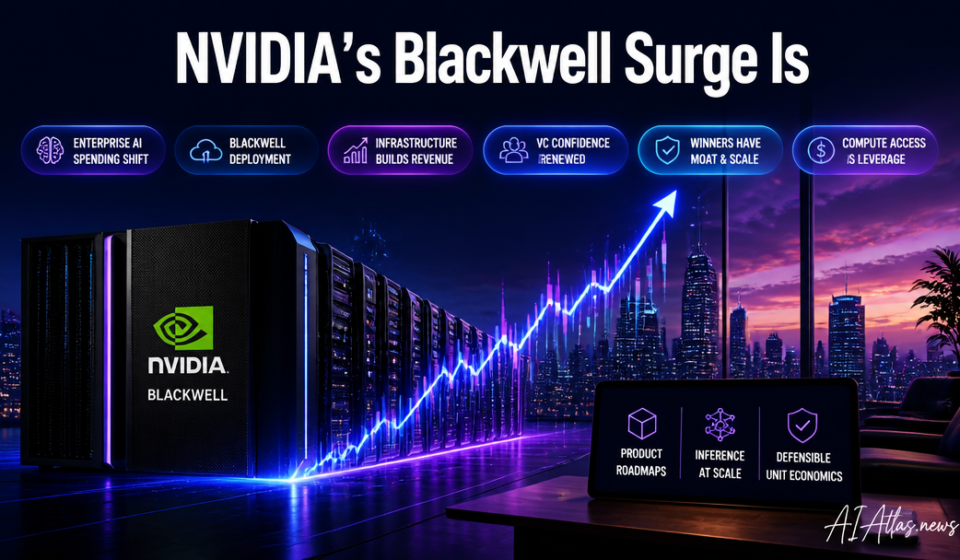
NVIDIA’s Blackwell Surge Is Not a Chip Story — It Is the Next Enterprise AI Spending Cycle
The Headline Truth
NVIDIA’s shares running to a fresh high after wide-scale Blackwell GPU shipments to major cloud providers isn’t just another “earnings moment”. In our view, it marks the point where premium AI compute stops being a marketing story and becomes a procurement reality. When hyperscalers move from limited allocations to broad roll-outs, the market treats it as capacity with a delivery date—not a future promise.
The key commercial detail is the phrase “wide-scale shipments”. That implies deployment across multiple availability zones, layered into enterprise onboarding processes, with enough volume that cloud providers can sell it as a reliable service tier. Benchmarks matter, but investors are ultimately underwriting infrastructure commitments: seats get booked, budgets get signed, and workloads get migrated.
Context Others Missed
Most coverage will focus on performance and supply. We think the more important layer is commercial throughput: the ability of cloud operators to operationalise next-gen accelerators into repeatable offerings. That includes capacity planning, scheduling policies, network topology, storage adjacency, and the billing constructs enterprises actually trust.
In our experience, enterprises do not pause experimentation because they doubt model capability. They stall because they can’t secure compute predictably—at the right price, with the right service levels, and within procurement timelines. Wide-scale Blackwell deployment compresses that gap. The market is reading it as the transition from “pilot-able AI” to “production-grade AI” at scale.
The Commercial Ripple Effect
Here’s the inflection point we’re seeing: enterprise AI budgets are moving from experimentation into infrastructure commitments. That matters because experimentation is elastic—teams can run small tests with minimal governance. Infrastructure commitments are not elastic; they force platform decisions, redesign workloads, and trigger multi-quarter spending patterns across data engineering, MLOps, security, and cost governance.
For cloud providers, the commercial upside is twofold. First, they can expand premium AI infrastructure offerings with credible availability windows. Second, they can reposition higher-margin services—managed training pipelines, inference orchestration, model hosting, and compliance-focused deployments—around a more dependable hardware base. For incumbents and start-ups, this availability window changes the competitive tempo: product pivots can accelerate because the compute bottleneck loosens.
Stakeholder Impact Analysis
Cloud providers: wider Blackwell shipments let them sell “capacity you can plan around”. That strengthens their ability to introduce differentiated tiers (latency, throughput, residency, and reserved capacity) without constantly re-quoting timelines. It also raises the pressure to tighten unit economics—because when capacity scales, customers compare costs more aggressively.
Enterprises: teams revisiting stalled AI programmes gain leverage to re-baseline timelines and re-open vendor selections. We expect renewed activity around document processing, coding assistants, forecasting, customer intelligence, and agentic workflows—provided the enterprise can control operational spend (GPU cost, token consumption, and observability) rather than treating compute as a blank cheque.
Incumbents: those with credible distribution (industry software, systems integrators, telecoms, fintech platforms) can accelerate AI product pivots—particularly where they must demonstrate measurable outcomes quickly. But they’ll face sharper scrutiny on cost-to-serve and model governance once adoption scales beyond sandbox pilots.
Venture investors and founders: compute availability improves the throughput of experimentation-to-deployment. Yet it also raises the infrastructure expectations of customers: if GPUs are more available, buyers will demand better performance-per-dollar, clearer cost accounting, and higher operational maturity from AI vendors. The winners will be those who translate compute into outcomes and margins, not just demos.
Strategic Comparison Table
To cut through the noise, we’ve mapped what changes commercially when wide-scale next-gen GPU capacity becomes accessible through enterprise cloud channels.
| Stakeholder | What becomes easier | What gets harder | Operator move to make now |
|---|---|---|---|
| Cloud providers | Quoting capacity with shorter lead times; scaling premium tiers | Unit economics pressure and tighter performance comparisons | Bundle compute with managed pipelines + clear cost governance |
| Enterprises | Re-starting production migrations; expanding workloads beyond pilots | Budget controls become a board-level concern | Adopt token/throughput monitoring and enforce workload prioritisation |
| Incumbent software firms | Accelerating AI feature rollout where compute was the constraint | Proving ROI and managing model lifecycle at scale | Standardise AI serving patterns and governance from day one |
| AI startups (inference & orchestration) | Faster time-to-integration with cloud offerings | Rising expectations on reliability, latency, and cost predictability | Quantify cost-to-serve; ship with observability and SLA discipline |
| Venture investors | More credible go-to-market signalling based on capacity availability | Greater scrutiny on margin structure and infrastructure dependency | Re-score portfolios on “compute efficiency + customer operational readiness” |
What we’d underline: compute availability helps everyone, but it doesn’t eliminate differences in operational execution. Once capacity is less scarce, buyers don’t pay for potential—they pay for throughput, reliability, and disciplined unit economics.
Visualised Market Response
The market response looks less like a pure hardware rally and more like a signal that the enterprise adoption cycle is tightening around infrastructure commitments.
Blackwell shipments expand across hyperscalers
Investor signal: Confirmation of real capacity
Availability horizon: Weeks–Months
Pilots convert into production workloads
Investor signal: Demand acceleration
Procurement posture: Shift to commitments
Premium tiers and managed services broaden
Investor signal: Margin competition intensifies
Customer focus: Cost-to-serve
Infrastructure expectations rise for vendors
Investor signal: Funding reallocation
Buyer bar: SLA + governance
Blackwell capacity becoming broadly available pushes the market from “can it work?” to “can it run profitably and reliably?” That’s why the stock move matters commercially.
Importantly, this won’t automatically lift every AI company. When compute becomes more obtainable, buyers will compare operating costs more ruthlessly. Startups that can’t articulate cost-to-serve, reliability engineering, and governance will feel the squeeze first—even if the underlying hardware supply improves.
Critical Market Risks
The upside is clear, but we can’t pretend the risks aren’t structural. First, capacity availability doesn’t guarantee affordability. If power constraints, networking bottlenecks, or allocation policies tighten elsewhere in the stack, enterprises may still experience quota friction—just later, and with higher effective prices.
Second, “next-gen” deployments can mask adoption risk. Production migrations involve compliance, data pipelines, evaluation harnesses, and model monitoring. If cloud providers expand availability faster than customers can operationalise governance, you get uneven uptake: spend rises, but churn risk increases for vendors who can’t prove operational durability.
Finally, investor mispricing remains a threat. A hardware-led rally can seduce funding into companies that merely benefit from better access to GPUs, rather than companies that convert access into superior economics, defensible distribution, and credible customer outcomes.
Conclusion and Future Outlook
NVIDIA’s share-price surge is the visible signal of a deeper commercial shift: enterprise AI budgets are graduating from experimentation into infrastructure commitments. Wide-scale Blackwell shipments to cloud providers change the adoption curve because they reduce the friction that historically delayed production—compute predictability, lead times, and service integration.
Going forward, our watchpoints are straightforward. For cloud providers: how quickly premium tiers translate into durable demand and healthier unit economics. For enterprises: whether teams build the cost governance and operational muscle required for sustained deployment. For startups and investors: whether the next wave of winners are defined by compute efficiency, reliability, and measurable ROI—not by benchmark enthusiasm.
Frequently Asked Questions
- Why does wide-scale Blackwell shipment matter more than benchmarks?
- It indicates capacity being operationalised through enterprise channels with predictable timelines. That’s what turns pilots into production budgets.
- Which AI startups are likely to benefit most?
- Those offering inference/training integration with clear cost-to-serve, observability, and SLA discipline. Better compute access raises the bar on operational maturity.
- What should investors reassess after this move?
- The infrastructure dependency and margin model of each company. With capacity improving, customers will demand stronger economics and governance.