
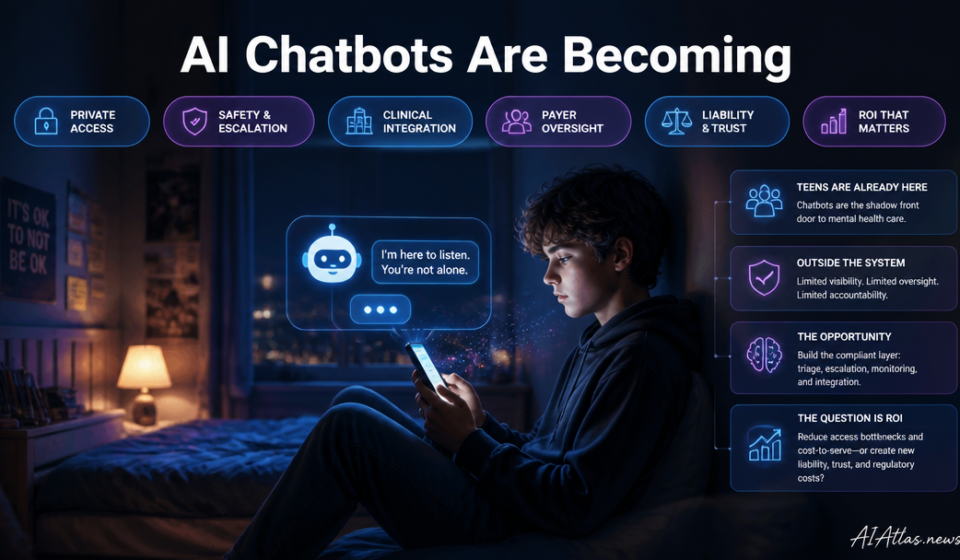
AI Chatbots Are Becoming the Shadow Front Door to Teen Mental Health Care
The Contrarian Thesis
We read the JAMA Pediatrics finding—nearly 1 in 5 U.S. adolescents and young adults seeking mental health advice from AI chatbots—as less about consumer curiosity and more about market behaviour under pressure. When the user base is already forming, the question stops being “will they try AI?” and becomes “who can turn hidden use into a governed clinical pathway?”.
Our contrarian stance is blunt: engagement metrics alone will not separate winners from losers. The companies that profit will be the ones that convert private, largely undisclosed chatbot interactions into safe, auditable, reimbursable, clinically useful workflows—inside a care system that is fragmented, under-resourced, and slow to change.
Flaws in Current Market Assumptions
In our experience, many pitch decks still assume AI adoption behaves like a typical digital product funnel: attract, retain, monetise. That assumption fails here. The JAMA result implies “shadow infrastructure”: support is being built outside traditional care pathways, outside payer oversight, outside parental visibility, and—crucially—outside liability frameworks.
We also see a second blind spot: teams often optimise for helpfulness rather than traceability. For mental health, traceability is not a bureaucratic extra. It’s the difference between a system that can demonstrate clinical reasoning, document user intent, record risk escalation, and support audit after an adverse event.
The Structural Shift
What’s happening is a structural re-routing of early help-seeking. Teens are already treating AI chatbots as an intake layer: they ask questions, rehearse disclosures, seek coping scripts, and—at the edges of risk—test whether anyone (or anything) will respond without judgement. Most then do not disclose use to anyone, meaning the “data exhaust” remains private, unmeasured, and unavailable to downstream care.
For operators and investors, the market warning is clear: demand is real, but it is currently ungoverned. This creates an opening for companies that can instrument consent, manage safety boundaries, and translate interaction signals into clinical artefacts—without waiting for users to volunteer the story after the fact.
Decision Framework for Capital Allocation
When we evaluate AI opportunities in regulated health markets, we start with one uncomfortable question: can this product be trusted by people who will be blamed if it goes wrong? If the answer is no, capital will be wasted. If the answer is “yes, with evidence”, we move to a workflow test.
Our capital allocation framework has four gates. First: safety governance (risk detection, escalation protocols, and documented limitations). Second: auditability (event logs, prompt/response provenance where appropriate, and clinician-accessible rationale). Third: interoperability (FHIR/HL7 integration, referral formats, and outcome reporting). Fourth: commercial legitimacy (payer or provider buying logic, not just user subscription demand).
Risk Assessment Table
Below, we compare five plausible go-to-market patterns against the commercial realities of youth mental health—especially where hidden usage is the starting condition.
| Business model (5-row comparison) | Safety & audit readiness | Disclosure/consent instrumentation | Reimbursable workflow fit | Main execution risk |
|---|---|---|---|---|
| Engagement-first chatbot | Low | Minimal | Unclear | Safety opacity + liability exposure |
| Consumer mental health companion | Medium | Some | Limited payer pull | Low clinical integration depth |
| Provider-embedded triage assistant | High | Structured consent prompts | Moderate (pilot-ready) | Workflow adoption by clinicians |
| Payer-integrated care navigation layer | High | Granular permissions | High (outcomes + reporting) | Long sales cycles + reporting burden |
| Community-to-clinic continuity programme | Medium-High | Coordinated outreach | Moderate-High (partner reimbursement) | Fragmented partners + data sharing friction |
Our judgement is that the winning patterns are those that can survive scrutiny after a bad week—not just those that sound empathetic on a good day. The JAMA finding effectively hands you a segmentation clue: the market already has “unseen need”; your product must make that need safe to translate.
Visualised Impact Matrix
We think you can visualise competitive advantage as the intersection of two capabilities: (1) instrumented trust (consent, disclosure, escalation discipline) and (2) clinical/commercial translation (auditable artefacts that providers and payers can use).
We expect early “AI mental health” winners to consolidate around Quadrant D. The reason is economic: payers and providers will only fund what they can measure, justify, and defend.
Strategic Recommendations for Leaders
First, design for disclosure conversion. Hidden usage is a starting point, not a marketing opportunity. Build low-friction consent flows that let young people decide what can be shared, with whom, and for what purpose—alongside clear explanations of safety escalation.
Second, ship clinical artefacts, not just conversations. Providers need structured outputs: risk tiering, symptom themes, crisis triggers, previous coping strategies attempted, and a referral-ready summary. If your system can’t produce that with audit trails, you are not integrating—you are merely interviewing.
Third, negotiate distribution through workflow, not through virality. School counsellors, youth services, urgent care networks, and behavioural health groups should be treated as distribution partners with shared accountability, not as “channels” to farm engagement.
Future-Proofing the Business Model
The long-term business advantage will come from compliance-as-infrastructure. That means documented model behaviour boundaries, safety evaluation over representative cohorts, and clear escalation paths. It also means preparing for regulatory expectations around medical device software, health data protections, and adverse-event reporting—so the company survives once scrutiny arrives.
We are also watching the reimbursement trend closely: funding will likely attach to outcomes, utilisation reduction, and safer triage. If you can’t demonstrate that your workflow improves access time, reduces escalation incidents, or strengthens follow-up rates, you will struggle to move beyond pilots.
Frequently Asked Questions
- Is this really evidence that teens want “mental healthcare”, or just a new chatbot habit?
- The study suggests need-seeking behaviour is present, but it’s happening outside traditional care pathways—so business value depends on how you translate that need into governed workflows.
- Why is “most users don’t disclose” such a big commercial issue?
- Because unreported use produces unmeasurable outcomes and ungoverned risk; without instrumentation and consent, providers and payers can’t confidently adopt the system.
- What should an investor demand before backing a youth mental health AI startup?
- Evidence of safety escalation, auditability, interoperability (e.g., FHIR-style artefacts), and a clear reimbursement or provider workflow pathway.