
The Sleep Apnea Microbiome Breakthrough Is Really a Cardiometabolic Drug Discovery Signal
The Contrarian Thesis
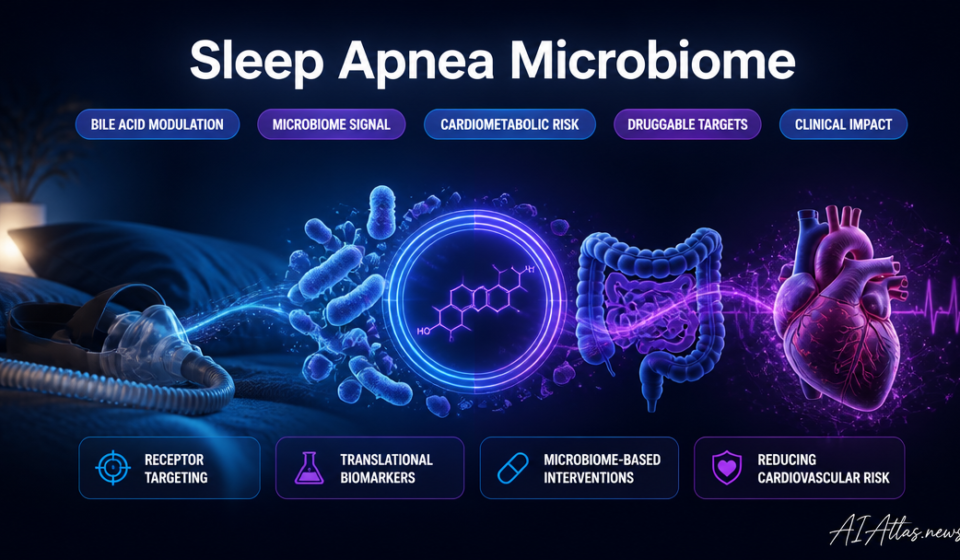
At ASM Microbe 2026, the headline is less “sleep apnea causes disease” and more “microbes may buffer the downstream cardiometabolic hit”. The mechanism on offer—microbiome-mediated modification of bile acids that then reduces cardiovascular and metabolic damage in mice—matters commercially because it points to biology we might be able to steer, not just symptoms we might be able to soften.
We would frame this less as a sleep-disorder story and more as an early signal: microbiome-driven bile acid modulation could become a commercially relevant pathway for cardiovascular-risk reduction in a high-prevalence chronic care population. That is the real bridge we are watching—between microbiome biology, cardiometabolic disease, and a market where existing interventions still underperform due to adherence drag, diagnosis gaps, and incomplete risk reduction.
Flaws in Current Market Assumptions
We keep seeing a recurring investment shortcut: “microbiome” is treated as a single category, then underwritten with the expectation that any stool-adjacent intervention will generalise across patients. In our experience, fundable programmes fail when they cannot translate mechanism into a reliable responder profile, and when stakeholders cannot agree on what “success” means early enough to de-risk funding.
There’s also a payer reality check that gets ignored. Cardiovascular and metabolic endpoints are slow; sleep apnea screening is patchy; and risk reduction is rarely attributed correctly in claims data. So even if the biology is plausible, the commercial pathway can stall unless the team designs around the operational bottlenecks from day one—diagnostics, endpoints, and reimbursement logic.
The Structural Shift
The ASM Microbe work is valuable not because it grants near-term clinical certainty, but because it identifies a plausible bridge: bile acid modulation → receptor-level effects → reduced cardiometabolic damage. Importantly, “targeting specific bile acid receptors” converts a diffuse microbiome hypothesis into a tractable therapeutic strategy—one that can be addressed by medicinal chemistry, antagonist/agonist logic, or engineered delivery systems.
For business leaders, the commercial implication is that we may be moving from “community reshaping” to “pathway steering”. That changes what you can ask regulators, payers, and clinicians to evaluate. It also changes how AI can contribute: not by predicting hype, but by accelerating mechanistic hypothesis testing—identifying receptor targets, mapping patient metabolomic signatures, and stratifying trial cohorts likely to show measurable effects.
Decision Framework for Capital Allocation
The business question is not “will microbiomes help sleep apnea?” It’s “can we build a repeatable, reimbursable route to cardiometabolic risk reduction using bile-acid biology—without betting the farm on perfect science or perfect adherence?” We use a five-factor screen to decide where capital can compound versus where it mostly burns.
| Approach | Time to first proof | Mechanistic confidence | Clinical/ops feasibility | Reimbursement path clarity | AI leverage (practical) |
|---|---|---|---|---|---|
| Specific bile acid receptor modulator (drug) | 6–18 months | High (pathway-linked) | Moderate (needs biomarkers) | Moderate–High | Target mapping, responder stratification |
| Clinically used bile acid class agents (repurpose/optimise) | 3–12 months | Medium (mechanism may vary) | High (known safety) | Moderate | Subgroup discovery, endpoint design |
| Engineered microbiome or consortia (precision) | 12–30 months | Medium (host variability) | Moderate (manufacturing/traceability) | Low–Moderate | Strain/omics matching, process QC |
| Dietary or lifestyle bile-acid modulation | 3–9 months | Low–Medium (signal dilution) | Low–Moderate (adherence) | Low | Adherence prediction, personalised plans |
| Digital monitoring + risk stratification (adjunct) | 2–6 months | Low (not a direct modulator) | High (distribution) | Moderate (care improvement claims) | Patient selection, workflow optimisation |
Risk Assessment Table
Mechanistic plausibility is necessary but not sufficient. In our experience, the commercial failure modes cluster around four areas: biology that doesn’t generalise, biomarkers that don’t stabilise, trials that miss the right endpoints, and reimbursement narratives that can’t withstand scrutiny. This is where you separate “interesting science” from investable delivery.
| Risk | Commercial impact | Likelihood | Mitigation we demand |
|---|---|---|---|
| Inter-species translation gap | Wasted lead asset cycles | High | Human bile-acid receptor engagement studies early |
| Responder heterogeneity | Weak effect size → poor payer uptake | Medium–High | Pre-specified metabolomic/omics responder stratification |
| Biomarker drift & assay inconsistency | Claims disputes; trial readout instability | Medium | Analytical validation, standardised sampling cadence |
| Endpoint misalignment | Regulatory delay; unclear clinical utility | Medium | Choose intermediate endpoints linked to cardiometabolic risk |
| Competitive crowding | Price pressure, differentiation loss | Medium | Mechanism + cohort + delivery differentiation must be explicit |
Visualised Impact Matrix
Operator read: we rate receptor-targeted pathways as the most fundable translation route, but only when biomarker strategy and cohort definition are built in—rather than appended later.
Strategic Recommendations for Leaders
First, treat bile-acid receptor targeting as an “evidence-to-reimbursement” programme, not a biology poster. That means demanding early demonstrations of receptor engagement, measurable downstream changes, and stable biomarker readouts that can survive routine clinical sampling—not just controlled lab conditions.
Second, stop outsourcing patient selection to the end of the roadmap. If sleep apnea patients are heterogeneous (and they are), then your differentiation will come from cohort definition and risk stratification. We would expect AI-enabled metabolomic patterning and receptor-linked signatures to become the quiet competitive advantage—because they shorten the path from mechanistic plausibility to statistically persuasive outcomes.
Future-Proofing the Business Model
We are wary of “single-asset” thinking in microbiome-adjacent work. The durable play is a platform that can (a) identify receptor-relevant pathways, (b) generate responder cohorts, and (c) run adaptive trials with faster learning cycles. That platform can then support multiple indications in cardiometabolic disease where bile acid biology and risk pathways overlap.
Finally, leaders should design for how payer strategy actually works: start with intermediate endpoints that map onto cardiovascular risk trajectories, and prepare the documentation needed for reimbursement conversations. In our experience, the firms that win are not the ones with the most intriguing mechanism—they are the ones with the cleanest path from mechanism to measurable, billable benefit.
Frequently Asked Questions
- This study’s commercial signal is mainly mechanistic: it points to bile acid receptors as a potentially targetable lever rather than a vague microbiome effect. That matters because receptor-level targets are easier to trial, dose, and position for reimbursement.
- We would not assume near-term clinical certainty. The investable step is early human pathway validation—receptor engagement, biomarker stability, and responder stratification that can translate into credible risk reduction endpoints.
- AI’s strongest role here is not “predicting outcomes” in the abstract. It’s accelerating target mapping and building metabolomic cohort selection to reduce heterogeneity and shorten the time to decision.