IBM’s ‘Control Gap’ Warning Is the Enterprise AI Adoption Story Executives Can’t Ignore
The Contrarian Thesis
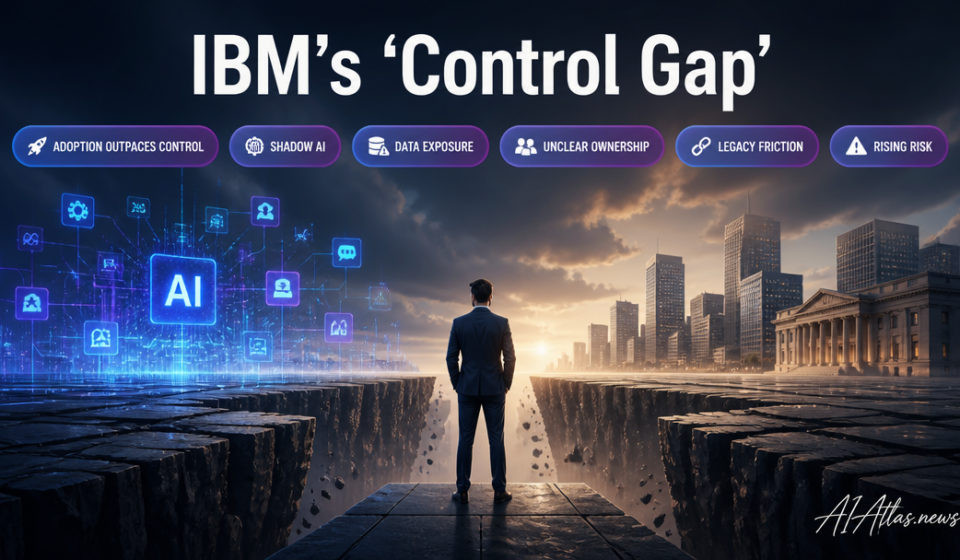
We’ve seen enterprise AI spending accelerate for long enough that the conversation has quietly changed: it’s no longer “can we deploy?” but “who exactly is on the hook when the system behaves like a stranger?”. IBM’s Institute for Business Value reports that roughly two-thirds of surveyed CIOs and CTOs say they are accountable for AI systems they do not fully control. In our experience, that’s not a governance gap in the abstract—it’s an operating crisis forming in real budgets, real SLAs, and real board-level risk discussions.
Our contrarian view at AI Atlas News is simple: the next wave of competitive advantage won’t belong to the firms with the flashiest automation demos. It will belong to companies that make AI systems legible in production—through governance ownership, technical observability, compliance artefacts, and disciplined integration with legacy processes. Speed is already commoditising; control is not.
Flaws in Current Market Assumptions
The market still treats AI adoption as a linear journey: experiment, scale, standardise. But IBM’s “control gap” finding suggests a more accurate model: deployment outpaces governance maturity, and accountability lags behind system control. That’s why leaders are suddenly accountable for outcomes they can’t fully predict, monitor, or remediate—especially when models are updated, vendors swap components, or business units deploy “helpful” AI with minimal oversight.
We also think the hype around “responsible AI” has misled buyers into paying for policy documents rather than operational mechanisms. A code of conduct does not provide lineage. A checklist does not produce audit-ready evidence. And a model card does not tell you why revenue recognition workflows changed last Tuesday. When oversight is missing, failure modes stop being technical and start being commercial: contract disputes, regulatory exposure, reputational damage, and internal trust collapse.
The Structural Shift
What IBM is describing is the moment AI stops being a programme and becomes infrastructure. The enterprise isn’t adopting a single model; it’s embedding decisioning capability across customer service, procurement, risk, marketing, engineering support, and back-office workflows. Each embedding creates a new dependency chain—data pipelines, identity and access, workflow orchestration, monitoring, incident response, and legacy system behaviour.
And that’s where the structural shift bites: integration friction and governance maturity move on different timelines. Business teams want outcomes now. Platforms want to standardise later. Procurement wants vendor assurances, but operational teams inherit the messy middle—shadow deployments, inconsistent prompts, unclear ownership of model updates, and observability that stops at “it ran”. The crisis isn’t that organisations lack AI talent; it’s that they lack an operating model for AI at scale.
Decision Framework for Capital Allocation
If we’re investing time and money right now, we should fund capabilities that reduce “time-to-legibility”: how quickly you can tell what the system did, why it did it, and who controls it. We recommend framing AI spend as control and integration work dressed up as innovation. The ROI case is straightforward: fewer production incidents, faster incident resolution, lower audit friction, and fewer expensive reversals when AI-driven decisions hit revenue or compliance.
Below is the comparison lens we use to separate genuine operational value from feature-driven selling.
| Spend category | Primary promise | What buyers actually need | Commercial upside | Hidden cost |
|---|---|---|---|---|
| Model-centric pilots | Better accuracy fast | Production ownership model, rollout gates | Early wins without operational debt | Orphaned decisions once scaled |
| Governance-first tooling | Policy and approval workflows | Accountability mapping + evidence generation | Audit-ready operations; fewer board escalations | Integration time with enterprise systems |
| Observability & audit | Traceability of outputs | End-to-end lineage, monitoring, incident hooks | Lower downtime and faster remediation | Data instrumentation overhead |
| Compliance & risk workflows | Regulatory coverage | Controls that map to business processes | Reduced regulatory and litigation exposure | Over-documentation without operational enforcement |
| Legacy integration enablement | Fewer barriers to deployment | Stable interfaces, versioning, and fallback paths | Higher adoption without chaos | Maintenance burden if poorly abstracted |
Risk Assessment Table
The “control gap” translates into predictable commercial risks. In our experience, the costliest failures are not always accuracy-related—they’re ownership-related (who can change what), observability-related (what you can prove after the fact), and integration-related (how quickly you can stop harm when the system drifts).
Use this table as a starting point to pressure-test proposals from vendors and internal AI product teams. If a plan doesn’t move these risk levers, it’s not ready for production-scale spend.
| Risk | What it looks like | Likelihood under fast scaling | Impact on the business | Mitigation that actually works |
|---|---|---|---|---|
| Orphaned accountability | Teams deploy AI without clear system owners | High | Board escalation; stalled rollouts | Named ownership + change-control gates per workflow |
| Unprovable outcomes | Audits can’t reconstruct why decisions happened | Medium-High | Regulatory and contractual disputes | Evidence pipelines: lineage, logs, and decision trace |
| Silent drift | Performance degrades after data or prompts change | High | Revenue leakage; customer churn | Monitoring tied to business KPIs + rollback mechanisms |
| Integration fragility | AI fails because legacy interfaces can’t cope | Medium | Operational downtime; workarounds spread | Versioned adapters + graceful fallback paths |
| Vendor change risk | Model/system updates happen without your control | Medium-High | Unplanned re-certification and retraining | Formal update policies + pre/post impact testing |
Visualised Impact Matrix
To navigate the operating crisis, we think leaders should treat AI deployment like a portfolio: some initiatives can absorb ambiguity; others can’t. The 2×2 below maps where funding tends to create value versus where it tends to amplify chaos.
We’re deliberately using “deployment speed” and “control maturity” as axes because IBM’s findings are, at heart, an asymmetry between how quickly systems land in workflows and how quickly organisations can govern, observe, and integrate them.
Vertical axis: Control maturity (Low → High)
Strategic Recommendations for Leaders
First: stop treating “governance” as a compliance department deliverable. We want governance to be a runtime property—embedded into how changes are approved, how evidence is captured, and how systems are monitored. That means defining system ownership for every AI-enabled workflow, even if the model comes from a third party. IBM’s finding about accountability without control should be used as a forcing function in internal operating reviews.
Second: invest in observability as if it were production uptime. Many vendors sell dashboards; fewer provide traceability that ties a decision back to data sources, prompt versions, model versions, and business rules. If you can’t reconstruct the “why” quickly, you don’t have operational control—you have guesswork with a delay.
Third: fund legacy integration early, not after the pilot fails. The integration layer determines whether you can enforce permissions, apply business constraints, and roll back safely. For buyers, this is also a procurement discriminator: teams should ask vendors what happens when their system degrades, how versioning works, and how quickly you can pause harm. If the answer is “we’ll investigate,” you’re already paying with risk capital.
Future-Proofing the Business Model
For investors and startup founders, the commercial opportunity is clear but narrow. We think the next winners will not merely improve model performance; they will sell the operational spine enterprises need: governance orchestration, audit-grade observability, compliance evidence automation, and integration tooling that behaves predictably in messy environments.
That also changes how we view funding. When a startup claims it will “accelerate adoption,” we look for proof that it reduces control friction: faster evidence capture, measurable reduction in incident time-to-triage, and credible integration pathways with legacy systems and existing security frameworks. If your product doesn’t shorten the legibility cycle, it will struggle against platforms that do—and against buyers who are now wary of owning what they can’t control.
Finally, for CIOs, CTOs, and board stakeholders, the lesson from IBM is not to slow innovation. It’s to align deployment speed with control maturity. The competitive advantage will be earned by organisations that can scale responsibly without turning every incident into an investigation, and every audit into a scramble. That’s where the next phase of enterprise AI spending will concentrate.
Frequently Asked Questions
- What does the “control gap” mean in commercial terms?
- It means leaders can be held accountable for AI outcomes without having sufficient runtime control, evidence, or rollback capability. The cost shows up as slower remediation and higher regulatory and reputational exposure.
- Which capabilities should enterprises prioritise first?
- We prioritise governance ownership with enforced change control, end-to-end observability for decision traceability, and integration tooling with legacy workflows. These reduce the time-to-legibility when things go wrong.
- How should investors evaluate AI startups in this phase?
- Focus on measurable operational leverage: audit-grade evidence generation, incident triage speed, and stable integration/versioning. Features that only improve model quality without reducing control friction will face slower adoption.