
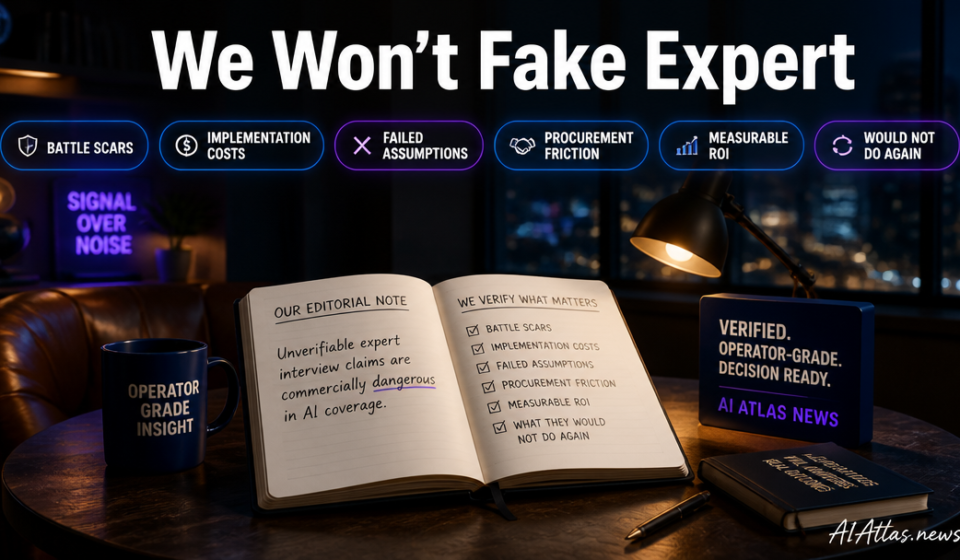
Why We Won’t Fake Expert Interviews Just to Chase the AI News Cycle
Editorial note (standards and accountability): We’ve noticed a recurring commercial failure mode in AI coverage: “expert interviews” that sound precise, reference proprietary-sounding evaluation work, and imply imminent capability jumps—yet they cannot be independently verified. When leaders build budget, procurement timelines, and product roadmaps on unverifiable interview claims, they don’t just risk missing a feature. They risk buying the wrong vendor, contracting the wrong unit economics, and reorganising teams around assumptions that collapse in the first real integration.
So this piece is deliberately not a recap of any specific 2026 interview. Instead, it’s a decision framework and editorial caution: how serious operators should interrogate interview-based intelligence. If you can’t ask for battle scars, implementation costs, failed assumptions, and measurable evidence, you should treat the commentary as marketing—not intelligence.
The Contrarian Thesis
In our experience, the biggest trade-off in rapid AI advancement isn’t model quality—it’s information quality. When progress is fast, the market is flooded with confident narratives. But narratives are cheap; verification is expensive. The result is a leader’s classic misallocation: capital spent on “certainty theatre” rather than on measurable reduction of operational risk.
We’re seeing a new kind of commercial fog: interview-led certainty masquerading as due diligence. The problem is not that experts are lying; it’s that they’re often describing outcomes under conditions that don’t map to your environment—your data hygiene, your integration constraints, your compliance posture, your throughput requirements, and your buyer tolerance for failure during rollout.
Flaws in Current Market Assumptions
The most common flawed assumption is that capability progress automatically translates into cost progress. In practice, unit economics are shaped by deployment realities: retrieval quality, prompt orchestration overhead, evaluation harnesses, monitoring, latency budgets, human-in-the-loop escalation, and failure-mode handling. An interview can sound like “it works”, while your organisation must still pay for “it works repeatably”.
A second assumption is that “evaluation” mentioned in an interview is equivalent to evaluation you can replicate. Many teams cite benchmarks without disclosing how data was sampled, how leakage was prevented, what guardrails were applied, and how drift was handled. We treat these omissions as commercial red flags: if the evidence cannot survive replication, your risk remains unpriced.
The Structural Shift
AI has moved from experimentation to procurement. That sounds obvious, but the structural consequence is less discussed: procurement changes the nature of uncertainty. Early-stage tests tolerate ambiguity; contracts and operational commitments do not. Once you choose a deployment pattern (vendor API vs private infrastructure, batch vs streaming, supervised vs self-improving loops), you also lock in costs, governance, and failure handling. Interview-based “future confidence” can therefore become an immediate operational constraint.
We’re also seeing that the competitive moat is shifting away from raw model access and towards repeatable production engineering: evaluation coverage, incident response playbooks, audit trails, and distribution of accountability across product, security, legal, and operations. In that world, the person who can describe how they handled a production incident—even if it embarrassed them—is far more valuable than the one who can recite roadmap rhetoric.
Decision Framework for Capital Allocation
When leaders rely on interview intelligence, we recommend a verification-first framework. Before capital is committed, force every claim through a “replicability chain”: evidence that can be re-run, costs that can be modelled, and assumptions that can be stress-tested against your constraints.
Practically, we ask four questions for any vendor claim, benchmark story, or implementation anecdote:
- Battle scars: What broke in production, how often, and what did it cost?
- Implementation cost: What was the real spend beyond licences (integration, data prep, monitoring, eval tooling, governance)?
- Failed assumptions: Which expectation turned out wrong (accuracy, latency, user behaviour, safety thresholds, tooling maturity)?
- Procurement fit: What terms are required to de-risk (SLAs, audit rights, data handling, exit clauses, pricing predictability)?
Risk Assessment Table
Below is a comparison table we use internally to translate “sounds credible” interview signals into a disciplined risk view. The scoring is heuristic (1–10) purely to force consistency; it should be adjusted to your risk appetite and regulatory environment.
| Interview signal (what’s said) | Commercial risk if wrong | Validation test (what you require) | Evidence threshold | Owner to interrogate |
|---|---|---|---|---|
| “It’s accurate enough for production.” | High: rework, churn, regulatory exposure | Request failure taxonomy + eval dataset + drift plan | Replicable metrics over time, not one-off scores | Head of Product + QA Lead |
| “Latency will be fine at scale.” | Medium–High: SLA breaches, user abandonment | Workload profile, worst-case latency, caching strategy | Measured p95/p99 across realistic traffic patterns | CTO/Platform Lead |
| “We’ll be able to cut costs quickly.” | High: budget overruns, margin compression | Unit economics model with guardrail + eval overheads | Cost curves tied to utilisation and quality targets | Finance + Ops |
| “Safety is handled.” | High: compliance incidents, reputational damage | Incident history, red-team results, monitoring coverage | Documented controls, escalation paths, audit logs | Security + Legal |
| “Pricing is predictable.” | Medium: procurement renegotiation late in cycle | Exit clause terms, rate limits, overage policy, indexation | Contractual predictability + scenario modelling | Procurement + Counsel |
Visualised Impact Matrix (div)
Interviews often tell you what might work but not how quickly you can de-risk it. This impact matrix helps leaders decide where to spend verification effort first—because verification is the scarce resource.
Strategic Recommendations for Leaders
For entrepreneurs and investors, the temptation is to outsource judgement to “experts” whose incentives reward attention, not verification. We recommend building a procurement-grade evidence pack before fundraising pivots or customer commitments. If the story can’t be operationalised into an eval plan, a cost model, and a governance workflow, it’s not investor-ready intelligence—it’s pitching material.
For business leaders adopting AI, treat implementation capability as a core diligence target, not an afterthought. Ask how evaluation is run (and by whom), what the rollback plan is, how failures are monitored, and how the system behaves under distribution shift. If the interview focus is mostly on model performance in idealised settings, refocus on production realities: data pipelines, latency budgets, and accountability.
- Vendor selection: prioritise teams that can disclose failure modes and remediation costs.
- Startup positioning: align your narrative to integration effort and measurable outcomes, not broad claims.
- Capital allocation: stage investment by verification milestones, not by “confidence levels”.
Future-Proofing the Business Model
In the next phase, competitive advantage will come from operational learning speed: how quickly you detect drift, improve evaluation coverage, and reduce the cost of safe failure. That means your business model must budget for continuous measurement and governance—not just initial deployment. Interviews that ignore long-term running costs are not merely incomplete; they bias leaders towards underfunded systems.
We also believe procurement strategy will matter more than model choice. Contracts that clarify responsibilities for incident handling, auditability, and data usage will outperform “best-effort” agreements when something inevitably goes wrong. Future-proofing is therefore partly legal and operational: build exit ramps, monitoring obligations, and evidence retention from day one.
Frequently Asked Questions
- If an expert’s interview claims can’t be verified, should we ignore it entirely?
- Not necessarily. We use it only as a hypothesis to design a proof with replicable evaluation and to surface what evidence is missing.
- What is the single strongest question to ask during vendor interviews?
- Ask for battle scars: what failed in production, how often, and what the remediation cost was. It’s the fastest way to distinguish engineering maturity from marketing confidence.
- How should investors stage capital when AI capability promises are moving quickly?
- Invest by verification milestones: eval harness readiness, measurable pilot outcomes, and procurement-grade cost/governance models. Avoid funding narratives that can’t survive replication.