
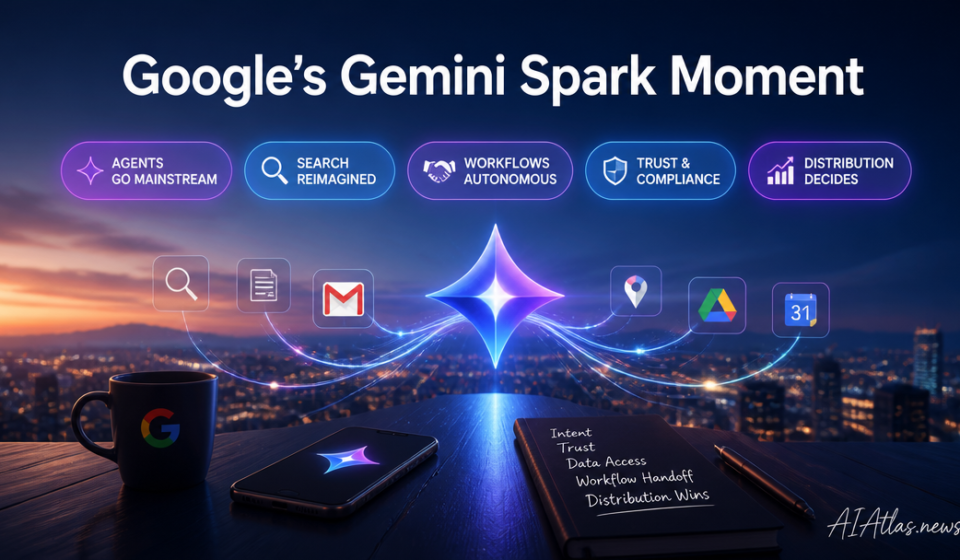
Google’s Gemini Spark Moment: AI Agents Move From Demo Theater to Distribution War
Strategic Objective
We’ve seen Google I/O 2026 framed as “new features”. In our experience, it’s better read as a distribution reset. Gemini Spark agents, the redesigned AI-first Search experience, and Android XR smart glasses with iPhone compatibility all point to one commercial reality: assistance is becoming persistent across search, devices, and daily workflows. That persistence will redraw budgets, attention, and power between creators, platforms, and commerce.
The consequence we’re watching is not whether “AI answers replace links” — that’s already half-true in many categories. The real prize goes to who controls the workflow state: what the agent knows, what it can do, and where transactions get executed. If Google moves consumers from query → decision via agentic steps, then SEO becomes less about rankings and more about being legible inside those steps. If ads become fewer, higher-intent moments in an agent-led journey, then ad economics will compress toward measurable outcomes and away from cheap clicks. And if the default assistant spans phones, XR, and enterprise systems, startup distribution will depend less on “getting indexed” and more on being reachable through the agent’s available tools.
Prerequisite Checklist
Before you spend a penny on “agentic SEO” or bespoke copilots, we insist on five prerequisites. Not because they’re fashionable, but because agent-driven systems amplify weak fundamentals: messy data, unclear authority, and uninstrumented outcomes. The platforms reward interoperability; your organisation must be ready for it.
Here’s what we’d validate in week one — with evidence, not slides:
- Answer-readiness: Do you have structured sources that can be cited or summarised without hallucination risk? (FAQs, product specs, policies, case studies with dates.)
- Intent mapping: Can you classify what customers want at each stage (research, comparison, procurement, usage, compliance)?
- Tool permissions: If an agent asks to act (check status, book, estimate, onboard), do you have APIs/workflows ready?
- Measurement discipline: Are you tracking not just traffic, but conversions by channel and by assisted journey stage?
- Brand safety and governance: Do you have content review, escalation, and refusal rules that agents can follow?
Sequence of Operations (Steps 1-5)
We recommend a deliberate build order. Agentic Search rewards momentum only after you’ve removed failure modes that generate rework. The goal is to make your brand a reliable input to autonomous decision-making, not a hopeful mention in an AI answer.
Follow these steps:
-
Audit your “agent footprint” across the journey.
Identify where your customers currently discover you: organic listings, comparison pages, app stores, marketplaces, support portals, and sales enablement. Then map what an agent would need at each moment. -
Convert key assets into machine-consumable form.
For each high-intent topic, publish or refactor: structured product/service pages, decision guides, warranty/service terms, and “how to choose” content. Ensure every claim has a provenance trail. -
Instrument assisted conversions end-to-end.
Add event tracking for lead capture, quote requests, onboarding completion, and purchase intent. Build attribution models that can handle reduced click-through and increased summarisation. -
Integrate with the actions agents expect.
Where it matters commercially, ship the minimum viable capabilities behind APIs: availability checks, pricing/estimates (even if range-based), scheduling, document submission, and status retrieval. -
Run “agent simulation” tests before scaling spend.
Test representative prompts and workflows against the outputs you can influence. Score responses for factuality, citation quality, and conversion pathway clarity. Then iterate.
Common Failure Points
We keep seeing the same spend-killers. The first is confusing “being mentioned” with “being chosen”. Agentic Search can summarise you without providing a clean route to purchase, and that won’t show up as a traffic spike. The second is building agent features before you harden your underlying content, data, and permissions.
Here are the most frequent pitfalls we’d avoid:
- Treating SEO as a content-only problem: In agentic journeys, visibility includes actionability (forms, APIs, availability, policies).
- Chasing generic prompts: You need intent-level coverage, not volume-level coverage.
- Ignoring measurement redesign: If CTR drops, your dashboard must change or you’ll misallocate budget.
- Over-automating without governance: One inconsistent answer can contaminate brand trust and trigger internal escalation loops.
- Waiting for platform features: You can’t control when Google rolls out behaviours, but you can control data quality and workflow readiness now.
DIY vs Outsource
When this wave hits, founders will be tempted into “let someone else handle it”. In our view, the right decision depends on where your organisation sits on three axes: internal data maturity, engineering bandwidth, and tolerance for experimentation. Below is a pragmatic comparison for agent-readiness work (not just marketing copy).
| Dimension | DIY | Outsource |
|---|---|---|
| Agent footprint audit | You learn your journey states deeply; slower start | Faster baseline; risk of shallow context transfer |
| Data structuring and provenance | Best control; requires internal editorial discipline | Quicker templates; governance must be enforced in-house |
| API/tool readiness | Higher engineering overhead; strongest long-term leverage | Short-term delivery; long-term dependency risk |
| Measurement redesign | Works best when your analytics team owns it | Useful if they map attribution to your KPIs early |
| Iteration cadence | You can move weekly; requires internal decision speed | Iteration can slow due to hand-offs and approvals |
The operator judgement we apply: do the audit and governance internally, outsource the boring tooling only if you can enforce standards. If you outsource decision ownership, you’ll lose the very capability that becomes a competitive moat: dependable workflow state.
Visualised Workflow Roadmap
We treat agent-readiness like a production system. You don’t “launch and hope”; you progress through proof, coverage, and automation — with checkpoints that stop you paying for mistakes twice. The roadmap below is our recommended operating cadence for teams adopting an agent-led Search and assistance layer.
Audit agent footprint & intent map
Structure assets + provenance
Instrument assisted conversions
Ship minimum viable agent actions
Commercially, this matrix matters because agentic Search turns quality into routing. If you can’t be reliably cited, you’ll get summarised away. If you can’t be acted upon, you’ll get presented — but never chosen. We’d rather you be chosen fewer times, with higher conversion quality, than visible everywhere and paid for everywhere.
Verification & Success Metrics
We define success as measurable improvement in decision outcomes, not more impressions. Agentic Search can reduce the number of sessions that “look like” traditional traffic. Your metrics must adapt to assisted discovery and agent-mediated conversion.
Use these verification gates:
- Answer accuracy rate: proportion of agent responses that correctly reference your structured claims.
- Citation quality score: whether your brand is referenced with the right scope and recency.
- Assisted conversion rate: conversions where a brand touch appears within the agent-mediated journey window.
- Time-to-action: median steps from recommendation to quote/demo/checkout.
- Cost per outcome: revised from CPC/CPA to measured lead/procurement events.
If you can’t compute at least the first two gates, you’re not ready to scale the rest. Most founders fail here by treating “AI Search visibility” as a vague brand metric rather than a controllable system input.
The Long-Term Maintenance Plan
Distribution resets don’t stop after launch. They harden. Google’s move toward persistent assistance means your content cadence, API reliability, and governance policies will become part of your operational rhythm, like security updates or tax filings. Ignore maintenance and your “agent legibility” decays quietly — until competitors look more dependable.
Our long-term plan focuses on three loops:
- Content stewardship loop: review structured assets quarterly; attach versioning, effective dates, and change logs.
- Action reliability loop: monitor API uptime, response correctness, and failure modes that agents could misunderstand.
- Experiment loop: run monthly prompt/workflow suites; compare conversion pathway changes when the platform updates behaviours.
Enterprise adoption will follow the same pattern: procurement teams will ask how you keep answers current, how you govern automation, and how you prevent unsafe or stale guidance. Investors should underwrite this as an operational capability, not a one-off growth sprint.
Frequently Asked Questions
- Will agentic Search completely replace traditional SEO?
- No. It will shrink the value of ranking-only strategies while increasing the value of answer-readiness, provenance, and actionability. In practice, SEO becomes less about where you appear and more about how confidently an agent can use you.
- What should startups prioritise first: content, data, or integrations?
- Start with content/provenance for your highest-intent topics, then instrument assisted conversions, then add the minimum agent actions that remove friction. Skipping measurement makes integration spend harder to justify.
- How will ad economics change under agent-led journeys?
- We expect fewer “open web” click moments and more high-intent outcomes mediated by assistants. Budget will likely shift toward formats and landing experiences that perform under summarisation and directly support next actions.