



Beyond the Prompt: Why Veeso AI’s Editable Design Shift Matters for Enterprise
The Strategic Objective
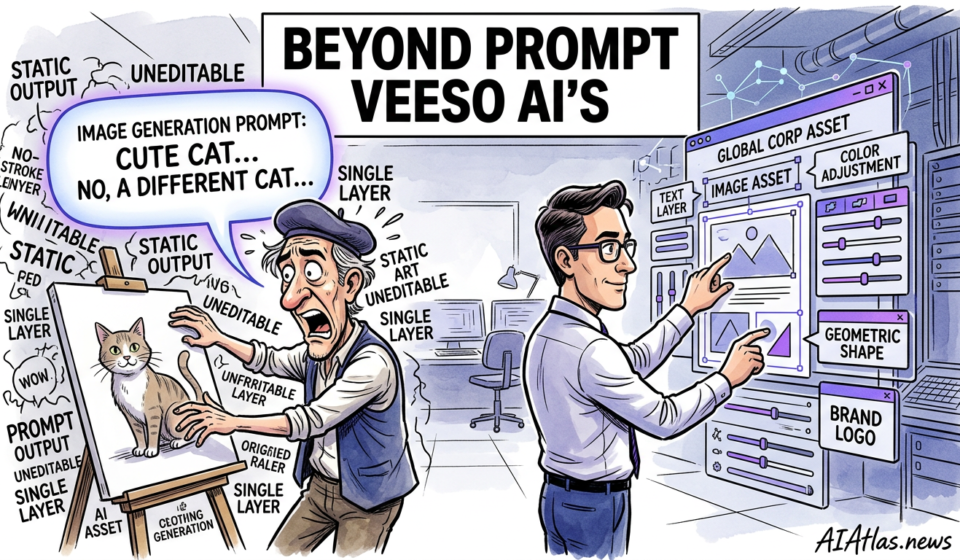
In our experience evaluating thousands of enterprise workflows, the initial fascination with text-to-image generators has masked a fundamental operational flaw: flat files are commercially useless. Creative directors and agency founders have burned millions in billable hours attempting to prompt-engineer their way to final, client-ready deliverables. The reality is that commercial-grade asset integration requires post-generation customisation, rigorous typography alignment, and pixel-perfect composition adjustments that single-layer visual outputs simply cannot accommodate. Producing a stunning concept is trivial; embedding it into a scalable production pipeline is where most businesses fail.
What we are seeing with platforms like Veeso AI is a necessary maturation of the medium. By moving beyond traditional text-based interfaces to offer workspaces that generate editable, layer-based design files, the technology finally meets the professional standards of working art directors. This shift from creative novelty to enterprise utility means teams can isolate elements, manipulate lighting on distinct vectors, and replace backgrounds without discarding the entire generation. For tech investors and agency leaders, adopting prompt-less, layer-based workspaces is no longer an optional upgrade—it is the only viable path to achieving sustainable, high-volume enterprise adoption.
Prerequisite Checklist
Before deploying a layer-based generative pipeline across your organisation, operators must confront the reality of their existing infrastructure. The most common error we observe in agency deployments is treating advanced generative tools as plug-and-play software. Unlike browser-based prompt boxes, manipulating multi-layered, high-resolution visual files requires significant local processing capability and robust cloud storage architecture. Teams attempting to run these workloads on standard administrative hardware will face immediate bottlenecks, destroying the very efficiency the software was purchased to create.
Equally critical is the human element. The prerequisite for commercial success is not a team of ‘prompt engineers’, but rather classically trained art directors who understand composition, colour theory, and layer hygiene. The software will generate the assets, but human operator judgement is required to assemble them into a cohesive brand narrative. Before initiating your deployment, ensure your team possesses the following foundational elements to avoid costly implementation delays.
- Enterprise-grade cloud storage infrastructure capable of handling exponentially larger layered file sizes.
- Comprehensive, vector-based brand guidelines pre-loaded into the workspace environment.
- High-performance workstation hardware for real-time manipulation of complex generated vectors.
- Established naming conventions and layer management protocols to prevent version control chaos.
Sequence of Operations
Transitioning a creative department from traditional flat-file rendering to a layered generative workspace requires strict operational discipline. We advise founders to implement this transition in a heavily controlled sequence, ensuring that quality assurance protocols are not bypassed in the rush to accelerate output. The goal is to build a repeatable pipeline where the machine handles the raw asset creation, while human operators retain absolute control over the final composition.
This sequence fundamentally alters the traditional agency resourcing model. By eliminating the unpredictable churn of repetitive text prompting, creative directors can focus entirely on spatial relationships and brand alignment. Adhere to the following operational sequence to build a resilient, scalable asset production machine.
Baseline Environment Configuration
Begin by establishing the spatial parameters and baseline brand constraints within the workspace. Operators must upload definitive brand reference materials, exact colour profiles, and fixed typography constraints before a single layer is generated. This ensures all subsequent outputs adhere to strict commercial standards.
Component Generation
Instead of requesting a complete scene, operators instruct the system to generate isolated components—foreground subjects, background environments, and mid-ground textures—as distinct, unmerged assets. This modular approach preserves editability and drastically reduces the need for comprehensive re-renders when a client requests a minor adjustment.
Spatial Arrangement
Once the individual components populate the workspace, the art director manually dictates the spatial arrangement. Utilising the layer-based interface, teams can adjust the depth of field, scale individual elements, and correct intersection points between generated assets, applying classical design principles to machine-made parts.
Post-Generation Customisation
This phase is where the commercial value is realised. Operators adjust the independent lighting layers, refine shadow directions to match brand requirements, and mask out unwanted generative artefacts. Because the elements remain on separate layers, applying destructive edits to one component does not compromise the integrity of the broader composition.
Commercial Asset Integration
The final operational phase involves exporting the refined layers directly into enterprise layout software. Typography is applied, compliance disclaimers are added, and the asset is prepared for multi-channel distribution. The preservation of layers allows for rapid dimension resizing across various media formats.
Common Failure Points
Even with access to advanced layer-based tools, businesses routinely hemorrhage capital through predictable implementation errors. The most prevalent failure point we track is the breakdown of layer management discipline. When operators treat a generative workspace like a rapid prototyping tool, they often neglect to name, group, or structure their layers. When these files are inevitably passed to the production team for formatting, the resulting confusion completely negates any time saved during the initial generation phase. Discipline in digital housekeeping is non-negotiable.
Another critical misstep is the over-reliance on the platform’s native compositing without applying necessary human correction. Generative systems still struggle with accurate light-source continuity across multiple independently generated layers. Agencies that export files without manually verifying shadow directions and ambient light matching deliver outputs that look fundamentally artificial. The software provides the raw materials; it does not replace the critical eye of a senior designer.
Comparison Table: Internal Workflows Versus External Provision
For investors and startup founders evaluating capital allocation, the decision to internalise a layer-based generative workflow versus relying on traditional external agency production is a critical juncture. Internalising production requires upfront expenditure on software licences and hardware, but drastically lowers the marginal cost of producing each additional asset.
Conversely, outsourcing to external providers shields the balance sheet from hardware depreciation and training downtime, but exposes the business to unpredictable billing cycles and slow revision turnarounds. We have synthesised the operational trade-offs into the following assessment based on our current market data.
| Operational Metric | Internal Layer-Based AI | Traditional External Agency |
|---|---|---|
| Asset Revision Speed | Minutes (Direct layer editing) | Days (Dependent on account management) |
| Marginal Cost Per Asset | Negligible post-setup | High (Billed per hour) |
| Capital Expenditure | High (Workstations, licences) | Low (Operational expense only) |
| IP and Brand Security | Absolute control internally | Distributed risk across vendors |
| Scalability | Infinite across digital channels | Constrained by agency headcount |
Visualised Workflow Roadmap
To truly understand the commercial advantage of this technology, operators must visualise the reduction in bottlenecks. In a standard pipeline, a client rejection of a flat file necessitates a complete restart of the prompting and rendering cycle. With a layered approach, only the offending element requires modification, drastically compressing the timeline from concept to final approval.
The magnitude of this efficiency gain is best demonstrated when mapping the hours spent on physical production. Our analysis indicates a severe discrepancy in resource allocation between legacy methods and modern workspace environments. The data below illustrates this stark contrast.
[Phase 1] Asset Ingestion & Environment Setup → [Phase 2] Modular Component Generation → [Phase 3] Spatial Structuring → [Phase 4] Lighting Integration → [Phase 5] Final Enterprise Export
Verification and Success Metrics
Implementing advanced software without rigorous tracking mechanisms is a guarantee of operational bloat. To verify that your transition to a layered generation environment is actually yielding commercial dividends, you must benchmark specific, quantifiable outcomes. We instruct clients to completely ignore superficial metrics like ‘number of images generated’ and instead focus on metrics that directly impact profit margins.
The primary indicator of success is the reduction in internal revision cycles. If the layer-based workflow is functioning correctly, art directors should be resolving compositional issues on the fly before a client ever sees the draft. Consequently, you should track the ‘time-to-first-approval’ metric, aiming for a minimum 40% reduction within the first quarter of deployment. A secondary metric is the total rendering compute hours logged; efficient modular generation should dramatically decrease the unnecessary heavy processing associated with continuous full-scene re-renders.
The Long-Term Maintenance Plan
Maintaining a high-performance generative pipeline requires ongoing administrative oversight long after the initial novelty fades. The models driving platforms like Veeso AI receive frequent updates, which can subtly alter the algorithmic interpretation of your baseline stylistic parameters. Businesses must schedule quarterly audits of their prompt-less parameter settings to ensure their commercial outputs do not suffer from model drift, maintaining strict visual consistency over time.
Furthermore, managing the digital archive of these massive, multi-layered files demands a rigid data retention policy. Unlike flat JPEGs, preserving editability means archiving heavy proprietary formats. Agencies must implement tiered storage solutions—keeping active campaigns on high-speed solid-state drives while migrating concluded projects to cost-effective cold storage. Failure to execute a structured archiving strategy will result in compounding cloud infrastructure costs that quietly erode your operational margins.
Frequently Asked Questions
As this technology rapidly transitions from experimental tooling to foundational commercial infrastructure, operators consistently raise concerns regarding workflow integration and long-term viability. Addressing these uncertainties requires a clinical look at both the software capabilities and the operational realities of modern creative agencies.
Below, we have compiled the most pressing commercial queries we receive from founders and investors navigating the deployment of layered generative environments.
- How does layer-based generation impact existing software subscriptions?
- It generally acts as a bridge rather than an immediate replacement. While it handles the heavy conceptual lifting and component generation, final commercial formatting still requires traditional enterprise layout tools.
- Are layer-based generative files natively compatible with standard design software?
- Most enterprise-grade platforms now export files in formats directly readable by industry-standard vector and raster editing suites. This ensures art directors can utilise familiar tools for final post-production refinement.
- Does modular generation significantly increase local storage costs?
- Yes, maintaining multi-layer editability results in file sizes substantially larger than flat images. Operators must budget for expanded cloud and local storage infrastructure to prevent aggressive pipeline bottlenecks.