
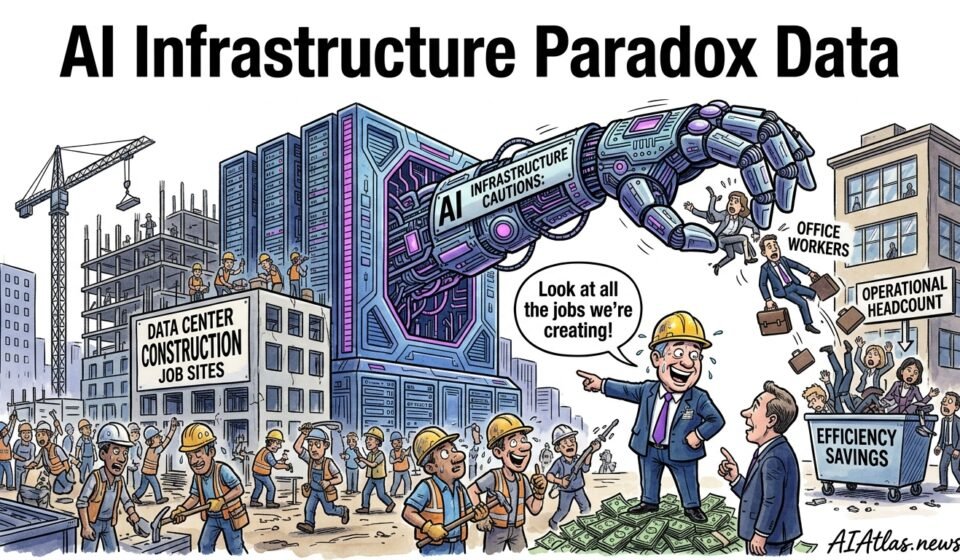
The AI Infrastructure Paradox: Why Data Center Construction Won’t Save Traditional Headcount
The Contrarian Thesis
When the April U.S. labour reports revealed a net increase of 115,000 jobs, mainstream financial commentators immediately categorised the data as evidence of a resilient economic engine. In our experience, superficial readings of macroeconomic data rarely serve the C-suite well. We are watching a fundamentally misunderstood transition. The job growth we are seeing is heavily distorted by an unprecedented surge in physical construction, specifically the concrete, steel, and electrical engineering required to house global compute capacity.
This construction-led growth presents a dangerous blind spot for strategic planners. By conflating the physical build-out of artificial intelligence infrastructure with broad-based operational health, market observers are missing the true structural shift. Beneath the headline figures, the reality is starkly different: white-collar roles in software, quality assurance, and middle-management are actively shrinking. The booming employment figures are a hardware phenomenon, masking an aggressive drive toward operational headcount efficiency in the knowledge sector.
Flaws in Current Market Assumptions
The prevailing narrative assumes that technological advancement uniformly expands the workforce across all related sectors. However, what we are seeing is a massive divergence between capital expenditure and operational expenditure. Boardrooms are eagerly authorising billions for high-performance processors, advanced cooling systems, and massive data centre facilities. Consequently, the temporary workforce required to construct these facilities has artificially inflated the monthly payroll data, leading casual observers to assume the technology sector remains a universal jobs engine.
This assumption fails to account for the actual end-goal of these massive infrastructure investments. The very data centres currently employing tens of thousands of electricians, foremen, and structural engineers are being built to execute algorithms designed to replace mid-tier cognitive labour. We strongly advise against interpreting a boom in commercial property development as a signal to maintain aggressive hiring targets within your core operational units. The hardware expansion is, in fact, a direct catalyst for software-sector contraction.
The Structural Shift
We must examine the commercial trade-offs happening within corporate budgets right now. To fund the enormous capital outlay required for modern compute capabilities, enterprise leaders are ruthlessly stripping overhead from legacy digital departments. Senior practitioners recognise that deploying advanced automation models directly cannibalises the need for large teams in customer support, routine code generation, and manual data analysis.
The capital shifting into physical infrastructure is being actively diverted from payroll. As these vast compute facilities come online, their processing capabilities allow firms to execute complex workflows with a fraction of the historical headcount. Founders and investors must understand that we have entered an era where scaling a digital product no longer requires a linear increase in human capital. The structural shift is permanent: capital intensity in hardware is directly inversely correlated with human intensity in software operations.
Decision Framework for Capital Allocation
Navigating this transition requires a disciplined approach to capital allocation. For venture-backed startups and established enterprise leaders alike, the immediate priority is determining the correct ratio of compute investment to human talent. We recommend viewing every new hire through the lens of automated capability over a three-year horizon. If a role primarily involves synthesising known data or writing boilerplate code, it is highly vulnerable to the very infrastructure currently being built on the outskirts of our major cities.
Instead of competing for volume in middle-tier engineering talent, astute capital allocators are redirecting funds toward securing raw compute access and hiring a highly concentrated, elite tier of strategic operators. This framework demands a ruthless evaluation of current operational expenditures. Leaders must ask themselves whether their budget is properly balanced to take advantage of the coming compute surplus, or if they are passively funding legacy operational models that will soon render their margins uncompetitive.
Risk Assessment Table
To provide a clearer view of where corporate risk and opportunity lie, we have evaluated the core components of technology operations against current macroeconomic labour trends. We consistently observe that operational vulnerability directly correlates to an over-reliance on routine human processing.
The table below outlines our assessment of how the shift toward physical infrastructure is impacting specific commercial functions. Business leaders should use this comparison to stress-test their own departmental budgets and align internal workforce planning with market realities.
| Operational Function | Current Employment Trend | Capital Intensity | Automation Vulnerability | Strategic Action |
|---|---|---|---|---|
| Routine Software Engineering | Contracting | Low | High | Freeze hiring; invest in code-generation tools. |
| Data Centre Construction | Expanding rapidly | Very High | Low (Physical) | Secure long-term contracts; monitor supply chains. |
| Customer Support Operations | Contracting | Low | High | Transition to automated triage; retain escalation teams. |
| Hardware Procurement | Expanding | High | Low | Elevate role to C-suite level; diversify vendors. |
| Strategic Data Architecture | Stable to Expanding | Medium | Medium | Aggressively recruit; focus on proprietary pipelines. |
Visualised Impact Matrix
Understanding the interplay between capital investment and human resources requires mapping out the strategic terrain. We categorise operational priorities based on their required financial outlay versus the risk of human capital redundancy as the market transitions.
The following matrix plots the strategic positioning of key business sectors during this hardware transition. Use this to identify which quadrants your core business operations currently occupy and where capital realignment is urgently required to maintain a competitive advantage.
Legacy Enterprise Tech Upgrades
Physical Infrastructure & Facilities
Routine Software & Support
Strategic Management & Data Architecture
X-Axis: Required Capital Expenditure
Strategic Recommendations for Leaders
To survive the current market disruption, founders and corporate executives must act decisively to restructure their organisations. First, we advise an immediate audit of all planned software engineering hires. If a specific technical vacancy can be reasonably supplemented by current automated models within eighteen months, that requisition should be cancelled. The resulting savings must then be reallocated towards securing reliable access to the physical compute infrastructure that will ultimately dictate market dominance.
Furthermore, executive teams must fundamentally redefine their productivity metrics. The historical benchmark of evaluating a company’s growth by its rising headcount is entirely obsolete. A modern, resilient enterprise operates with maximum capital deployed into compute density and minimum capital tied up in routine human administration. Those who stubbornly maintain bloated white-collar hierarchies will find their margins decimated by leaner competitors utilising the very infrastructure currently being built out by those 115,000 new workers.
Future-Proofing the Business Model
Looking ahead, the divide between the physical builders of the new algorithmic economy and the shrinking pool of traditional digital workers will only widen. For the strategic operator, ensuring long-term viability means decoupling operational output from human input. As the concrete dries on the latest generation of hyperscale data centres, the companies poised to command the market are those actively engineering themselves to run on silicon rather than salaries.
We urge the C-suite to look past the superficial optimism of generic macroeconomic reports. The surge in construction employment is not a rising tide meant to lift all boats; it is the building of a dam that will fundamentally alter the flow of digital capital. By acting on these structural realities today, you position your firm to capture the immense margins that this new era of operational efficiency demands.
Frequently Asked Questions
- Why are tech-related construction jobs growing while software roles shrink?
- The industry requires massive physical facilities and power infrastructure to run advanced algorithms, driving temporary construction employment. Concurrently, the deployment of these algorithms eliminates the need for large teams handling routine coding and administrative tasks.
- Should we reduce our overall technology budget based on this analysis?
- No. Instead, capital should be aggressively reallocated from operational expenditure, such as middle-tier salaries, directly into capital expenditure for compute power and proprietary data assets.
- How can startups compete with enterprises building their own data centres?
- Startups must maintain an ultra-lean operational profile and secure flexible, long-term compute contracts early. By avoiding the trap of premature human scaling, agile firms can match enterprise output at a fraction of the historical cost.