




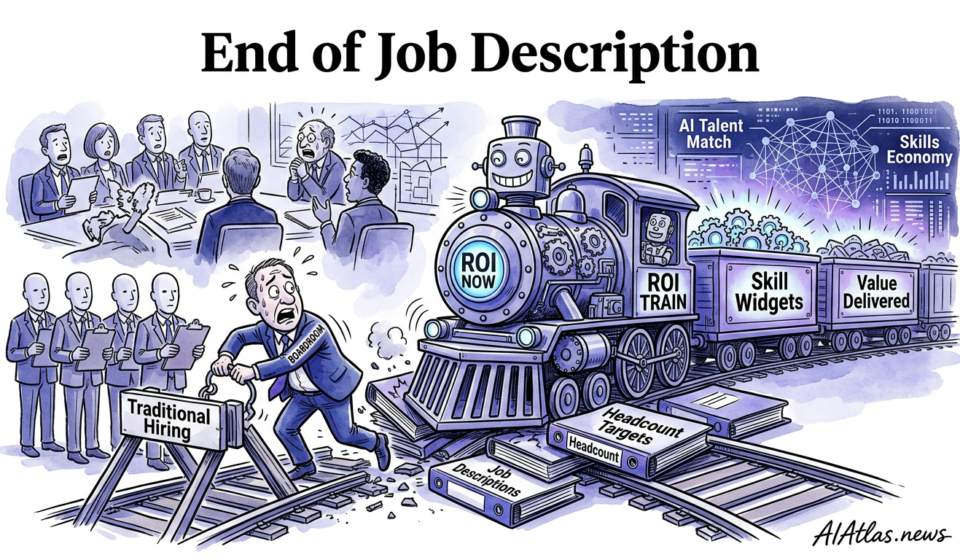
The End of the Job Description: Why ROI Now Trumps Headcount
The Contrarian Thesis
In our experience evaluating early-stage enterprise software and advising late-stage capital allocators, a dangerous complacency has settled into corporate boardrooms. The standard operating procedure for scaling a business remains aggressively tied to the industrial-era organigram. Founders and executives continue to map their growth trajectories against fixed job titles, believing that acquiring a ‘Vice President of Marketing’ or a ‘Director of Data Science’ is the primary mechanism for capturing market share. We view this legacy architecture as not merely outdated, but commercially toxic. Retaining a title-based hiring model guarantees organisational bloat, introduces severe capital inefficiency, and critically restricts execution velocity in an era defined by algorithmic acceleration.
The insights emerging from the Gartner Data and Analytics Summit 2026 have codified a reality we have been observing quietly within elite venture portfolios: job titles are dead equity. The structural pivot is moving aggressively towards hiring for ‘skill clusters’. Rather than paying for the artificial construct of a mid-level manager, high-performing organisations are explicitly procuring clusters of intersecting capabilities—such as probabilistic modelling combined with prompt architecture and domain-specific financial literacy. This contrarian approach dismantles traditional departmental silos and directly attacks ‘headcount friction’, which we define as the exorbitant capital and time wasted recruiting, onboarding, managing, and inevitably restructuring rigid human capital. In an age where compute scales infinitely faster than human comprehension, your hiring strategy must shift from acquiring static personnel to deploying dynamic cognitive assets.
Flaws in Current Market Assumptions
What we are seeing across the venture capital landscape is a pervasive, systemic misunderstanding of what artificial intelligence actually does to a modern workforce. There is a prevailing myth amongst many chief executives that algorithmic tools are merely supercharged software applications designed to make traditional employees execute their standard tasks slightly faster. This assumption leads directly to the creation of absurd, reactionary job titles. The market is currently flooded with postings for entirely synthetic roles which attempt to force a non-linear technological capability into a strictly linear corporate hierarchy. This fundamental miscategorisation leads to catastrophic capital misallocation, as executives attempt to map artificial capability onto legacy human workflows instead of reimagining the workflow itself.
The reality, which many legacy operators refuse to accept, is that advanced computational models do not function on a one-to-one replacement ratio with human workers, nor do they perfectly augment a static job description. Instead, these systems fracture traditional workflows into microscopic, disparate tasks. A conventional ‘Data Analyst’ role, for instance, historically comprised data gathering, cleaning, analysis, and presentation. Algorithmic systems absorb the gathering and cleaning instantly, leaving behind highly specialised strategic fragments. If founders continue to hire for the complete historical title, they are paying premium salaries for massive redundancies. The enterprise of the near future does not require workers who can execute an entire linear process; it requires operators who possess the specific, high-variance skill clusters necessary to orchestrate, audit, and refine the outputs generated by intelligent systems.
The Structural Shift
To fully understand the commercial magnitude of the insights shared at the Gartner Data and Analytics Summit 2026, we must break down the anatomy of a skill cluster. A skill cluster is fundamentally a modular grouping of human capabilities designed to perfectly interface with augmented workflows. Consider the traditional marketing department. Under the old regime, a firm would hire a copywriter, a media buyer, and an analytics associate. Under the new structural mandate, we advise portfolio companies to target a single operator demonstrating a specific cluster: behavioural psychology, algorithmic media bidding logic, and autonomous agent orchestration. This single human node, augmented by a bespoke stack of automated systems, commands the output previously expected from a six-person department.
This structural reorganisation directly neutralises headcount friction, which has historically been the silent killer of gross margins. Traditional human resources departments operate on multi-month lead times, spending vital capital searching for candidates who perfectly match archaic, bullet-pointed job descriptions. By shifting the procurement focus towards skill clusters, organisations unlock profound labour agility. When an enterprise transitions to this model, they stop thinking about filling empty chairs and begin treating human intelligence exactly like cloud infrastructure: a dynamic, scalable resource deployed precisely where computational logic reaches its limitations. The financial implications are staggering, allowing seed-stage companies to maintain the operational footprint of a Series B incumbent without the corresponding payroll liability.
Decision Framework for Capital Allocation
For venture capitalists and chief executives looking to underwrite this transition, the financial models must be aggressively rewritten. We consistently advise general partners to stop evaluating startups based on traditional metrics such as revenue-per-employee. In a market dominated by autonomous execution, this metric is worse than useless; it is actively deceptive. A business boasting a high revenue-per-employee might simply be artificially restricting its growth by relying too heavily on human bottlenecks. The new definitive metric for operational excellence is ‘revenue-per-workflow’, measuring the capital efficiency of an entire automated pipeline overseen by a targeted human skill cluster. Capital allocation must pivot away from fixed payroll budgets and flow directly towards dynamic talent acquisition and expanded compute budgets.
When assessing an organisation’s readiness for funding or public market entry, we scrutinise their human capital supply chain. Are they spending capital on executive search firms looking for traditional vice presidents, or are they deploying capital to identify unconventional talent demonstrating high-adaptability skill clusters? The most resilient portfolios we observe are actively migrating their operational expenditure away from middle management—a layer historically dedicated to merely moving information between silos. Instead, they reallocate those funds into advanced systemic architecture and the elite, multidisciplinary operators required to guide it. This framework forces a ruthless evaluation of what constitutes actual value creation versus mere administrative overhead.
Risk Assessment Table
Transitioning from conventional human resources to a dynamic, skills-centric organisational architecture is not without profound operational risk. The implementation requires tearing down entrenched cultural norms and significantly re-training the talent acquisition division. Founders must clearly delineate the strategic advantages against the immediate transition costs. In our ongoing analysis of enterprise transformation, we have found that companies attempting to run both models concurrently suffer immediate operational paralysis, as the agility of the cluster model is constantly throttled by the bureaucracy of the legacy system.
To provide a clear, actionable overview of these commercial trade-offs, we have constructed a comparative risk and efficiency model. This table contrasts the legacy job-title framework directly against the emergent skill-cluster deployment model, highlighting the financial and operational realities that executives must immediately digest. Investors should use these metrics to audit their existing portfolios and identify which firms are actively mitigating their long-term payroll liabilities.
| Evaluation Metric | Traditional Title-Based Hiring | Skill-Cluster Deployment |
|---|---|---|
| Capital Expenditure (CapEx) Focus | Fixed, recurring payroll liabilities and benefits. | Compute resources, automation stacks, and high-margin human oversight. |
| Scalability Constraints | Strictly linear. Revenue growth requires corresponding headcount growth. | Highly non-linear. Marginal cost of output drops as compute assumes task load. |
| Execution Attrition Risk | High. Loss of an employee removes an entire functional node and institutional memory. | Low. Workflows are structurally automated; humans merely direct and audit the logic. |
| Organisational Integration | Siloed. Deep departmental divides requiring heavy middle-management translation. | Fluid. Cross-disciplinary skill clusters inherently bridge technical and commercial gaps. |
| Primary Return on Investment | Predictable but stagnant baseline productivity aligned with historical benchmarks. | Exponential workflow velocity, leading to aggressive margin expansion over time. |
Visualised Impact Matrix
To assist managing directors and founding teams in auditing their current workflows, we rely on a specific capability evaluation methodology. Not all processes should be immediately transitioned to a skill-cluster model. Executives must ruthlessly map their internal capabilities against two distinct axes: the susceptibility of the task to algorithmic execution, and the strategic variance (the value derived from unique human intuition) of the workflow. Misdiagnosing where a specific departmental function sits on this matrix is a primary reason we see digital transformation programmes fail, burning millions in venture funding without yielding a tangible increase in operational speed.
The matrix below serves as our internal diagnostic tool. We urge leadership teams to plot their existing job titles onto this grid. Roles falling into the ‘Process Automation’ sector should be immediately stripped of human capital and handed to automated logic. Conversely, functions mapping to ‘Augmented Alpha’ represent the exact nexus where you must deploy sophisticated skill clusters. These are the areas where human intuition, augmented by vast computational power, creates an insurmountable competitive moat.
High Algorithmic Susceptibility
Low Strategic Variance
Action: Displace & Automate
High Algorithmic Susceptibility
High Strategic Variance
Action: Deploy Skill Clusters
Low Algorithmic Susceptibility
Low Strategic Variance
Action: Outsource entirely
Low Algorithmic Susceptibility
High Strategic Variance
Action: Retain Specialist Talent
Strategic Recommendations for Leaders
We do not recommend half-measures or gradual phasing when confronting this transition; the market will simply move too fast, and competitors operating on a skill-cluster model will swiftly outprice and out-deliver you. The immediate, practical step for any executive team is to freeze all current recruitment pipelines that are anchored to traditional job titles. You must interrogate your human resources directors and demand an entirely new taxonomy for talent acquisition. If a candidate cannot demonstrate fluency in orchestrating complex, algorithmically assisted workflows alongside their core domain expertise, they represent an unacceptable long-term liability to the balance sheet. Recruitment agencies operating on standard commission models for placing legacy managers should be immediately dismissed.
Furthermore, internal performance metrics must be comprehensively rewritten. We strongly advise leadership teams to cease evaluating employees based on their manual execution volume and begin assessing them on their systemic influence. You must reward the operators who successfully automate portions of their own workflows. An employee who successfully eliminates forty per cent of their daily manual tasks by building an automated cluster has not made themselves redundant; they have demonstrated exactly the type of high-leverage architectural thinking that justifies premium compensation. Leaders must actively foster a culture where the goal is no longer to manage the largest team of junior staff, but to manage the most commercially impactful network of computational agents.
Future-Proofing the Business Model
Looking beyond the immediate horizon of 2026, the enterprises that survive and dominate will be those that view human capital not as a static foundation, but as a fluid, highly specialised overlay on top of automated infrastructure. Valuations in both the private and public markets will increasingly be tied directly to a firm’s operational elasticity. If an organisation requires six months and three million dollars in recruitment fees to launch a new product vertical, they will be heavily penalised by investors. If they can assemble an internal skill cluster and deploy an automated workflow in three weeks, they will capture the premium.
Ultimately, what we are observing is the financialisation of talent management. The decision to hire is no longer a standard operational requirement; it is a critical capital allocation event carrying immense systemic risk. By embracing the skill-cluster model, founders and investors can systematically strip away the administrative friction that has historically choked scaling companies. The companies that internalise this reality today will operate with a margin profile and execution speed that legacy competitors simply cannot comprehend, let alone replicate.
- How do we effectively evaluate a ‘skill cluster’ during the interview process?
- You must abandon standard behavioural questioning in favour of live, multidisciplinary technical auditing. Provide the candidate with a complex, automated workflow environment and observe how they blend algorithmic tooling with their domain expertise to solve an immediate commercial problem.
- What are the implications for our existing layer of middle management?
- Middle management, traditionally responsible for routing information between departments, faces severe systemic risk. We advise either aggressively upskilling these managers into workflow architects who direct automated systems, or structuring generous severance packages to eliminate the operational bottleneck.
- How does this transition alter initial funding requirements for early-stage startups?
- Seed-stage funding requirements are bifurcating; founders need significantly less capital for early payroll, but markedly more for compute resources and initial automation architecture. Investors are increasingly willing to fund higher initial infrastructure costs if it guarantees a permanently deflated human headcount.