





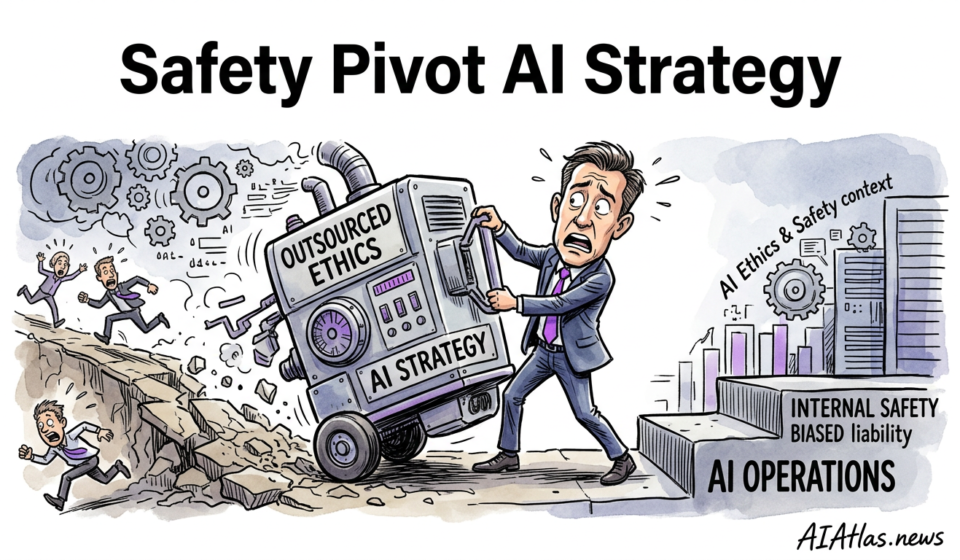
The Safety Pivot: Why Your AI Strategy Can No Longer Outsource Ethics
The Contrarian Thesis
In our experience covering the intersection of technology and capital, rare moments occur when a global consensus abruptly shatters. The March 9, 2026 AI Impact Summit was precisely such a fracture. We watched as international stakeholders decisively abandoned the rigorous, Bletchley-era emphasis on collective safety scaffolds. During the Bletchley era, institutions relied heavily on state-led initiatives to establish baseline security protocols. In its place, a new geopolitical doctrine emerged at the summit, singularly focused on rapid technological deployment and sovereign competitiveness. This pivot has created a sprawling regulatory vacuum, leaving enterprise leaders and startup founders to navigate uncharted commercial waters without a state-sponsored compass.
What we are seeing across the institutional investment landscape is a fundamental misreading of this event. The prevailing market sentiment treats the evaporation of global safety standards as a definitive green light for unchecked expansion. We strongly dispute this interpretation. In our judgement, the dilution of state-mandated guardrails must be framed strictly as a critical enterprise risk management issue, rather than a philosophical or moral debate. The absence of external regulation does not eliminate commercial risk; it merely transfers the entire liability burden directly onto the balance sheets of private enterprises.
For startup founders and enterprise CTOs managing aggressive product roadmaps, this structural shift requires a total recalibration of how technical debt is measured. Deploying advanced neural networks without robust, verifiable constraint mechanisms is no longer a regulatory compliance failure—it is an acute commercial vulnerability. The rush to monetise raw compute capabilities without building proprietary safety infrastructure will expose firms to catastrophic data poisoning, intellectual property breaches, and enterprise-scale tort claims. The contrarian reality is that in a deregulated global market, self-imposed algorithmic restraint becomes the ultimate commercial moat.
Flaws in Current Market Assumptions
There is a dangerous hangover persisting from the consumer internet era, dictating that rapid iteration and breaking conventions are the sole prerequisites for market dominance. This assumption fails spectacularly when applied to enterprise-grade artificial intelligence. Software-as-a-service applications were historically low-stakes environments; if a deployment failed, a quick rollback sufficed. Machine learning models, however, now govern critical infrastructure, financial allocations, and proprietary corporate logic. Breaking things in this context yields breached contracts, evaporated trust, and severe financial penalties.
Institutional investors are currently mispricing this regulatory arbitrage. We observe venture capitalists eagerly funding startups that promise hyper-accelerated time-to-market metrics, driven by the belief that capturing early market share guarantees long-term dominance. Yet, they fail to account for the ballooning, hidden costs of remediation. When a minimally constrained model inevitably hallucinates on a vital client deliverable or leaks training data to a commercial rival, the cost of retrofitting safety protocols into a live system dramatically exceeds the initial capital saved by skipping them.
Furthermore, the assumption that national mandates for technological speed will provide a legal shield for private firms is entirely unfounded. Sovereign states are pursuing unconstrained advancement to ensure geopolitical parity, particularly in military and macro-economic intelligence. They will not indemnify a private software firm against civil litigation or commercial loss resulting from an unconstrained algorithm. The market is confusing state-level strategic imperatives with corporate-level operational safety, leading to highly misaligned product roadmaps across the startup ecosystem.
The Structural Shift
The profound structural shift catalysed by the March 9 Summit is the privatisation of algorithmic governance. During the previous era, governments attempted to socialise the cost of safety through shared international frameworks, compliance audits, and theoretical red-teaming mandates. Now, the burden of defining, implementing, and defending operational boundaries falls squarely on the enterprise CTO. This represents a massive transfer of operational friction from the state to the private sector, fundamentally altering the economics of technology commercialisation.
We are already witnessing a severe bifurcation within the market. On one side are the commoditised integrators—firms that rapidly implement generic foundation models through basic API calls to maximise immediate feature velocity. On the side of genuine enterprise value are the architectural defensives—startups and mature companies that view internalised safety protocols as a core intellectual property asset. These architectural defensives understand that the enterprise layer requires absolute operational certainty. By building complex verification engines, they create a synthetic regulatory environment within their own software stack. Over a 36-month horizon, we expect this second group to command massive valuation premiums.
This shift is further complicated by the fragmentation of the global technology stack. As nations prioritise sovereign capability over international cohesion, cross-border data flows and model deployment will become legally treacherous. A product deployed seamlessly in London may violate opaque, localised commercial standards in Tokyo or Washington. Consequently, CTOs can no longer rely on a singular, global standard for deployment. They must architect their systems with profound modularity, ensuring that risk management parameters can be dynamically adjusted based on specific jurisdictional liabilities.
Decision Framework for Capital Allocation
In light of this regulatory vacuum, capital allocation strategies must undergo severe revision. We advise institutional investors to overhaul their due diligence frameworks immediately. It is no longer sufficient to evaluate a startup based on benchmark performance or parameter counts. Investors must rigorously interrogate the foundational risk architecture. A critical metric for capital deployment should now be the shadow compliance budget—the internal capital a firm dedicates to red-teaming, output verification, and legal indemnification mechanisms.
For business leaders directing internal research and development, the capital decision matrix must pivot from pure capability expansion to verified reliability. If a new deployment cannot be deterministically audited, it should not receive funding. We recommend reallocating a minimum of thirty per cent of generative compute budgets directly into output constraint research. This is not an expenditure on ethics; it is a raw defensive investment to protect core commercial valuation in an era where foundation providers refuse to underwrite the outputs of their models.
To operationalise this framework, decision-makers must map their exposure across specific commercial vectors. Relying on intuition or outdated compliance checklists will lead to catastrophic resource misallocation. Below, we provide a detailed analytical table that breaks down the enterprise vulnerabilities inherent in the new sovereign speed mandate, offering clear strategies for CTOs and founders to align their technical investments with pragmatic risk management.
Risk Assessment Table
The following matrix is designed for senior operators evaluating the disconnect between global mandates and commercial reality. We have identified five distinct areas where the geopolitical drive for velocity directly threatens corporate stability. CTOs must utilise this framework to stress-test their current developmental pipelines, identifying where technical debt is silently accumulating under the guise of rapid iteration.
By categorising the sovereign imperative against the specific enterprise vulnerability, leaders can effectively assign internal capital to targeted mitigation strategies. This exercise quantifies the financial impact of the regulatory vacuum, translating abstract geopolitical shifts into concrete board-level discussions regarding liability and margin protection.
| Risk Category | Sovereign Imperative | Enterprise Vulnerability | Mitigation Strategy | Financial Impact |
|---|---|---|---|---|
| Data Provenance | Aggressive, borderless scraping for model superiority | Copyright infringement and systemic IP contamination | Cryptographic watermarking and strictly licensed data pipelines | High liability exposure; potential injunctions halting sales |
| Output Determinism | Maximising parameter scale over output predictability | Hallucinations triggering automated client financial losses | Implementation of deterministic routing and verifiable logic gates | Severe contract invalidation and customer churn |
| Security Topography | Rapid open-weight releases to stimulate local ecosystems | Adversarial manipulation and catastrophic data extraction | Air-gapped deployment and proprietary semantic firewalls | Massive remediation costs post-breach |
| Vendor Dependency | State subsidisation of domestic foundational monopolies | Forced reliance on un-auditable, zero-liability API endpoints | Aggressive multi-model orchestration and open-source fallback | Erosion of gross margins due to unpredictable API pricing |
| Jurisdictional Friction | Abandonment of Bletchley consensus for localised rules | Cross-border compliance failure resulting in frozen assets | Modular legal scaffolding within the software architecture | Loss of international total addressable market (TAM) |
Visualised Impact Matrix
To conceptualise where a firm stands within this new reality, we rely on a strategic positioning matrix. Visualising the tension between deployment velocity and the depth of proprietary safeguards is essential for executive alignment. Companies that mistakenly prioritise raw speed without internalising safety controls are walking into a liability trap. Conversely, those that build defensive moats will define the new standard for enterprise readiness.
The two-by-two matrix below maps the strategic landscape. The vertical axis represents the speed of commercial deployment, driven by the post-summit market pressure. The horizontal axis measures the depth of proprietary, internalised safeguards. In our analysis, the top-right quadrant—Verified Velocity—is the only sustainable commercial position. Founders and investors must ruthlessly evaluate their current portfolio against these four quadrants to prevent severe capital misallocation.
Depth of Proprietary Safeguards →
High Speed
Low Safeguards
High Speed
High Safeguards
Low Speed
Low Safeguards
Low Speed
High Safeguards
Strategic Recommendations for Leaders
To survive and scale in this environment, business leaders must aggressively internalise the functions previously expected of regulatory bodies. We recommend establishing an independent, technically rigorous internal audit function that operates with complete authority over the deployment pipeline. This team should not report to product managers, whose incentives are tied solely to feature delivery and user acquisition. Instead, they must report directly to the Chief Risk Officer, ensuring output verification is entirely isolated from immediate commercial pressure.
Furthermore, enterprise CTOs must restructure their commercial contracts. The traditional terms of service provided by foundational model vendors aggressively disclaim all liability for output accuracy, copyright infringement, and system bias. If your business integrates these APIs without a buffer, you are legally absorbing that discarded liability. We urge leaders to invest in middleware constraint layers—proprietary systems that intercept, evaluate, and sanitise model outputs before they trigger internal enterprise actions or reach the consumer.
For institutional investors, the strategic recommendation is equally stark: rewrite your term sheets. Demand explicit, technical proof of internalised safety architecture during the due diligence process. A startup that claims to have solved a complex enterprise problem using raw neural networks, without detailing its proprietary verification engines, is a catastrophic liability waiting to materialise. Capital should only flow to founders who understand that demonstrable risk management secures valuation.
Future-Proofing the Business Model
Looking ahead to the next 24 to 36 months, we anticipate a severe market correction. The current period of unchecked, geopolitically encouraged deployment will inevitably result in a series of highly public, highly damaging enterprise failures. Whether it takes the form of massive intellectual property contamination, algorithmic financial trading errors, or severe privacy breaches, these events will shatter the illusion that raw speed is risk-free. When these failures occur, the pendulum will swing violently in the opposite direction.
Legislators, reacting to public outcry over autonomous operational failures, will likely bypass nuanced technological governance in favour of blunt, restrictive mandates that could freeze unverified developmental pipelines overnight. The businesses that will thrive through this inevitable correction are those that begin future-proofing their models today. By voluntarily adopting rigorous, verifiable safety scaffolds now, firms can insulate their operations against the shock of sudden legislative crackdowns. More importantly, when enterprise clients begin to suffer from the liabilities of unconstrained systems, they will migrate en masse to vendors who can provide legally defensible, mathematically verifiable operational guarantees.
Ultimately, the fallout from the March 9 AI Impact Summit should serve as a wake-up call, not a cause for unbridled celebration. The dilution of global standards is a formidable commercial challenge that separates sophisticated operators from amateur integrators. In our judgement, the most successful firms of this decade will not be those that simply compute the fastest, but those that master the complex mathematics of enterprise risk, turning regulatory silence into a profound competitive advantage.
- How should startups adjust their pitches in a deregulated market?
- Startups must pivot from selling raw capability to selling verified operational safety. Institutional investors are increasingly wary of unconstrained models, so founders should highlight their proprietary constraint layers and shadow compliance budgets to prove commercial maturity.
- Does the absence of global guardrails mean faster enterprise adoption?
- No, it actually introduces severe friction for enterprise procurement teams. Without state-mandated safety standards, enterprise CTOs must conduct exhaustive, bespoke due diligence on every vendor, drastically lengthening the business-to-business sales cycle for non-compliant software.
- Why cannot companies rely on foundation model providers for liability protection?
- Foundation model vendors strictly disclaim legal liability for outputs, copyright infringement, and data poisoning in their terms of service. Enterprises integrating these endpoints automatically absorb this discarded liability, making internal middleware constraint layers a commercial necessity.