
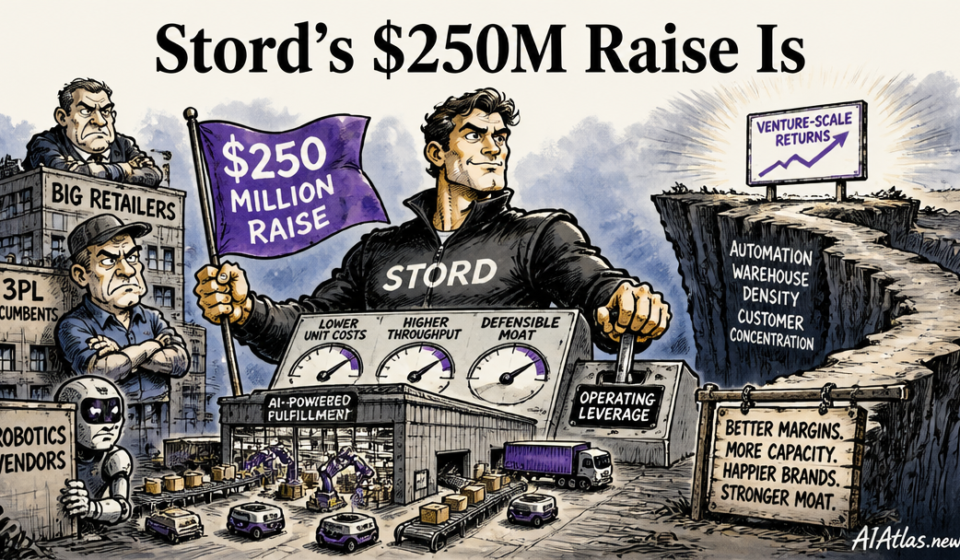
Stord’s $250M Raise Is a Bet That Logistics AI Needs Operating Leverage, Not More Software Hype
The Contrarian Thesis
Stord’s $250m late-stage round at a $3bn valuation is being sold as proof that AI-native logistics can earn venture-grade returns. We see it differently. In our experience, this is less a “logistics with better software” story and more a stress test of whether operational automation can stay economically defensible as demand, customer mix, and warehouse density swing around.
The hard question is not whether Stord can bolt AI and robotics onto fulfillment. The question is whether those upgrades translate into measurable, repeatable improvements in unit economics (cost per order, throughput per labour hour, rework rates, exception costs) and service performance (SLA hit rates, delivery reliability, peak resilience) fast enough to justify a premium multiple—without locking Stord into a fragile customer concentration pattern.
Flaws in Current Market Assumptions
Most AI logistics commentary starts with capability: more vision, more planning, more orchestration. What we watch instead is durability. Fulfilment is a competition of throughput and accuracy under constraints—space, power, labour, carrier variability, returns volume, and SKU volatility. That means the “AI” portion is only valuable if it lowers controllable costs and reduces avoidable exceptions at scale.
Investors also assume that outsourced fulfillment plus automation naturally creates long-lived economics. Outsourcing is profitable when the buyer believes switching costs are real. Automation can raise those switching costs—but it can also increase them for the wrong reason: proprietary integrations, bespoke robotics configurations, and centre-specific re-optimisation that make churn painful yet unprofitable.
| Fulfilment AI/Robotics Strategy | Primary Hypothesis | What Must Be Measured in 90 Days | Commercial Failure Mode We See |
|---|---|---|---|
| Pick-path optimisation + exception reduction | Lower cost per pick and fewer faults | Pick accuracy, exception rate, minutes per pick | Benefits degrade with SKU mix or peak spikes |
| Robotics densification (warehouse layout + routing) | Higher throughput per square foot | Units/hour, dwell time, throughput stability | Reconfiguration costs erase margin on new nodes |
| AI scheduling and workforce planning | Labour efficiency under variability | Forecast error, overtime rate, SLA stability | Seasonality breaks the model assumptions |
| Warehouse “control tower” for outsourced clients | Service premium via predictability | SLA hit rate, customer-visible latency, ticket volume | Operational excellence exists but isn’t priced |
| End-to-end automation platform (beyond one site) | Replicable systems create compounding returns | Ramp time, time-to-stability, centre-to-centre variance | Custom deployments prevent scale economies |
Stord’s claim—accelerating AI and robotics integration to help smaller brands compete against large retail platforms—sounds attractive. But we would only underwrite it if the company can show that gains survive three uncomfortable realities: (1) clients scale order volume unevenly, (2) SKU and demand graphs mutate, and (3) major marketplaces dictate fulfilment expectations in ways that shift quickly.
The Structural Shift
What’s truly new here is not “automation”, it’s the convergence of infrastructure-level AI, robotics-enabled warehousing, and outsourced fulfilment under one economic promise. Each element exists elsewhere. The wager is that orchestration across them produces a measurable flywheel: better planning reduces chaos; reduced chaos makes automation more effective; more effective automation improves service, which wins higher-volume lanes; higher volume funds further density and integration.
However, flywheels in operations don’t spin because the pitch deck says so. They spin because teams can replicate the system with tolerable variance. In our experience, the operational “make-or-break” metrics are ramp time and stability: how quickly a new centre reaches target throughput and accuracy, and how much performance drifts when customer profiles change.
If Stord uses this round to drive that replicability—rather than only expanding deployment footprint—it could justify the valuation premium. If it uses the capital mostly to install more hardware and refine bespoke client workflows, the economics could look great in a controlled setting and then flatten as complexity rises.
Decision Framework for Capital Allocation
Late-stage capital is only “smart” when it funds compounding mechanisms, not merely better execution of a plan that already exists. We recommend leaders and investors apply a simple framework: link each dollar to an operator metric, confirm that metric is causal (not correlated), and test whether the uplift is portable across centres and client types.
Concretely, we would ask Stord—and any logistics operator making similar moves—to separate improvements into three buckets: (a) cost-to-serve reductions that show up within one operational quarter, (b) service performance wins that directly reduce penalties, chargebacks, and churn, and (c) platform investments that reduce future deployment variance. Without that decomposition, the $250m becomes a lump sum that investors can’t verify.
Here is the risk profile we’d map before assuming the valuation is justified.
Risk Assessment Table
In our experience, the highest-risk failure modes in AI-enabled fulfilment are not technical. They are commercial and operational: pricing misalignment, variance in client demand, integration sprawl, and the creeping cost of “exception handling” when models meet messy reality.
| Risk | What It Looks Like in Practice | Why It Hits Valuation Multiple | Early Warning Signals |
|---|---|---|---|
| Automation benefits don’t generalise | Uplift works in pilots, drops across new sites | Scalability premium evaporates | Centre-to-centre variance rises above target |
| Service gains aren’t monetised | Lower exceptions, but pricing doesn’t reflect value | Margins improve slower than the story implies | Stable SLA, but churn or rate pressure persists |
| Customer concentration and lane dependency | A few clients drive most volume; churn breaks utilisation | Predictability discount | Utilisation swings after contract renewals |
| Integration and configuration sprawl | Robotics stack becomes bespoke per client/centre | Deployment costs balloon | Ramp time increases with each new contract |
| Peak and exception spikes overwhelm models | AI improves steady-state, fails under rare surges | Service credibility declines | Exception backlog during peak weeks |
Visualised Impact Matrix
The clearest way we judge whether Stord’s “AI + robotics + outsourced fulfilment” model earns a premium is to plot outcomes by unit economics uplift and deployment reproducibility. The matrix below uses practical thresholds leaders can track immediately.
High ≥ 10% contribution margin/order (measured and attributable)
Strategic Recommendations for Leaders
If you’re a founder or operator looking at Stord’s funding as a signal, don’t ask whether AI/robotics can improve a warehouse. Ask whether your cost-to-serve reductions are contractible and measurable. In our experience, logistics providers win long-term by making operational improvements legible to the buyer: fewer chargebacks, fewer mis-picks, tighter delivery windows, and predictable handling of exceptions during peaks.
We would push leaders to run three governance moves immediately. First, create an “attribution ledger” linking AI decisions to outcomes (with counterfactual controls where possible). Second, define deployment standard work: what exactly is templated across sites, and what remains bespoke. Third, pressure-test pricing so that service performance improvements translate into either explicit premiums or reduced penalties—otherwise the market will treat you as a cost supplier, not a value carrier.
For investors, late-stage due diligence should focus on centre ramp curves, exception taxonomy, and variance drivers. If those aren’t available at board level, the valuation story is mostly narrative.
Future-Proofing the Business Model
AI-native operations live or die on how they respond to change: carrier disruptions, demand shifts, regulatory changes, returns behaviour, and customer concentration. Future-proofing therefore isn’t about adding another model. It’s about building a control system that learns within guardrails and degrades gracefully when conditions diverge from training data.
Stord’s stated goal—helping smaller brands compete with larger retail platforms—also implies a broader strategic bet: lowering the friction of fulfilment for firms without procurement leverage. That’s credible only if the provider can keep service quality stable while client order patterns remain less predictable. The premium valuation will ultimately be judged by whether Stord improves “time-to-stability” and keeps cost-to-serve resilient even when the buyer mix changes.
Our bottom line: if Stord uses this $250m to prove replicable unit-economics and service performance, it supports the case for venture-scale returns in AI-enabled fulfilment. If it spends primarily on expansion without operational standardisation, it risks becoming another automation installer—brilliant in individual facilities, but structurally unable to sustain premium margins across the portfolio.
Frequently Asked Questions
- We’d look for repeatable, attributable unit-economics uplift across new centres, plus service metrics tied to churn, penalties, and chargebacks. The key is variance control, not pilot performance.
Frequently Asked Questions
- Ramp time to throughput/accuracy targets, exception taxonomy trends, minutes per pick, and SLA hit rate stability under peak conditions. Couple those with customer-visible cost-to-serve outcomes.
Frequently Asked Questions
- The benefit must show up as measurable reliability and cost predictability that the contract reflects. If service improvements aren’t monetised, the buyer won’t pay and margins won’t compound.