AI’s Hidden Infrastructure Bill Is Becoming a Sovereignty Problem
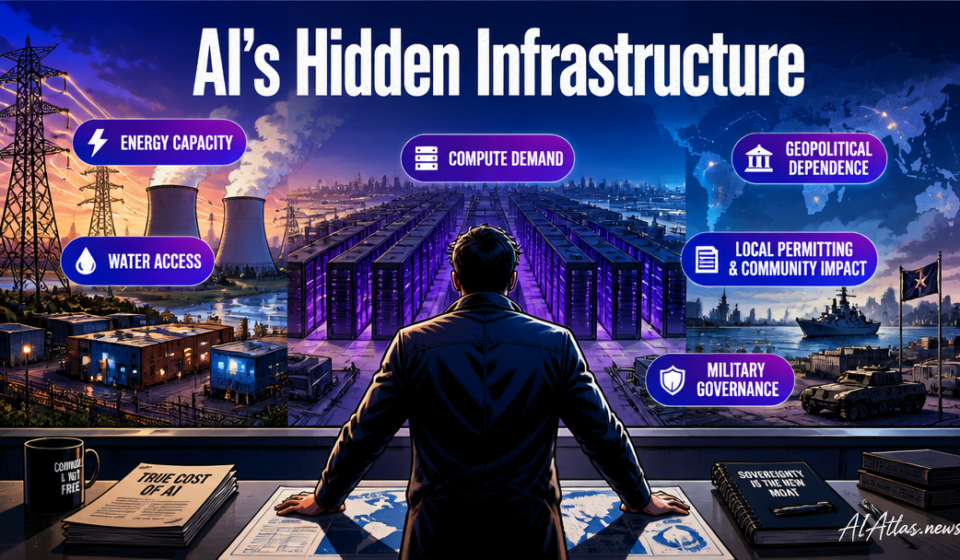
We keep hearing that the AI boom is limited only by imagination. Our view at AI Atlas News is blunter: the bottleneck is increasingly physical, jurisdictional, and political. A recent expert-led warning — focused on hidden environmental, social and geopolitical costs — aligns uncomfortably with the Vatican’s call for strict regulation of AI in warfare. Taken together, these signals suggest the market is moving from “model risk” to “deployment risk”: energy capacity, water strain, local permitting, and governance over critical infrastructure.
The Contrarian Thesis
We don’t doubt AI’s economic value. We doubt the commercial narrative that it arrives on neutral ground, with friction that can be engineered away. What we are seeing is a shift in where risk lives: off-balance-sheet costs are becoming board-level constraints.
When experts warn that rapid AI expansion can erode national or institutional control over critical infrastructure, that’s not moral theatre. It’s an operational vulnerability with pricing consequences. And when governance pressure intensifies — including around warfare — it changes the compliance timetable, not just the ethics slide deck. The question leaders should be asking is not “is AI transformative?”, but “who pays when the system needs power, water, permits, and political legitimacy?”
Flaws in Current Market Assumptions
Most market assumptions still treat compute like a fungible utility. In practice, capacity is a geography-specific asset: constrained by grid upgrades, substation availability, data-centre permitting cycles, and the politics of local land use. Energy is not just a cost line; it’s a gating variable for deployment timelines, procurement leverage, and customer commitments.
Then there’s water. Even where the headline model scales elegantly, the cooling and auxiliary systems can turn water access into a local licensing issue and, in some jurisdictions, a reputational risk. Add social licence — community impact, labour scrutiny, and the visibility of “industrial AI” — and you get friction that doesn’t show up in model benchmarks.
Finally, governance. The Vatican’s push for strict regulation of AI in warfare is a reminder that the most sensitive use cases are where public accountability concentrates. For commercial teams, this means auditability requirements, traceability obligations, and restrictions on who can deploy what — and where. These are the types of constraints that regulators can enforce quickly, even when technology adoption is fast.
The Structural Shift
We are moving from a phase where companies compete on training efficiency to one where they compete on infrastructure defensibility. The winners won’t just be the ones with the best algorithm; they’ll be the ones who can secure reliable energy supply, manage water and cooling requirements, and maintain institutional control over key stacks.
That structural shift is visible in three patterns. First, procurement is becoming longer and more contract-heavy: customers are pushing for service continuity clauses, environmental reporting, and security commitments. Second, operators are rethinking deployment architectures — not for latency alone, but for compliance boundaries and operational fallback plans. Third, investment is starting to price “constraint likelihood”: how probable are energy upgrades, permitting delays, and geopolitical interruptions over a deployment horizon?
In short, AI’s physical resource demands are becoming part of cost structure and market access. And military-governance pressure turns “regulatory exposure” into something that can hit margins quickly — through restrictions, documentation costs, and customer eligibility.
Decision Framework for Capital Allocation
If you’re funding or buying AI, we recommend treating infrastructure constraints as first-order inputs to your capital plan. Not as a contingency, not as an afterthought. Build your investment logic around “constraint clearance” just as you would around technical feasibility.
Our decision framework is simple and operational:
- Map the bottleneck: Identify the limiting resource first — energy, cooling/water, GPU availability, or permissions.
- Quantify the constraint horizon: Estimate how long it takes to clear each bottleneck in the target geography.
- Model margin impact: Stress-test unit economics under higher power costs, utilisation dips, and compliance overhead.
- Audit control exposure: Determine where you lose institutional control — data paths, vendor dependencies, and deployment jurisdictions.
- Pre-plan governance pathways: For sensitive domains, align deployment documentation with likely regulatory scrutiny before scale.
We find that teams that do this early negotiate better contracts. They also make fewer “surprise pivots” when constraints tighten. The market rewards credibility, and constraint credibility is now a differentiator.
Risk Assessment Table
Use this as a quick operator-level scan. The point is not to predict the future perfectly — it’s to identify where your costs, timelines, and defensibility are likely to drift when governance and resource constraints intensify.
| Constraint / Risk | Margin Pressure | Regulatory Exposure | Defensibility Lever |
|---|---|---|---|
| Energy capacity & grid dependence | Higher power price + utilisation volatility | Reporting requirements; capacity restrictions | Long-term energy contracts; site diversification |
| Water strain & cooling limits | Retrofit/recooling costs; local sourcing risk | Local permitting and environmental compliance | Dry/recirculating cooling designs; water stewardship metrics |
| Local permitting & infrastructure lead times | Delayed go-live; higher interim spend | Community and environmental scrutiny | Permitting playbooks; partner with experienced operators |
| Geopolitical dependence of critical AI infrastructure | Supply interruptions; renegotiation risk | Cross-border compliance and export controls | Multi-source procurement; jurisdiction-aware architecture |
| Military governance & warfare-specific oversight | Extra audit, traceability, and eligibility constraints | Strict regulation and enforcement escalation | Use-case gating; evidence-ready model governance |
Visualised Impact Matrix (div)
Here’s how we’d visualise the trade-off space. The most dangerous issues are those that are both high-intensity (likely to attract regulatory or political attention) and low-controllability (hard to mitigate within your current operating footprint).
Contracting, reporting, and governance processes can reduce exposure without relying on major infrastructure rewrites.
Examples: audit-ready deployment playbooks; verified energy procurement documentation
Governance escalation can force scope reductions or shutdowns; mitigation is constrained by jurisdiction and supplier control.
Examples: warfare-use eligibility; cross-border infrastructure dependence
Costs are real but predictable; you can plan upgrades and compliance work internally or with known partners.
Examples: model cost optimisation; predictable on-site cooling upgrades
Constraints may not trigger enforcement immediately, but they can still disrupt schedules and unit economics.
Examples: permitting surprises; local resource bottlenecks without contractual protection
Strategic Recommendations for Leaders
Let’s be direct: if your go-to-market plan assumes elastic compute and frictionless scaling, you’re building on sand. We recommend revising commercial planning to include constraint clearance as a dependency with owners, milestones, and budget.
Concretely, we would push leaders to:
- Demand “resource evidence” from suppliers: proof of power sourcing, water strategy, and operational resilience under utilisation swings.
- Segment deployments by governance sensitivity: treat warfare-adjacent or high-accountability domains as distinct programmes with audit-ready pipelines.
- Negotiate timeline realism: build contract structures that compensate for permitting and capacity delays, not just model performance gaps.
- Reduce single-jurisdiction exposure: diversify infrastructure footprints where regulation and geopolitics could tighten without notice.
- Turn compliance into a sales asset: customers increasingly want credible risk management, not just capability demos.
In our experience, the startups that survive aren’t those with the most impressive demos — they’re the ones that can prove they won’t get stuck on power, water, or governance eligibility.
Future-Proofing the Business Model
Future-proofing now means designing for constraints, not ignoring them. The business model implication is straightforward: price structures and cost projections must reflect physical realities and governance trajectories.
We see three durable patterns. First, shift from “scale at any cost” to “scale within verified boundaries” — where capacity expansion is tied to energy contracts, cooling plans, and permitting milestones. Second, professionalise data and deployment governance so that evidence is generated continuously, not at the point of regulatory panic. Third, build optionality: multi-vendor capacity strategies and jurisdiction-aware deployment architectures that can pivot when political conditions change.
If the Vatican’s warfare regulation pressure accelerates, the commercial winners will be those who already treat sensitive deployment as a governed product, not a feature flag. And if the environmental and political cost warnings are right, the market will increasingly reward operators who can demonstrate control over the physical supply chain — not just performance on benchmarks.
Frequently Asked Questions
- How do energy and water constraints affect pricing in practice?
- They show up as utilisation limits, retrofit and sourcing costs, and delayed go-live dates. Those translate into either higher unit costs or slower revenue realisation unless contracts and capacity plans are built upfront.
- What should enterprise buyers demand from AI vendors?
- Evidence around power sourcing, cooling/water strategy, and operational continuity, plus clear audit trails for regulated use cases. In sensitive domains, buyers should require governance documentation early, not after deployment.
- How can startups defend themselves against geopolitical or regulatory disruption?
- Use multi-source procurement and jurisdiction-aware deployment designs, and segment products by governance sensitivity. The goal is to keep viable deployment pathways when restrictions tighten or suppliers face interruptions.