
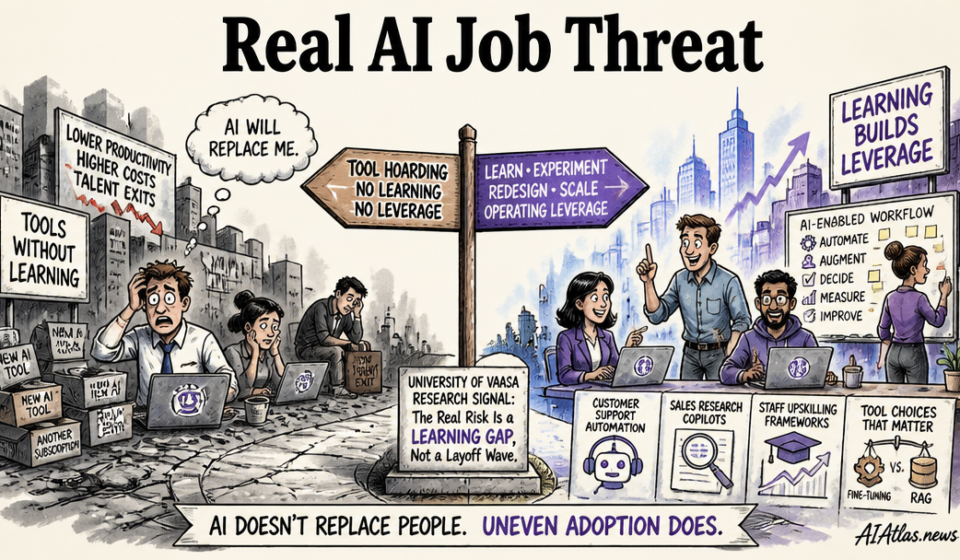
The Real AI Job Threat Is a Learning Gap, Not a Layoff Wave
The Strategic Objective
Research from the University of Vaasa doesn’t dispute that AI will reshape work. It reframes the debate: the bigger employment threat is not AI deleting roles overnight, but employees failing to adapt to generative AI tools and working practices. That is a market signal, not an HR footnote.
In our experience, the companies that win won’t be the ones buying the most AI tools. They will be the ones converting employee experimentation into repeatable operating leverage—redesigning workflows, choosing the right tools for the job, and applying them safely inside real constraints: quality, compliance, cost, and speed. For entrepreneurs and operators, the commercial read is uncomfortable but valuable: you’re building capability, not installing software.
Prerequisite Checklist
Before you spend another pound, we recommend you treat adoption as an organisational capability gap to close, not a technical procurement exercise. The University of Vaasa result points to “learning velocity” and workplace adaptation; your prerequisites should measure whether your teams can learn faster than the chaos.
Ask three blunt questions: Can your people redesign workflows? Will your org support safe experimentation? Do you have enough data and process clarity to evaluate whether the new method actually wins?
Training happens, but work design doesn’t change.
Measured pilots become standard practice.
Experiments fail; knowledge stays tribal.
Individuals win; the business can’t repeat it.
- Workflow map for 1–3 processes: inputs, outputs, decision points, failure modes, and where time is currently wasted.
- Tool shortlist aligned to tasks: drafting, classification, retrieval, summarisation, extraction—no generic “use ChatGPT” brief.
- Safety baseline: data handling rules, approval gates, and a clear definition of “acceptable risk”.
- Evaluation protocol: how you will test quality, cost per outcome, and error types before you scale.
- Learning loop ownership: one accountable owner per process, plus a small “practice community” to share patterns.
Sequence of Operations
If you want workforce productivity gains without lighting your budget on fire, run AI adoption like a product, not a procurement. Start small, measure hard, then standardise the workflow changes—because the University of Vaasa finding is ultimately about behaviour change.
Here’s the sequence we use when founders and enterprise leaders need results fast, and when investors want credible defensibility rather than demos.
- Select a high-leverage workflow: choose work with clear inputs/outputs, short feedback cycles, and measurable rework. Avoid “strategy” tasks that lack ground truth.
- Design the new workflow around intent: specify what the model should do, what humans must verify, and what happens when confidence is low.
- Instrument evaluation before rollout: create a test set (realistic samples), define quality criteria, track time saved, and log failure modes.
- Run a timeboxed pilot with controlled access: limited users, limited scope, clear escalation. Goal: learn patterns of safe use, not to “impress” internally.
- Standardise and embed: convert the winning workflow into templates, checklists, and training that teaches decision rules—not button-clicking.
Common Failure Points
We are seeing the same expensive mistakes across startups, scale-ups, and enterprise programmes. They all share one trait: they treat AI as a replacement for process thinking, when the competitive advantage is process redesign and learning velocity.
Here are the failure points that consistently drain cash while producing vague “productivity” claims.
- Tool-first budgeting: buying subscriptions before mapping workflow bottlenecks. This creates tool sprawl and no measurable outcome.
- No operational definition of quality: teams can’t tell whether accuracy improved or simply changed. Without ground truth, you can’t steer.
- Training without governance: users adopt unsafe patterns, then leadership panics and freezes the programme—turning learning into fear.
- Unbounded scope pilots: pilots expand to “everything the business touches”, which guarantees ambiguous results and stakeholder fatigue.
- Knowledge not captured: the best practices live in individuals’ heads. When they leave—or get reassigned—value disappears.
DIY vs Outsource Comparison
The DIY versus outsource question isn’t ideological; it’s about which parts of capability you can build quickly and safely. In our view, founders should DIY what drives learning velocity, and outsource what accelerates evaluation or compliance when internal expertise is thin.
Use the table below as a practical decision frame for budgeting, hiring strategy, and investor narratives. Be honest: if you can’t answer the evaluation questions, you’re not ready to scale.
| Decision area | DIY (build internally) | Outsource (buy expertise) | Primary risk |
|---|---|---|---|
| Workflow redesign | Faster tacit learning; clearer ownership | You may get diagrams, not durable practice | “Pretty plans” without adoption |
| Evaluation setup | You learn what “good” means in your context | Quicker start if testing craft is scarce | Vanity metrics and weak benchmarks |
| Safety & compliance | Best for long-term governance depth | Best for specialist risk assessments | Hidden exposure from unclear controls |
| Tool integration | Builds internal capability; slower at first | Speed, but watch vendor lock-in | Dependency on external providers |
| Scale & training | Creates repeatability and culture | Creates content; you still need adoption work | Low utilisation after rollout |
Visualised Workflow Roadmap
Think of the roadmap as an adoption pipeline: learning happens in the field, then becomes standard operating practice. If your roadmap is just “pilot then procure”, you’ll replicate the same failure patterns we see in enterprise transformation budgets.
Below is a practical, operator-friendly workflow roadmap for converting employee experimentation into repeatable results.
Verification & Success Metrics
Verification is where hype dies. In our experience, the only credible case for AI adoption—whether you’re pitching investors or justifying enterprise transformation budgets—is evidence that your workflows improve without adding unacceptable risk.
Set metrics before rollout, compare against a baseline, and publish the results internally in plain language. The goal is to prove that learning velocity translates into operational outcomes.
- Productivity: % reduction in cycle time (target: 15–30% in a well-chosen workflow) and/or throughput per person.
- Quality: measured error-rate categories (target: non-trivial improvements or stable quality with faster delivery).
- Reliability: deflection from rework—track “redo” counts and downstream corrections.
- Adoption: % of eligible tasks completed with the new workflow (not “trained users”); track usage frequency per team.
- Safety: number of policy violations, escalation events, and incidents requiring rollback (target: near-zero after governance stabilises).
- Unit economics: cost per outcome (including human verification time), not just software subscription spend.
The Long-Term Maintenance Plan
Once you have early wins, the biggest threat is regression: people revert to old habits, the toolchain changes, and evaluation drifts. Maintenance is where we see capability gaps reappear—quietly, then expensively.
Plan for continuous learning as part of your operating rhythm. In practical terms, that means governance that supports adaptation rather than freezing it, and training that updates decision rules as your workflow improves.
- Governance cadence: monthly review of quality and failure modes; quarterly refresh of evaluation sets.
- Model/tool change control: treat updates like product releases, with canary tests and rollback criteria.
- Internal champions programme: designate process owners who own the “how we work” documentation and training materials.
- Budget allocation for learning: reserve spend for evaluation, prompt/workflow iteration, and secure integration—not only model access.
- Defensibility for startups: turn workflow playbooks and evaluation rigs into an asset; investors should underwrite repeatability, not novelty.
Frequently Asked Questions
- How do we choose the first workflow for adoption?
- Pick work with clear inputs and measurable outputs, plus a feedback loop your team can access within weeks. Avoid vague knowledge work where “success” can’t be objectively verified.
- What does “adaptation” look like in practice for employees?
- Adaptation is learning judgement: when to use the tool, how to verify outputs, and how to recognise low-confidence situations. Training should teach decision rules and failure handling, not just prompts.
- When should we outsource versus build internally?
- Build internally where you need durable process ownership and learning velocity. Outsource evaluation craftsmanship and safety reviews when you lack specialists, but keep ownership of workflows and metrics with your team.