
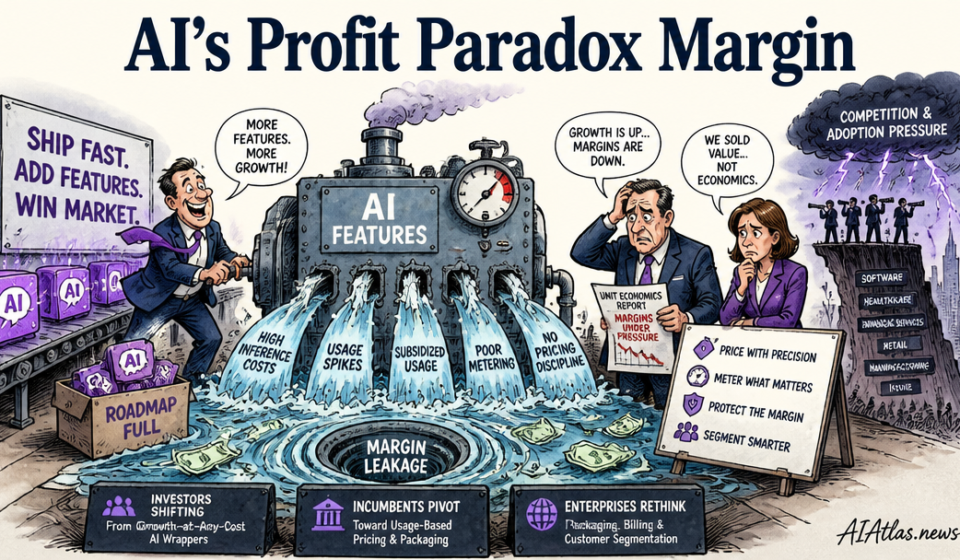
AI’s Profit Paradox: The Margin Crisis Hiding Inside Every ‘Smart’ Feature
The Headline Truth
DigitalRoute’s “AI State of Monetization 2026: The Year Pricing Broke” lands with uncommon clarity: only 8% of organisations fully understand the real cost of delivering AI features, while nearly half cite rising AI-related costs as a primary challenge. That combination is not a pricing issue in isolation—it is a measurement and attribution failure, and it sits directly on the income statement.
What we are seeing is a shift from the AI adoption cycle to the AI profitability cycle. The market has moved past “can it work?” and is now punishing “can you price it, meter it, and recover your serving costs consistently?” In our experience, teams still describe success in terms of feature velocity and engagement uplift, not cost-to-serve per unit of value. DigitalRoute is effectively telling investors: the unit economics are lagging the product.
Context Others Missed
Everyone says AI is expensive, but the study’s most investor-relevant point is that most companies do not even know where the expense is coming from. “Real cost” is rarely just the model bill. It includes prompt and response handling, retrieval pipelines, tool orchestration, vector storage and bandwidth, caching strategies, latency-driven infrastructure choices, and—most underestimated—operational overhead for QA and exception handling.
We also think the cost problem is structurally amplified by product design. When teams ship a wider surface area (“one more capability” for every customer segment), they implicitly broaden the compute envelope. Without disciplined cost attribution by feature, tenant, geography, and workflow, pricing becomes guesswork. Then procurement and renewals arrive, and the margin story that looked plausible in a demo disintegrates under real usage patterns.
The Commercial Ripple Effect
If you can’t measure the cost of serving, you can’t build pricing architecture that scales. That means the next competitive advantage won’t be “more AI features”—it will be the ability to meter usage, segment pricing by value and cost drivers, and manage margin at the point of interaction. The study suggests many organisations are deploying features faster than they can quantify unit economics, so pricing decisions arrive after the damage is done.
We expect to see a rapid shift in what counts as “product excellence”. Teams that treat cost-per-task, latency budgets, and workflow conversion rates as first-class product metrics will outperform those that treat them as backend concerns. Practically, that means feature packaging will become more granular, with explicit controls for model selection, context length, retry behaviour, and governance requirements—because those knobs determine margin.
Stakeholder Impact Analysis
For entrepreneurs, the immediate implication is due diligence on your own cost model. If only 8% of organisations understand delivery costs end-to-end, founders should assume their rivals are flying blind too—but investors will not be. We expect investor questions to become more surgical: What is your cost-to-serve per workflow? How does gross margin change with context length, tool calls, and retries? What percentage of spend is attributable to the “long tail” of complicated requests?
For investors and operators assessing exposure in AI-enabled companies, the risk is not that AI costs exist—it’s that they are unrecoverable. When costs are opaque, companies are forced into reactive pricing, bespoke enterprise contracts, or “discounting to preserve churn”, which quietly destroys margins. In portfolio terms, that turns an otherwise investable growth story into a cash burn story. The winners will show evidence: pricing experiments with measurable margin outcomes, not just revenue growth.
Strategic Comparison Table
Here’s how we see the market divide between feature-first monetisation and profit-first monetisation. The difference is not philosophical; it is operational.
| Dimension | Feature-first default | Profit-first alternative | Investor diligence question | Typical margin impact |
|---|---|---|---|---|
| Compute & inference | Single model assumption; limited cost tagging | Model routing, per-workflow cost accounting | What is cost per successful task by workflow? | Protects gross margin as usage scales |
| Latency & caching | Performance treated as UX only | Latency budgets linked to caching and retry policy | How do retries and timeouts affect unit cost? | Reduces waste and variance |
| Human-in-the-loop | Manual review assumed “occasional” | Review thresholds; automated escalation rules | What % of requests require paid human review? | Prevents hidden cost blow-ups |
| Data & compliance | One-size storage and governance policy | Retention tiers; policy-based processing costs | How do governance requirements change delivery cost? | Avoids margin erosion in regulated use |
| Packaging & pricing | Flat seats with implicit consumption | Metered usage, value caps, and cost-aware bundles | How fast do you detect and correct margin drift? | Improves recoverability of serving costs |
In our experience, the profit-first model is not “nickel-and-diming” customers; it is reducing unpredictable cost exposure. The pricing that survives renewals is the pricing that stays connected to the cost drivers inside the product.
Visualised Market Response (div)
We think 2026 is where the market’s patience ends. The DigitalRoute findings give us a storyline: measurement lags deployment, and pricing fractures when costs show up in bulk.
2024–2025
Feature sprint era
2026
Pricing breaks: only 8% fully understand real cost; ~50% cite rising AI costs
2026–2027
Cost attribution builds: workflow-level tracking and cost-by-feature
2027
Metering and governance: model routing, caching, retry control, and usage caps
2028
Margin durability: pricing tied to cost drivers and measured recovery
Investor takeaway
In the next round of competition, we expect procurement clauses, usage reporting, and cost transparency to become standard—not special. Companies that cannot show margin governance will be priced as “growth with unresolved unit economics”.
This is also why we expect pricing models to diversify. Pure flat-rate SaaS will become harder to justify for high-variance workloads. We’ll see more hybrid approaches: base subscription plus usage bands, cost-aware limits, and price adjustments tied to measurable consumption, not political negotiations.
Critical Market Risks
The first risk is structural: building revenue without building cost observability. When the product team controls roadmap and the finance team only sees aggregate spend, the business becomes reactive. That typically shows up as “mysterious” margin compression after launch, followed by emergency discounts or contract renegotiations.
The second risk is behavioural: teams optimise for adoption metrics while ignoring cost drivers. A feature that increases usage can lift top-line while silently inflating cost per outcome. The third risk is governance: without metering controls, the long tail of complex requests will dominate compute cost. The companies that address these risks will look boring at the feature level—and stronger at the earnings level.
Conclusion and Future Outlook
DigitalRoute’s message is uncomfortable for founders who built their strategy around speed, but it is empowering for those willing to operationalise profitability. We are entering an era where pricing architecture, metering precision, and cost attribution will determine survivability. The market will reward the teams that can measure the serving cost of every workflow, then price and govern accordingly.
Our future outlook is straightforward: the next wave of AI funding will tilt towards businesses that demonstrate margin recovery mechanisms, not just model performance. If you are evaluating an AI-enabled company—or planning one—start with the hard question: can they explain unit economics at the feature level, and can they prove that pricing keeps up with cost?
Frequently Asked Questions
- The study’s headline figure (8%) indicates most organisations lack end-to-end cost attribution for AI features. For investors, that means unit economics risk is likely understated in current market valuations.
- “Only 8% understand real cost” matters because pricing decisions depend on cost visibility. Without workflow-level cost models, companies will underprice high-variance usage and later struggle to recover margin.
- The most practical response is profit-first monetisation: metering, cost-by-feature tracking, and pricing tied to cost drivers. Founders should prioritise governance controls such as model routing, caching, and retry policies alongside commercial packaging.