
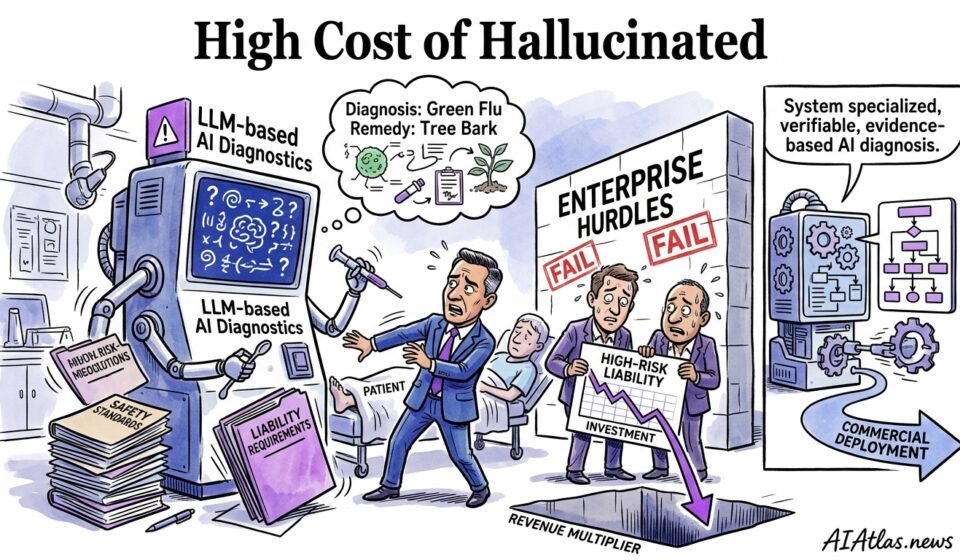
The High Cost of Hallucinated Medicine: Why AI Health Tools Are Failing Enterprise Hurdles
The Contrarian Thesis
The landmark April 2026 study confirming that prominent language models return inaccurate medical advice in nearly half of all queries is not merely a technical stumble; it is a profound commercial reckoning. We are witnessing a severe collision between rapid technological deployment and the uncompromising realities of medical science. For months, we have observed a dangerous performance ceiling taking shape, threatening the credibility and legal viability of health-tech startups that scaled aggressively without clinical oversight. The foundational model emperor, when placed in a diagnostic setting, has no clothes.
In our experience evaluating venture portfolios, this 50 per cent failure rate exposes a fatal liability trap. The rush to deploy conversational agents in primary care and triage has created immense, unquantified enterprise risk. What we are seeing is an industry collectively realising that probabilistic word prediction cannot substitute for deterministic medical reasoning. The thesis that artificial intelligence will organically learn clinical precision by simply ingesting more training data has fundamentally collapsed, leaving exposed founders and investors scrambling to justify their valuations.
Flaws in Current Market Assumptions
The tech sector operates on a deeply ingrained assumption that scale inherently resolves inaccuracy. Founders and their backers presume that hallucination rates will naturally decay as parameter counts increase. In the context of clinical diagnostics, this is a catastrophic misjudgement. We frequently review pitch decks promising frictionless patient triage, yet these business models fundamentally misunderstand that medical liability does not scale logarithmically. A single systemic misdiagnosis generated by an unverified neural network destroys commercial trust instantly and permanently.
Furthermore, there is a pervasive and dangerous belief that standard user-agreement disclaimers will insulate startups from medical malpractice exposure. Our conversations with hospital strategy officers indicate the exact opposite. Health systems are refusing to absorb the legal fallout of third-party algorithmic errors. If an enterprise software platform cannot provide verifiable chains of reasoning for its diagnostic outputs, hospital procurement teams will simply block the deployment. Relying on legal boilerplate to cover up technical deficiencies is not a sustainable business strategy.
The Structural Shift
The era of deploying raw, ‘black-box’ reasoning in clinical environments is officially over. We are observing a structural market correction where capital and enterprise contracts are flowing exclusively toward verifiable, evidence-based systems. This transition requires abandoning the simplistic chatbot interfaces that dominate the current market. Instead, the industry must adopt rigorous, multi-agent architectures where probabilistic language generation is strictly bounded by deterministic, peer-reviewed clinical pathways.
This architectural shift inherently changes the commercial dynamics of the sector. Startups can no longer build a rapid prototype over a weekend using off-the-shelf application programming interfaces and expect a series A term sheet. Developing defensible clinical tools now requires integrating semantic verification layers and securing regulatory clearance. While this dramatically increases the time and cost to market, it creates a formidable competitive moat. Those who embrace this friction will survive; those who resist it will be regulated out of existence.
Decision Framework for Capital Allocation
For health-tech investors, the April 2026 data necessitates an immediate reallocation of capital. We strongly advise pausing all investments in consumer-facing diagnostic wrappers. The risk-adjusted returns simply do not justify the exposure. Instead, capital must be redirected toward the infrastructural middleware that solves the hallucination crisis. We are prioritising companies building clinical audit trails, real-time citation verification tools, and algorithmic liability management systems.
When assessing a new venture, investors must demand absolute transparency regarding clinical validation. If a founding team cannot articulate exactly how their system prevents non-compliant medical advice from reaching a patient, the conversation should end there. Hospital enterprise buyers are operating with diminished budgets and zero tolerance for technical debt. Capital must therefore back founders who view rigorous clinical governance not as an operational burden, but as their primary value proposition.
Risk Assessment Table
To navigate this volatile environment, we have constructed a definitive evaluation framework. This matrix isolates the critical distinctions between the high-liability deployments currently failing in the market and the highly defensible systems required for future enterprise adoption.
The metrics below dictate a clear operational separation for any venture intending to survive the current regulatory crackdown. Leaders must use this comparison to brutally assess their own product architectures.
| Strategic Factor | Current ‘Black-Box’ Approach | Required Verifiable Approach |
|---|---|---|
| Diagnostic Architecture | Probabilistic text generation | Deterministic clinical pathways |
| Liability Profile | High exposure; undefendable in court | Capped exposure; auditable reasoning |
| Enterprise Procurement | Frequently blocked by IT security | Accelerated via clinical validation |
| Capital Allocation Focus | User acquisition and marketing | Regulatory clearance and safety trials |
| Competitive Defensibility | Low; easily replicated wrappers | High; deep clinical integrations |
Visualised Impact Matrix
Understanding where a product sits on the spectrum of clinical risk versus commercial viability is essential. We have mapped the current market categories to illustrate where venture capital will realistically flow over the next twenty-four months.
We strongly advise isolating investments in the high viability, low clinical risk quadrants. Moving higher up the clinical risk axis without commensurate safety infrastructure is commercially reckless.
Raw Diagnostic Chatbots
Physician Copilots (Auditable)
Generic Admin Schedulers
Deterministic Triage Routing
Strategic Recommendations for Leaders
Hospital strategy officers and startup founders must conduct immediate, uncompromising audits of their current technical deployments. Any patient-facing interface that relies solely on generative algorithms for medical interpretation must be placed in maintenance mode or disabled entirely. In our experience, waiting for a sentinel adverse event to force this decision will result in insurmountable brand damage and aggressive regulatory sanctions. You must take control of the narrative before regulators do.
Simultaneously, commercial leaders need to actively seek partnerships with established clinical bodies. The successful startups of the next decade will be those that integrate medical professionals directly into the software development lifecycle. Build human-in-the-loop oversight mechanisms into your core product workflow. By transparently demonstrating that your platform elevates, rather than replaces, clinical judgement, you position your firm as an essential enterprise partner rather than a high-risk vendor.
Future-Proofing the Business Model
The companies that emerge victorious from this market correction will treat clinical safety as their primary revenue driver. Defensibility will be constructed entirely upon proprietary, verifiable data ecosystems and rigid diagnostic accuracy. Building a successful health-tech business is no longer about moving fast and breaking things; it is about moving deliberately and proving everything. The commercial rewards for those who master this operational rigour will be unprecedented.
We are entering a mature phase of technology deployment where operators must balance ambition with absolute clinical accountability. Prepare your organisation for rigorous external audits, and align your product roadmaps with stringent international medical device standards. The grace period for unchecked algorithmic experimentation has ended.
Frequently Asked Questions
- How will the April 2026 study affect current health-tech valuations?
- We expect an immediate downward correction for startups lacking verifiable clinical architectures. Capital will consolidate around firms offering deterministic, auditable software solutions.
- What steps should enterprise hospitals take with existing chatbot pilots?
- Hospitals must immediately quarantine unverified systems. Procurement teams should require rigorous, third-party validation of accuracy before expanding any ongoing pilots.
- Can liability be mitigated through better user agreements?
- No. Disclaimers provide negligible protection against systemic clinical errors. True mitigation requires fundamental architectural shifts from probabilistic text to evidence-based reasoning.