
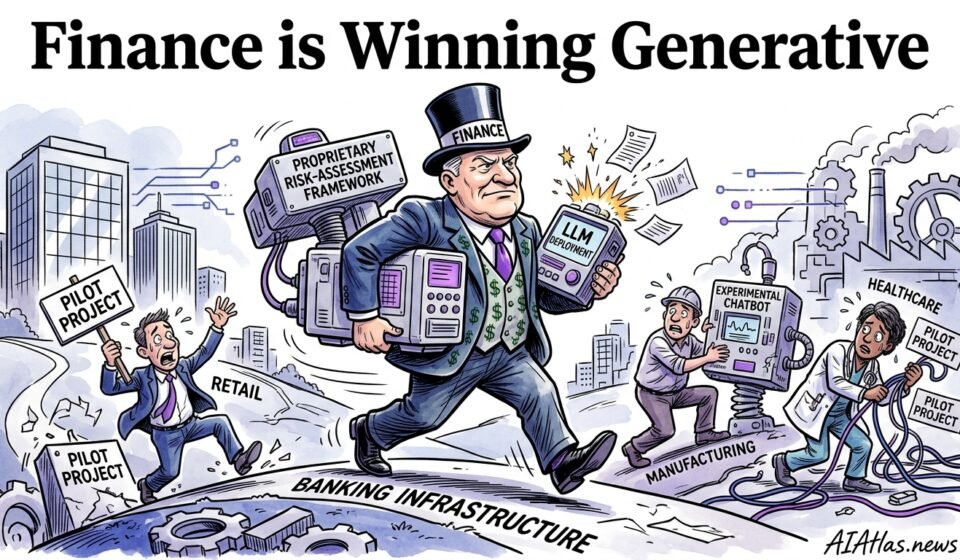
Why Finance is Winning the Generative AI Arms Race
The Contrarian Thesis
What we are seeing in the market is a fundamental misallocation of attention. While the broader tech ecosystem fixates on conversational interfaces and generative customer service features, global tier-one banks are executing a vastly different playbook. They are systematically moving away from off-the-shelf generative pilots and directing serious capital towards proprietary large language models specifically trained for institutional risk assessment. In our experience, this divergence represents the most significant commercial moat being constructed in the financial sector this decade.
It is a thesis that contradicts the prevailing narrative of AI as a universal consumer equaliser. By embedding complex reasoning engines deep within their proprietary risk frameworks, financial institutions are locking down competitive advantages that startups cannot replicate via open API calls. The commercial trade-off is clear: banks are willingly sacrificing the marketing visibility of flashy consumer tools to secure structural dominance in credit decisioning, fraud detection, and capital allocation.
Flaws in Current Market Assumptions
A pervasive error among fintech founders and technology commentators is the assumption that consumer-facing deployment is the ultimate validation of an AI product. We routinely observe startup founders pitching generative tools designed to help retail customers navigate their spending habits. However, the commercial reality of banking dictates that customer experience, while important, is entirely secondary to the accurate pricing of risk.
Deploying non-deterministic models in consumer-facing environments introduces an asymmetric compliance liability. Hallucinations in a customer service chatbot can trigger immediate regulatory censure and reputational damage. Conversely, an internal LLM acting as a co-pilot for a human credit analyst presents a highly contained risk profile with massive upside. The market has incorrectly priced the value of consumer delight over operational alpha, leaving a massive blind spot that incumbents are actively exploiting.
The Structural Shift
We are witnessing a decisive migration from experimental, third-party model dependency towards fully sovereign, proprietary infrastructure. Banking infrastructure is uniquely suited to this deployment model because financial institutions possess the one asset that cannot be easily commoditised: decades of highly structured, heavily audited, proprietary financial data. This historical repository of transaction flows, default events, and market shocks provides the perfect training substrate for highly specialised local models.
This shift moves the industry from renting intelligence to owning intellectual property. Rather than relying on generalised models that know a little about everything, banks are fine-tuning smaller, highly specific models that understand the nuanced language of financial contracts, SWIFT messages, and loan covenants. This creates an environment where the infrastructure itself becomes the product, effectively boxing out new entrants who lack the historical data required to train competing systems.
Decision Framework for Capital Allocation
For venture capitalists and CTOs navigating this environment, the capital allocation framework must urgently adapt. We advise our partners to cease funding thin integration layers that rely entirely on public foundational models. Instead, investment should flow towards companies building the picks and shovels for secure, on-premise model deployment: data sanitisation pipelines, compliance verification tools, and model auditing frameworks.
The trade-off here involves balancing immediate deployment speed against long-term defensibility. Developing a proprietary risk-assessment LLM demands significant upfront capital expenditure in compute arrays and specialist talent. However, this high barrier to entry is exactly what makes the strategy appealing to regulated incumbents. Capital must be directed towards initiatives that compound in value as the underlying data grows, rather than software that faces immediate obsolescence when foundational model providers update their core offerings.
Risk Assessment Table
The divergence between internal risk deployment and external consumer features demands a rigorous comparison. We have formalised the commercial trade-offs in the table below, evaluating the structural differences that drive enterprise adoption.
This comparison highlights why regulated entities are uniformly retreating from the public-facing deployment of non-deterministic systems, opting instead for highly controlled, back-office implementations.
| Deployment Category | Primary Value Driver | Regulatory Liability | Data Moat Defensibility | Capital Requirement |
|---|---|---|---|---|
| Proprietary Risk LLMs | Credit pricing & fraud detection | Contained (Human-in-loop) | Extremely High | High (Compute & Talent) |
| Consumer Generative Bots | Customer service deflection | Severe (Hallucination risk) | Low | Low to Medium |
| Internal Knowledge Graph | Policy & document retrieval | Low | Medium | Medium |
| Off-the-Shelf APIs | Rapid prototyping | High (Data privacy leakage) | Zero | Low (Variable Opex) |
| Algorithmic Trading Agents | Market execution alpha | Extreme | High | Very High |
Visualised Impact Matrix
To practically map where value is accumulating, we must plot these initiatives against their commercial viability. The matrix below illustrates the current landscape, contrasting operational impact against feasibility and regulatory risk.
We classify high-impact, highly feasible projects entirely within the realm of internal operations and risk management, whilst consumer-facing features linger in the high-risk, low-impact quadrant. This visualises the precise areas where institutional capital is currently being deployed.
High Feasibility / Contained Risk
Autonomous Trading
Agents
Proprietary Risk LLMs
& Compliance Engines
Retail GenAI
Chatbots
Internal Document
Search & Retrieval
High Commercial Impact
Strategic Recommendations for Leaders
Founders attempting to sell into global banks must radically adjust their product roadmaps. The appetite for generic productivity tools has evaporated. What we are seeing is an intense demand for middleware that allows institutions to securely connect their proprietary data lakes to locally hosted open-source models. If your product does not explicitly reduce the friction of internal, sovereign model deployment, it will simply not survive the institutional procurement cycle.
Furthermore, leaders must cultivate deep expertise in algorithmic governance. The most valuable vendors in the next five years will be those who can mathematically prove that an LLM’s credit decision does not violate anti-discrimination laws. Stop building conversational interfaces; start building deterministic guardrails for probabilistic reasoning engines. That is where the enterprise budgets are moving.
Future-Proofing the Business Model
Surviving the next wave of industry consolidation requires a stark acknowledgement of where your firm sits in the financial value chain. If you are an intermediary relying on information arbitrage, proprietary models deployed by tier-one banks will inevitably compress your margins to zero. You must either own a unique dataset that these models need for fine-tuning, or own the secure workflow that financial analysts use to consume the model’s outputs safely.
We remain convinced that the institutions embedding sophisticated risk assessment capabilities into their core banking ledgers today are establishing monopolies for the next decade. The window for startups to provide auxiliary infrastructure is rapidly closing. Future-proofing now demands aggressive, highly concentrated bets on vertical-specific compliance, model auditing, and absolute data sovereignty.
Frequently Asked Questions
- Why are consumer-facing AI features considered a distraction for major banks?
- Consumer-facing AI introduces severe compliance and reputational liabilities due to model hallucinations. Banks recognise that the true commercial value lies in accurately pricing risk and automating compliance, which yields massive structural advantages rather than minor customer service efficiencies.
- How does a proprietary risk