
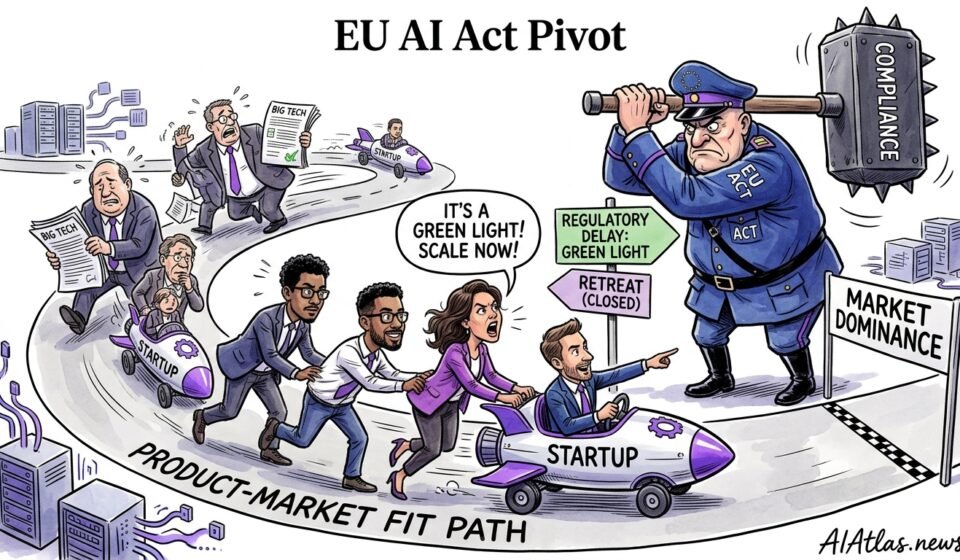
The EU AI Act Pivot: Why Compliance Delays Are a Strategic Green Light
The Headline Truth
In our view, the May 7, 2026 finalisation of the EU AI Omnibus represents the most significant commercial reprieve European technology has seen this decade. By officially pushing high-risk system compliance deadlines to December 2027 and August 2028, Brussels has fundamentally altered the startup lifecycle on the continent. The mainstream press has predictably framed this delay as a bureaucratic failure, a legislative stalling tactic, or a concession to intense corporate lobbying from multinational tech conglomerates. We see the situation entirely differently, viewing it through a strictly commercial lens.
What we are seeing is a deliberate and highly valuable decoupling of early-stage product innovation from crippling, long-term legal overhead. For the last two years, founders building high-risk models—ranging from biometric categorisation to critical infrastructure management and automated employment sorting—have been forced to budget for severe legal compliance before they even confirmed their product-market fit. This legislative pause removes the immediate compliance hammer, transforming an existential threat into a scheduled, manageable operational milestone. It effectively hands operators the runway they desperately needed.
Context Others Missed
If you merely read the top-line summaries from standard news outlets, you might assume the regulatory landscape has simply frozen in place due to political gridlock. However, our ongoing conversations with leading Chief Legal Officers and regulatory specialists across London, Paris, and Berlin reveal a much more nuanced operational reality. The delay is not a retreat by European legislators; it is a pragmatic acknowledgement that the physical and bureaucratic infrastructure required to assess these complex systems—notably the state-appointed notified bodies and independent testing frameworks—is nowhere near ready for commercial-scale deployment.
For startup founders, this structural delay translates directly into a critical window of operational freedom. Previously, the threat of impending regulation forced engineering teams to build conservative, easily auditable features at the expense of genuine user value and rapid iteration. Now, teams possess an eighteen to twenty-four month runway to aggressively test assumptions, acquire users, and secure market share without the immediate spectre of regulatory audits. The smartest operators will use this period to solidify their user base, ensuring that when the compliance costs eventually arrive, they are supported by mature, recurring revenue streams rather than finite, dilutive seed capital.
The Commercial Ripple Effect
The immediate consequence of the AI Omnibus delay is a dramatic shift in how venture capital will be deployed across European technology hubs. Over the past twelve months, we observed a worrying trend where early-stage startups were forced to allocate up to thirty percent of their initial funding rounds strictly towards regulatory readiness and legal consultancy. Capital that should have been spent on securing exceptional machine learning talent, refining data pipelines, and executing aggressive market expansion was instead locked away in defensive posturing to appease anxious board members.
With the deadlines firmly pushed to late 2027 and mid-2028, investor calculus changes overnight. Venture funds are now actively encouraging their portfolio companies to redirect those dormant compliance budgets back into pure research, development, and customer acquisition. We anticipate a sharp acceleration in commercial deployments across sectors previously deemed too risky for early-stage disruption, particularly in healthcare diagnostics and automated financial decisioning. Startups can now afford to build scale first, treating the eventual regulatory framework as a standard cost of doing business rather than an insurmountable barrier to entry.
Stakeholder Impact Analysis
Different players within the ecosystem will experience this Omnibus delay in fundamentally different ways, necessitating tailored operational responses. For early-stage startup founders, the mandate is abundantly clear: focus ruthlessly on commercial validation and user growth. The pressure to prematurely optimise data architectures for theoretical compliance audits has dissipated, allowing product teams to concentrate on solving genuine customer pain points. However, this freedom demands strict internal discipline; engineering leaders must still meticulously document their architectural decisions to avoid catastrophic, highly expensive retrofitting costs when the 2027 deadlines eventually materialise.
For investors and Chief Legal Officers, the timeline shift requires a complete recalibration of risk assessment and resource allocation. Investors can now confidently underwrite aggressive European expansion plans for their US-based portfolios without fearing immediate regulatory roadblocks or sudden fines. Meanwhile, CLOs at later-stage companies must pivot from reactive firefighting to strategic capacity building. Rather than scrambling for expensive external counsel to meet an impossible compliance deadline, legal teams now have the breathing room to hire dedicated internal specialists, establish robust data governance frameworks, and map out a phased compliance strategy that aligns seamlessly with the commercial product roadmap.
Strategic Comparison Table
To properly understand the magnitude of this legislative shift, we must contrast the operational assumptions of the previous operating environment with the new realities established by the May 2026 AI Omnibus. The table below outlines how this delay reshapes fundamental business strategies across five critical operational vectors. The transition from defensive planning to offensive execution is the defining commercial characteristic of this new regulatory era.
| Business Vector | Previous Assumption (Pre-Omnibus) | New Reality (Post-Omnibus) |
|---|---|---|
| Capital Allocation | High percentage of seed capital reserved for external legal counsel and compliance audits. | Funds redirected entirely toward engineering talent, product iteration, and market capture. |
| Go-to-Market Strategy | Delayed feature releases pending extensive internal regulatory reviews. | Aggressive launch schedules aimed at rapidly establishing product-market fit. |
| Legal Operations | Reactive firefighting to meet immediate, poorly-defined statutory deadlines. | Strategic, phased recruitment of internal compliance specialists over an 18-month period. |
| Enterprise Procurement | Stalled vendor contracts due to imminent regulatory uncertainty and liability fears. | Accelerated deal closures as statutory liability is definitively deferred to late 2027. |
| Product Roadmap | Over-indexed on building defensive audit trails rather than core user functionality. | Balanced approach: prioritising core functionality whilst maintaining basic architectural hygiene. |
Visualised Market Response
Mapping the revised compliance timeline is absolutely essential for visualising the actual commercial runway now available to ambitious operators. We have designed the following timeline to illustrate the distinct phases of market response, demonstrating exactly how the legislative delay creates a structured progression from rapid, unfettered iteration to final, rigorous compliance. This sequential view highlights the clear operational window startups now possess for achieving vital product-market fit before regulatory costs spike.
May 2026: The Omnibus Decision
Immediate decoupling of innovation from compliance. Capital unlocked for pure R&D.
Q3 2026 – Q2 2027: The Golden Iteration Window
Founders aggressively pursue product-market fit and revenue scaling unburdened by audit costs.
December 2027: First Compliance Milestone
Initial transparency requirements activate for mature, revenue-generating high-risk systems.
August 2028: Full Enforcement
The compliance hammer falls. Only companies that successfully used the runway to scale will easily absorb these costs.
Critical Market Risks
While the delayed compliance schedule offers undeniable commercial benefits, it simultaneously introduces an insidious new risk profile: the silent accumulation of immense technical and regulatory debt. We are already hearing from certain factions within the venture community who mistakenly believe that the Omnibus delay signals a permanent softening of European technology policy. This is a profound and dangerous miscalculation. Startups that treat this extension as a free pass to completely ignore data provenance, model transparency, and bias testing will face insurmountable rebuilding costs when the December 2027 deadlines finally materialise.
Furthermore, there is a substantial risk of market bifurcations driven strictly by enterprise procurement behaviour. Even if the legislative hammer is temporarily paused, large corporate clients—particularly in banking and healthcare—may still demand stringent compliance guarantees before signing significant vendor contracts. Startups that completely abandon their internal governance initiatives may find themselves unable to close enterprise deals, functionally locking them out of the most lucrative market segments. The operational challenge for management teams is maintaining a dual-track mindset: innovating at maximum speed to capture market share, whilst quietly laying the basic architectural foundations required for future audits.
Conclusion and Future Outlook
The May 2026 AI Omnibus decision fundamentally rewrites the playbook for European technology commercialisation over the next three years. By replacing an atmosphere of immediate regulatory panic with a structured, phased enforcement timeline, Brussels has inadvertently handed ambitious founders the exact resource they needed most to compete globally: time. Time to test hypotheses, time to fail without catastrophic legal penalties, and crucially, time to build sustainable, revenue-generating businesses capable of absorbing eventual compliance overheads.
In our final judgement, the commercial winners in this new era will not be the companies that ignore regulation entirely, nor will they be the overly cautious incumbents that over-prepare prematurely. The market will be conquered by pragmatic operators who systematically exploit this eighteen-month window to aggressively establish product-market fit, whilst maintaining just enough engineering discipline to survive the regulatory winter of 2028. For founders, investors, and legal officers alike, the starting gun for European market dominance has not been delayed; the parameters of the race have simply changed to favour rapid execution.
Frequently Asked Questions
- How does the Omnibus delay directly impact current startup funding rounds?
- It drastically improves capital efficiency for early-stage companies. Founders can now pitch investors with the assurance that seed capital will be deployed entirely toward product development and user acquisition, rather than being swallowed by immediate legal and compliance consultancy fees.
- Should companies halt their ongoing compliance preparations entirely?
- Absolutely not. While immediate hiring for dedicated compliance roles can be deferred, engineering teams must maintain basic architectural hygiene and document data provenance, otherwise they will face crippling technical debt when the 2027 enforcement dates arrive.
- Will enterprise clients still require compliance guarantees before 2027?
- Yes, significantly so. Risk-averse corporate procurement teams, especially in finance and healthcare, often implement internal standards that mirror upcoming regulations long before they are legally enforced, meaning startups still need defensible governance practices to close enterprise deals.