
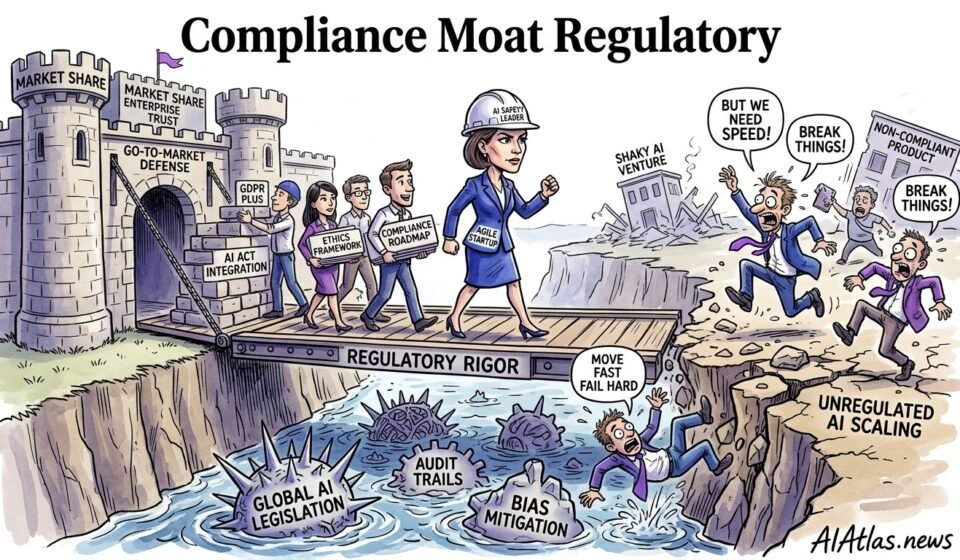
The Compliance Moat: Why Regulatory Rigor Is Your Next Competitive Advantage
The Contrarian Thesis
Global lawmakers are dropping the hammer on autonomous systems and generated disinformation, sparking a profound panic among Silicon Valley and European tech hubs. Industry leaders are forcefully arguing that these accelerating legislative efforts will stifle economic growth, throttle product velocity, and cede technological supremacy to less regulated nations. In our experience, this dominant narrative completely misreads the commercial reality. We are watching companies waste precious venture capital lobbying against the inevitable, treating government intervention as an existential threat rather than a structural advantage.
We maintain a contrarian thesis: compliance is not a bottleneck; it is an aggressive commercial moat. What we are seeing on the ground is that treating AI regulation as a rigid operational roadmap allows astute operators to secure massive market share before the regulatory floor hardens. By the time the dust settles and federal mandates take full effect, the cost of retrofitting opaque models will bankrupt latecomers. The market will soon belong exclusively to those who recognise that regulatory alignment is a core product feature, aggressively embedding governance into their underlying architecture.
Flaws in Current Market Assumptions
Most venture-backed boards are currently operating under the delusion that moving fast and breaking things still applies to geopolitical tech governance. They assume that pending legislation will be watered down, prompting a wait-and-see approach to infrastructure investment. In our view, this hesitation represents a catastrophic misallocation of time. Boards are viewing governance purely as a legal headache to be deferred, failing to recognise that enterprise buyers are already adjusting their procurement standards to mitigate third-party liability.
This widespread assumption creates a massive vulnerability for incumbents. If you wait for the European Union or the United States federal government to finalise their enforcement mechanisms, you have already lost the commercial race. The architectural debt accrued by deploying unconstrained, unauditable generative platforms will be impossible to service once compliance audits become mandatory. Expecting leniency or delayed enforcement is a fundamentally flawed strategy that exposes investors to unacceptable levels of commercial risk.
The Structural Shift
We are witnessing a permanent structural shift from a market that rewarded pure, unconstrained product velocity to one that demands defensible, transparent architecture. Early-stage capital is no longer subsidising reckless scale; it demands a clear line-of-sight to regulatory viability. Institutional investors are actively pulling term sheets from startups that cannot demonstrate exactly how their models handle data lineage, bias mitigation, and automated decision-making controls.
This structural shift dramatically elevates the role of compliance officers, transforming them from internal roadblocks into direct revenue-enablers. Startups that embed auditability and safety kill-switches into their core tech stack from day one are commanding premium valuations. They are winning lucrative enterprise contracts because they effectively de-risk the deployment process for their clients. It is becoming increasingly evident that provable safety is the new primary vector for establishing trust and closing enterprise sales.
Decision Framework for Capital Allocation
For investors and founders alike, capital allocation strategies must pivot immediately towards governance-first infrastructure. Pouring hundreds of millions into raw compute power without a corresponding, aggressive investment in risk mitigation is a fast track to holding stranded assets. We advise leadership teams to radically restructure their development budgets, allocating a minimum of twenty-five percent of their engineering spend specifically to regulatory alignment, explainability frameworks, and synthetic data licensing.
Our operational framework prioritises funding entities that build provable, deterministic systems. We look for teams that can trace their system outputs directly to distinct, licensed training data pools without falling back on algorithmic opacity. When assessing portfolio companies, we penalise those treating safety as a post-launch add-on. If the core mechanics of the platform cannot be easily deciphered and audited by a third-party regulator, we strongly advise against deploying capital into the business.
Risk Assessment Table
To successfully navigate this transition, leadership teams must rigorously quantify the specific commercial threats associated with lagging compliance. Ignoring the tightening legislative grip is no longer viable for any company operating at scale. The cost of non-compliance has shifted from nominal fines to existential business interruptions.
We have outlined the primary threats facing autonomous systems and generative platforms over the next twenty-four months, alongside the operational impact for those caught unprepared. This matrix serves as a baseline for recalibrating enterprise risk.
| Risk Category | Regulatory Threat Level | Commercial Impact | Primary Target | Mitigation Strategy |
|---|---|---|---|---|
| Autonomous System Liability | Critical | Immediate product recalls and massive civil damages. | Healthcare, Logistics, FinTech | Implement strict human-in-the-loop override protocols. |
| Copyright & IP Infringement | High | Forced model deletion and retroactive licensing fees. | Generative Media, Coding Copilots | Deploy licensed data exclusively with full provenance tracking. |
| Disinformation Penalties | Critical | Platform bans and severe statutory fines across the EU. | Social Media, News Aggregators | Integrate cryptographic watermarking and origin authentication. |
| Algorithmic Opacity | High | Loss of public sector contracts and enterprise procurement bans. | Credit Scoring, Recruitment Tech | Build explainable architectures with transparent decision trees. |
| Cross-Border Data Transfer | Moderate | Service fragmentation and localised infrastructure costs. | Global SaaS Platforms | Adopt federated learning and strict local data sovereignty protocols. |
Visualised Impact Matrix
Understanding exactly where enterprise capital is flowing requires a clear view of shifting market priorities. As aggressive legislation forces the issue, enterprise technology budgets are being drastically reallocated away from experimental research and toward operational security.
Below is our breakdown of where forward-thinking corporations are redirecting their infrastructure spend to proactively eliminate regulatory bottlenecks. This share distribution highlights the dominance of defensive engineering.
Data Provenance (28%)
Red-Teaming & Security (20%)
Raw Compute Scaling (14%)
Strategic Recommendations for Leaders
We urge chief executives to fundamentally overhaul their product lifecycles. Stop treating legal counsel as a final, tedious hurdle just before a product launch. You must integrate your compliance, legal, and risk teams directly into the initial product discovery phase. Architect your systems from day one with the baseline assumption that you will face strict liability for any automated decision your platform makes.
Furthermore, it is critical to establish a direct, ongoing dialogue with regulatory bodies. Do not merely react to laws; actively participate in shaping the technical standards that will govern your sector. The companies that help draft these operational guidelines will inevitably influence rules that favour their own proprietary architectures. This strategy effectively pulls the ladder up behind them, creating insurmountable barriers to entry for smaller, less sophisticated competitors.
Future-Proofing the Business Model
Building a resilient commercial entity in this turbulent environment means completely abandoning the illusion of unregulated technological expansion. The market share of tomorrow belongs exclusively to those who view stringent governance as a highly marketable feature, rather than a bureaucratic tax. Trust and auditability are becoming the primary metrics by which enterprise software is judged.
As we look ahead to the next phase of deployment, the ultimate winners will not necessarily be the teams boasting the largest parameter models. The victors will be those operating the most trusted, transparent, and compliant systems. Adapt your strategic roadmap right now, embedding regulatory constraints into your core value proposition, before the legislative floor permanently solidifies beneath you.
Frequently Asked Questions
- Why shouldn’t startups just wait for the final regulations to be published before adapting?
- Waiting ensures you accumulate insurmountable architectural debt that is too costly to retrofit. By anticipating the legislative trajectory now, you build a compliant infrastructure that secures enterprise contracts while your competitors are forced to halt development.
- How does treating regulation as a roadmap actually increase a company’s market share?
- Enterprise buyers are incredibly risk-averse regarding third-party software liability. If your product natively addresses data provenance and explainability, you instantly become the only viable vendor for highly regulated industries, capturing their budgets effortlessly.
- What is the most urgent step a tech CEO must take today to align with this shift?
- CEOs must immediately reallocate at least twenty-five percent of their engineering resources away from raw feature scaling and toward model explainability and compliance logging. Integrating legal and risk teams into the initial product design phase is now mandatory.