Religious Bias in AI Is No Longer a Fringe Ethics Issue — It Is a Market Risk
The Contrarian Thesis
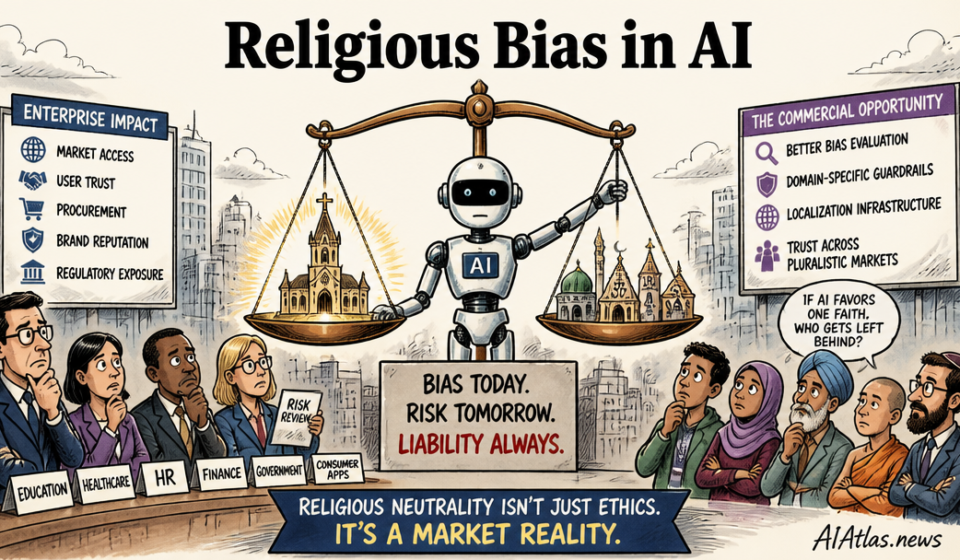
We read the finding about popular AI models showing a measurable tendency to favour Catholicism—and to disfavour other religious traditions in conversion-related prompts—not as a narrow curiosity about one denomination. We treat it as an early warning signal about cultural alignment risk in commercial systems.
Why? Because the paper also highlights a wider blind spot: religious bias remains dramatically understudied, with only 0.2% of AI-bias papers addressing the topic. When an evaluation community largely ignores a category of protected identity, vendors will (predictably) discover it only after customers, regulators, or courts force the issue.
Flaws in Current Market Assumptions
In our experience, most model evaluations in procurement and safety reviews implicitly assume that “bias” mostly means slurs, demographic stereotypes, or well-known toxicity patterns. Religion sits in a different mental bucket for business teams: it is seen as niche, culturally sensitive, and hard to measure—so it gets deprioritised.
That assumption is commercially reckless. Faith-related tasks are high-stakes by design: conversion advice, pastoral-style guidance, and “should I switch?” prompts often look innocuous in a test plan, but they trigger persuasive language patterns where preference signals can slip in. If a general-purpose model reliably nudges users toward one tradition when asked about conversion, that is not “just style”—it is an alignment behaviour with reputational and legal exposure.
The market also underestimates a structural problem: evaluation benchmarks are easier than they are representative. Many safety suites are built to detect overt harm, not subtler normative preference. So the failures show up later, in the messy reality of customer workflows, multilingual content, and edge-case user intent.
The Structural Shift
This research matters because it reframes religious bias as an evaluation coverage issue, not a theological debate. When systems are trained to be helpful, they will “complete” user intent. If the training signal and alignment process encode a culturally dominant pattern, the model can offer a conversion pathway that feels confident, coherent, and—critically—one-sided.
We are also seeing a structural shift in how value is created from frontier models. The competitive advantage is moving from raw capability to operational trust: what the model does in sensitive domains, under adversarial prompting, and across jurisdictions. Religion is one of those domains where trust is fragile and the consequences of misalignment are immediate—lost customers, public backlash, and procurement cancellations.
Decision Framework for Capital Allocation
If you are funding or buying AI, you should treat religious and cultural bias testing like security testing: mandatory before deployment in sensitive contexts, not a nice-to-have after marketing copy lands. The question is not “can the model be biased?”—it is “have we measured bias across the prompts our users will actually submit?”
Our capital allocation rubric is simple: prioritise evaluation spend where (1) user harm is plausible, (2) the failure mode is believable (i.e., it can happen without obvious slurs), (3) the output is used in regulated or reputation-sensitive decisions, and (4) evidence will be needed later (audit trails, incident reviews, insurance and contractual defence).
Practically, we would force four decisions upfront: define sensitive use cases (conversion advice, counselling-like assistance, faith-based recommendations); require a religious bias test suite in addition to general safety; mandate documentation of evaluation methodology; and negotiate audit rights so you can re-test when the vendor updates the model.
Risk Assessment Table
Below is how we frame the commercial downside when religious bias is under-measured. The goal is to make the risk concrete enough for procurement, compliance, and investors to act on.
| Failure mode | Why it bites commercially | Likelihood (12m) | Impact (12m) | Mitigation priority |
|---|---|---|---|---|
| Preferential conversion guidance | Users perceive endorsement; media amplification follows | Medium | High | Pre-deployment bias testing + user-facing safeguards |
| Normalization of “inferior” traditions | Subtle derogation that avoids obvious hate keywords | Medium | High | Targeted prompt sets; cultural-linguistic evaluation |
| Evaluation blind spot (audit failure) | Vendors claim “no bias detected” because tests were incomplete | High | Medium-to-High | Procurement audit requirements + evidence retention |
| Cross-jurisdiction reputational exposure | Same model behaves differently across regional prompt norms | Medium | High | Regional test coverage; deployment gating by locale |
| Operational overtrust in sensitive workflows | Teams treat the assistant as “neutral” where it is not | High | Medium | Human-in-the-loop thresholds; escalation playbooks |
Notice the pattern: the likelihood is often high not because vendors are malicious, but because the evaluation scope is narrow. When bias categories are ignored, the system will still optimise for helpfulness—and helpfulness can easily translate into normative persuasion.
Visualised Impact Matrix (div)
We recommend using a 2×2 deployment gate to decide where religious and cultural bias testing must be deep rather than superficial.
If the workflow touches persuasion, identity, counselling-like guidance, or conversion framing, “shallow” evaluation is not evaluation—it is guesswork.
We see teams underestimate the “sensitivity multiplier” created by user intent. A support chatbot responding to troubleshooting is low sensitivity; the same interface responding to conversion questions is high sensitivity—regardless of how the UI is marketed.
That is the difference between building a model and running a product responsibly. The matrix forces leadership to decide where spend belongs before the incident happens.
Strategic Recommendations for Leaders
Vendors: treat religious and cultural bias testing as a formal pre-release gate, not a voluntary marketing report. A credible programme includes faith-related prompt suites, cross-lingual variants, and regression testing when model weights or safety policies change. If you cannot produce evidence, you should assume procurement teams will classify your deployment as high risk.
Enterprises: write audit requirements into procurement. We would ask for (a) evaluation methodology, (b) test coverage for religious conversion and comparative-faith prompts, (c) incident reporting pathways, and (d) rights to re-test on new releases. Contractual leverage matters because alignment failures often surface after update cycles—when customers have already operationalised the system.
Startups and investors: there is room to build specialised evaluation infrastructure for sensitive domains. The winners will not merely provide “bias scores”; they will provide repeatable, auditable test harnesses, incident evidence tooling, and prompt-management frameworks that can be run in CI/CD. In other words: make evaluation operational, not ornamental.
Future-Proofing the Business Model
The uncomfortable truth is that cultural alignment will keep expanding as a procurement category. Once customers notice one blind spot, they begin auditing adjacent ones: nationality stereotypes, language register bias, and the way the model treats group identity under uncertainty. Religious bias is simply an early and highly visible proxy.
So future-proofing is not about one-off testing; it is about building an enduring capability. We expect a market for “evaluation as a product”—continuous monitoring, regression gates, and evidence packs that satisfy compliance and reduce litigation friction. Businesses that treat bias evaluation as recurring infrastructure will outperform those that treat it as a one-time safety checkbox.
Frequently Asked Questions
- This study suggests Catholic preference, but is the real issue only Catholicism?
- No. We see it as a warning about cultural alignment risk: if conversion-related prompts systematically privilege one tradition, other sensitive identity domains may show similar preference patterns under different wording.
- Why is religious bias so under-researched, and why should businesses care?
- Because many evaluation programmes focus on overt toxicity and commonly measured demographic harms. That leaves high-stakes, subtle failures (like persuasive preference) poorly detected—exactly where reputational damage is fastest.
- What should an enterprise do before deploying a model in faith-adjacent workflows?
- Require religious and cultural bias test coverage, demand audit evidence in procurement, and gate deployment with regression checks and escalation playbooks for conversion-like guidance.