NASA’s Moon Base Contracts Are a Robotics Market Signal, Not Just a Space Story
The Headline Truth
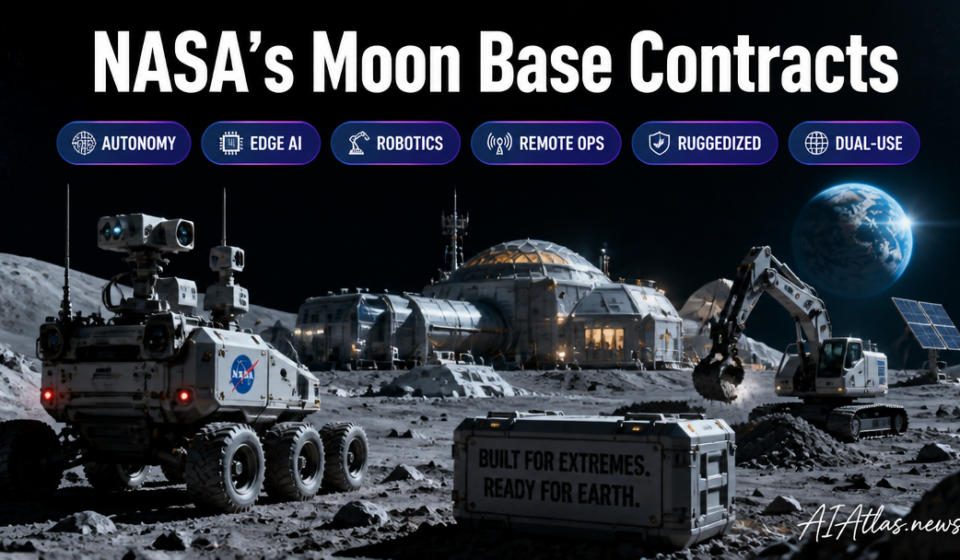
NASA’s first tranche of a long-term, permanent moon base programme is less about romance and more about procurement discipline. The agency has awarded large, structured contracts to U.S. companies across lunar landers, rovers, drones, and enabling infrastructure—effectively turning “Artemis” into an ongoing demand channel for autonomy, robotics and field operations.
In our experience, the moon base is the headline; the investors’ real asset is the emerging market structure behind it. When government-backed missions start paying for repeatable capability—remote ops, edge decision-making, rugged supply chains—the commercial ecosystem stops being a collection of prototypes and starts behaving like an addressable buyer with budgets, timelines and specifications.
Context Others Missed
Most commentary fixates on hardware milestones. We focus on the operational model: how systems will be deployed, monitored and recovered with limited comms windows, high latency, and long duty cycles. That drives very specific engineering requirements—fault tolerance, autonomous localisation and navigation, onboard planning, and verifiable autonomy rather than “demo AI” in a lab.
What we are seeing is the maturation of a procurement stack for advanced robotics: the lander gets attention, but the repeat spend tends to flow to the support ecosystem—software for mission control workflows, on-device inference under power constraints, robust telemetry pipelines, and the industrial processes that can ship components reliably at aerospace quality. The moon base announcement is therefore a demand signal for dual-use capability, not just space industrial policy.
The Commercial Ripple Effect
For founders and investors, the fastest translation is straightforward: NASA contracting now creates immediate pull for autonomy at the edge, remote operations tooling, ruggedised robotics, and AI-enabled field systems that can degrade gracefully when conditions drift. Even if the end customer remains government, the underlying constraints—environmental harshness, safety requirements, low-manpower operations—map cleanly to industrial settings on Earth.
We would treat this as a near-term “orders and references” moment for teams building operational autonomy, sensor fusion, and robotics middleware designed for offline planning and intermittent connectivity. That same capability bleeds into defence (ISR and logistics), mining (autonomous inspection and underground/yard robotics), and industrial automation (fleet management with strict safety cases). In short: the procurement is a market; the technology is the entry fee.
Stakeholder Impact Analysis
Prime contractors will win the headlines, but they will also compress their risk by buying subsystem maturity from specialists—navigation stacks, autonomy controllers, rugged actuators, thermal/power management, and mission-ops software. Suppliers that can demonstrate repeatability, configuration control and test evidence will be preferred over those who simply claim performance.
Startups should assume procurement will reward “integration-with-proof”: clear interfaces, traceable validation, and the ability to operate under verification regimes. Investors, meanwhile, should stop evaluating these businesses like consumer tech or even typical aerospace startups; the better framing is as operational infrastructure with a long tail of services, spares and upgrades. The winners will build reusable components that reduce lifecycle cost for the mission buyer—while keeping pathways open to industrial and defence customers.
Strategic Comparison Table
Below is how we see NASA’s contract themes converting into investable categories. We’re not chasing the moon base; we’re chasing the repeatable buying patterns behind it.
| Capability NASA is funding | Commercial “why now” | Where startups fit | Likely buyer behaviour | Investment signal |
|---|---|---|---|---|
| Lunar landers and mobility platforms | Demand for reliable actuation, thermal/power margins, and maintainable designs | Subsystems vendors (power, drive electronics, durability engineering) | Spec-driven selection; long qualification cycles | Higher revenue visibility if you supply proven modules |
| Rovers/field robots | Real-world navigation, traction control, mapping and recovery matter more than speed | Robotics middleware, navigation autonomy, test-and-telemetry systems | Integration-first; evidence of robustness is decisive | Strong traction when pilots translate into interface standards |
| Drones and inspection platforms | Autonomous flight/hover, collision avoidance, and safe modes under constraints | Autonomy stack + safety logic + rugged comms handling | Preference for defensive design and verifiable behaviours | Attractive exit paths into industrial inspection and defence UAS |
| Edge compute and onboard decision-making | Intermittent comms forces local intelligence and strict resource management | Edge inference, scheduling, sensor fusion, offline planning tools | Performance per watt; reproducibility and validation assets | Durable differentiation if you reduce operational burden |
| Supporting infrastructure | Operations require ground segments: telemetry, tooling, spares, logistics workflows | Remote ops platforms, asset tracking, rugged fleet management | Long-term contracts with upgrades and lifecycle services | Best risk-adjusted returns for “ops infrastructure” specialists |
Our judgement: the most investable angle is rarely the first vehicle. It’s the layer that keeps vehicles working—autonomy, verification tooling, and operational logistics that reduce the cost of having robots in the field.
Visualised Market Response
To clarify where the immediate upside concentrates, we map capability areas by (1) how fast procurement demand tends to show up and (2) how readily the same capability can scale into defence and industrial markets.
High cross-market scalability
Autonomy for remote ops
Edge planning & verification
Lower scalability
Mission-specific mechanical subsystems
High cross-market scalability
Inspection automation platforms (software-first)
Lower scalability
Niche hardware with heavy customisation
1) More requests for autonomy evidence (test artefacts, validation methods, safety modes).
2) Faster budgets for edge compute, telemetry, and fleet management tooling.
3) Consolidation around suppliers who can integrate across vendors without bespoke glue code.
That last point is where many teams stumble. Buyers don’t just want components; they want operational compatibility—interfaces, data formats, and repeatable commissioning procedures.
Critical Market Risks
The main risk is mistaking a funding announcement for a scalable commercial market. Government programmes can absorb cost and delay, and the qualification treadmill is slow. Startups that raise on “moon momentum” without a clear path to repeat sales—via industrial pilots, defence procurement, or derivative contracts—risk getting stranded after the first reference mission.
Second, founders should expect autonomy to be scrutinised like safety-critical software. Teams relying on fragile models, opaque decision-making, or assumptions about perfect conditions will struggle. Third, supply chains remain the silent bottleneck: long lead times, constrained components, and radiation/thermal qualification requirements can erode delivery schedules. Investors should demand credible manufacturing and test evidence—not just system-level performance claims.
Conclusion and Future Outlook
NASA’s lunar base contracts matter because they institutionalise demand for operational autonomy and robotics infrastructure. The commercial story is not the moon; it is how the procurement pattern forces suppliers to mature into repeatable, verifiable capability that can later be exported to Earth-bound sectors.
In our view, the next 18–36 months will reward startups that can turn autonomy into a serviceable capability: measurable robustness, documented safety behaviour, and integration that reduces mission control workload. If you’re building for this moment, focus less on flashy demos and more on the boring mechanics of field operations—interfaces, verification, and lifecycle support—because that is what the market will pay for.
Frequently Asked Questions
- How should founders interpret NASA’s contracts if they don’t build lunar vehicles?
- Treat them as signals for demand in autonomy, edge compute, remote operations, telemetry, and rugged integration. If you can prove repeatable performance under constrained communications and harsh conditions, you’re in the conversation even as a non-prime supplier.
- What due diligence should investors prioritise in lunar robotics and autonomy startups?
- Demand validation artefacts: test evidence, safety-mode design, failure handling, and configuration control. Also assess manufacturing readiness and lead-time risk—proof of delivery matters as much as technical capability.
- Is the opportunity mainly government-funded, or can it translate to Earth markets quickly?
- There is translation potential where the operational constraints match: industrial inspection, logistics automation, and defence-adjacent ISR and mission support. The best teams structure the product so references from space reduce sales friction elsewhere.