
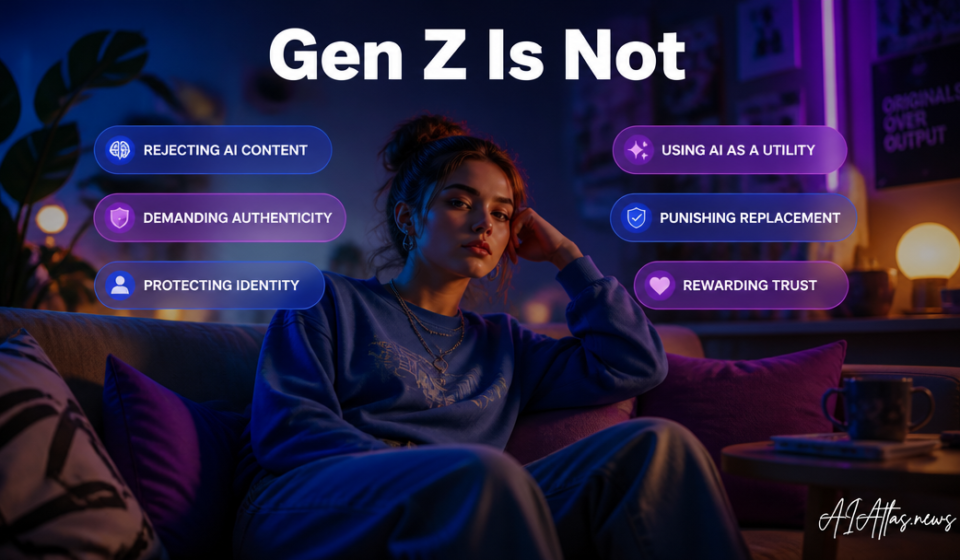
Gen Z Is Not Rejecting AI Content — It Is Rejecting Cheap Substitution
The Contrarian Thesis
We’re watching AI-generated social media video move faster than anyone’s commercial instinct can keep up with. Animated fruit stories, talking beauty products, surreal micro-dramas—these formats are proliferating because they’re cheap to produce and easy to iterate. But cost curves don’t equal market acceptance.
What we’re seeing in Gen Z usage data is the warning light: adoption is rising as a utility, while sentiment is getting more polarized—excitement cooling and anger increasing. From an operator’s chair, that’s not a “culture-war” headline. It’s an early indicator that media economics are shifting from creation-price competition to trust-price competition.
Flaws in Current Market Assumptions
The dominant market assumption is dangerously linear: “If AI makes content cheaper, audiences will consume more of it.” That ignores a basic trade-off—audiences don’t just buy novelty or volume. They pay in attention, emotional buy-in, and perceived authenticity. When those signals erode, engagement can flip from curiosity to backlash.
We also see another faulty assumption: sentiment naturally tracks novelty and will stabilise once people “get used to it”. In our experience, anger doesn’t behave like excitement. Once users learn to associate certain synthetic tropes with deception, spam, or hollow branding, the cost of earning trust rises faster than the cost of generating content falls.
The Structural Shift
The commercial read is a split market. Gen Z will use AI aggressively as a utility—editing, ideation, speed, personalisation. But that same cohort will punish AI-generated media when it feels unearned: when disclosure is missing, when rights are unclear, or when the product performance looks too rehearsed to be real. In other words, adoption of tools is not acceptance of output.
For entertainment and social media, the next phase won’t be defined by who can generate the most content at the lowest marginal cost. It will be defined by credibility mechanics: verifiable provenance, rights-compliant distribution, human accountability, and monetisable intellectual property that audiences can recognise and brands can stand behind.
Decision Framework for Capital Allocation
Capital should follow the point where audience acceptance is actually bought—not where generation capacity is cheapest. We recommend you treat “trust readiness” as a measurable funnel stage, not a branding afterthought. The fastest way to avoid burning cash is to fund workflows that reduce audience risk while improving monetisation clarity.
Acceptance drivers
Rights & provenance: 17%
Authenticity cues: 21%
Anti-deception controls: 16%
Monetizable IP familiarity: 18%
The practical takeaway is blunt: you can’t out-generate low trust. Even if your CAC collapses, platform signals—reporting, dwell-time quality, dispute rates, brand safety flags—will start gating distribution. So when you underwrite content factories, you must underwrite trust infrastructure too: disclosure standards, provenance logs, and rights verification.
To keep decisions disciplined, we use a simple comparison across strategies, because investors often fund “production capacity” instead of “audience survivability”.
| Strategy | Primary commercial bet | Key cost centre | Main risk signal | Early indicator |
|---|---|---|---|---|
| Low-stakes meme synthesis | Scale wins via volumes | Creative refresh + moderation | Rapid audience fatigue | Retention per format, not views |
| Brand-safe product explainers | Utility + compliance | Rights clearance + QA | Misrepresentation complaints | Lower disputes, higher saves/shares |
| Creator augmentation (human-in-loop) | Authenticity through authorship | Workflow + training | Identity ambiguity | Consistent creator-brand recall |
| IP-first synthetic adaptations | Recognisable IP monetisation | Licensing + asset management | Rights churn or infringement | Repeat purchases / licensing renewal |
| Verification & disclosure layer | Trust as a distribution advantage | Provenance tooling | Platform trust penalties | Improved reach under stricter rules |
Risk Assessment Table
If Gen Z anger is rising, you should expect enforcement pressure to follow: tighter platform policies, higher friction in monetisation, and increased scrutiny of deceptive synthetic content. The risk is not theoretical; it shows up in retention dips, advertiser withdrawal, and costly takedowns.
Below is how we score the risks we see most often when teams move from “cool demos” to repeatable revenue.
| Risk | What it looks like in the real world | Commercial damage path | Mitigation that actually works |
|---|---|---|---|
| Authenticity backlash | “This isn’t real” comments; creator boycotts | Lower watch time → reduced distribution | Disclosure + human authorship cues |
| Rights ambiguity | Unlicensed likeness, music, brand assets | Claims → revenue holds → reputation drag | Provenance logs + legal gating |
| Platform monetisation throttling | Reduced eligibility, higher moderation latency | Lower RPM → unit economics collapse | Trust KPIs aligned with platform policy |
| Identity confusion | Impersonation feels plausible to viewers | Regulatory exposure + advertiser churn | Verification standards + watermarking strategy |
| Content quality homogenisation | Surreal tropes become indistinguishable spam | Engagement volatility → higher ad risk | Format discipline + audience co-design |
| IP commoditisation without ownership | Teams generate variations but don’t control rights | Lower margins; no defensible revenue | Acquire or licence IP; build an asset flywheel |
Visualised Impact Matrix
Anger is a leading indicator because it concentrates around a small set of triggers: deception cues, missing disclosure, and rights uncertainty. When those triggers rise, the distribution cost rises too—first in moderation attention, then in monetisation eligibility, and eventually in brand-safe advertiser demand.
Here’s a simplified impact matrix we use to separate “cheap to make” from “profitable to scale”.
Human-verified creator posts
Licensed brand explainers
Synthetic influencer campaigns
Unlicensed template variations
Rights-unclear content farms
Strategic Recommendations for Leaders
First, we would stop treating AI video as a production problem. It’s a distribution problem with legal and reputational constraints. If you can’t explain how the content was made, where assets came from, and who is accountable, you’re effectively betting against your own revenue.
Second, invest in monetisable IP, not just generation throughput. The teams that win will build repeatable libraries: licensed characters, consistent creative direction, and author-controlled formats that audiences learn to trust. In parallel, require disclosure and provenance from day one—because retrofitting trust is expensive and rarely persuasive after backlash begins.
Third, build measurement around “trust friction”, not only view counts. Track dispute rates, refund/takedown frequency, complaint sentiment, creator attrition, and platform eligibility signals. When anger rises, it shows up in these metrics before it appears in the comments.
Future-Proofing the Business Model
Over the next 18–36 months, AI content economics will separate into two ecosystems. One ecosystem treats synthetic media as a utility—speeding up creators and brands with clear disclosures and rights. The other ecosystem tries to win volume without accountability and will find monetisation increasingly expensive, volatile, and politically risky.
For investors and operators, the strategic question isn’t “Can we generate more?” It’s “Can we prove what we generated, and can we licence and monetize it without triggering audience punishment?” If you want a durable advantage, design your business model around trust, rights, authenticity, and defensible IP—then use AI to reduce cost inside those boundaries, not to bypass them.
Frequently Asked Questions
- Is Gen Z “anti-AI”, or is it something more commercial?
- It’s more commercial than cultural: they’ll use AI as a utility, but they punish outputs that feel deceptive, unlicensed, or inauthentic.
- What should platforms do differently as AI video grows?
- Platforms need measurable trust enforcement—provenance signals, disclosure compliance, and faster handling of rights disputes to protect monetisation quality.
- Where do early opportunities exist for startups?
- In workflows that reduce trust friction: rights verification, provenance tooling, creator-in-loop systems, and IP libraries with clear licensing pathways.