
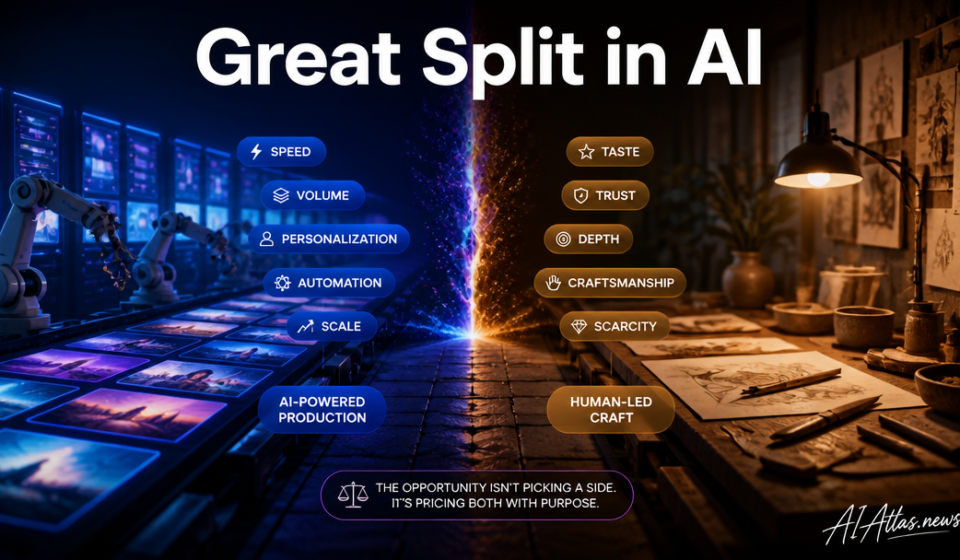
The Great Split in AI Design: Why Human Craft Is Becoming a Premium Asset
The Strategic Objective
We’re watching creative markets split into two economies, and the winners won’t be the ones who “play with styles”. In our experience, they embed AI-assisted design and image generation into production systems so output scales while risk is managed.
The market signals are consistent across agencies, enterprise marketing teams, ecommerce brands, and design-software vendors: teams want higher-volume content production, they fear copyright exposure, they’re under pressure to shorten creative cycle times, and they’re simultaneously re-emphasising premium, human-made work as a differentiator. That creates a clear objective: automate unit production costs—then use human craftsmanship as the strategic layer for taste, trust, and pricing power.
Prerequisite Checklist
Before we touch tooling, we verify whether the organisation is ready to industrialise creativity. Most budgets die not because the model is weak, but because the workflow is undefined and the governance is missing.
Here’s the checklist we apply before recommending any AI art/design deployment:
Rights & risk readiness
- Documented provenance policy: what inputs are allowed, what outputs are permitted, and how assets are stored.
- Clear stance on dataset/third-party content sources and a plan to respond to takedowns or claims.
- Human sign-off authority for any customer-facing claim, campaign creative, or brand-critical asset.
Production foundations
- A usable asset taxonomy (campaign, channel, format, localisation, audience, usage window).
- Template discipline: brand-safe layouts, type rules, colour systems, and spacing constraints.
- Integration points: DAM/CMS links, naming conventions, version control, and review queues.
Operational control
- Defined SLAs for turnaround times and revision limits (otherwise “iteration” becomes an open chequebook).
- Metric ownership: who tracks throughput, cost per variant, and quality gates.
Sequence of Operations (Steps 1-5)
This is the sequence we’d run with an entrepreneur, an agency leader, or a brand executive who wants measurable cost reduction without legal chaos. It’s designed to prevent the typical pattern: ad hoc prompts in a spreadsheet, followed by a scramble to “professionalise” after money has already been spent.
Steps 1–5
-
Define your asset families and where automation fits.
Start with the repetitive, high-volume categories (ad variants, social crops, thumbnails, alternate compositions). Keep premium hero pieces on a human-led path until the system proves quality. -
Build a rights-aware generation pipeline.
Create a standard input policy (approved references, permitted styles, no “unknown source” browsing). Add an internal “allowed prompt patterns” library and log prompts/parameters per output. -
Constrain output to brand-safe templates.
Use strict layout templates, consistent typography, and controlled visual components. Treat the model as a draftsman, not a final artist. -
Install human review gates with bounded decision-making.
For each asset family, specify what humans verify: brand integrity, compositional correctness, compliance, and claims. Cap revision rounds to stop infinite churn. -
Integrate into production systems and instrument everything.
Push outputs into your DAM/CMS workflow, trigger approvals, and measure cost/throughput/quality continuously. The goal is predictable unit economics, not sporadic creative wins.
Common Failure Points
We’ve seen the same costly mistakes repeat across organisations, from lean startups to large enterprise marketing departments. They’re not technical problems; they’re operating-model problems.
Failure point patterns we’d avoid:
- Buying tools before mapping workflows. You end up with “cool outputs” that cannot be governed, versioned, or published at speed.
- Letting prompts become the product. When prompts are unmanaged, quality drifts and attribution becomes untraceable.
- No hard revision limits. The model generates; humans keep “fixing”; costs creep until someone discovers unit economics have collapsed.
- Weak rights logging. Teams can’t prove provenance or explain decisions if a claim arises—so legal response becomes expensive and slow.
- Confusing volume with value. High throughput without conversion lift simply adds noise, not revenue.
Comparison Table: DIY vs Outsource
The decision isn’t about morality (“own versus rent”). It’s about time-to-control. We compare DIY and outsourcing based on how quickly you can reach governed production with stable quality.
| Criterion | DIY (Build internal workflow) | Outsource (Partner production pipeline) |
|---|---|---|
| Speed to first governed output | Moderate (requires workflow design) | Fast (if partner already has a governed model) |
| Control of rights & logs | High (you own the audit trail) | Variable (depends on partner governance transparency) |
| Unit cost trajectory | Better at scale, later | Good early, may plateau |
| Quality consistency | High once templates and gates mature | High if partner uses repeatable templates |
| Internal capability build | Strong (skills become reusable) | Limited (risk of dependency) |
Visualised Workflow Roadmap (div)
Here’s the operational roadmap we prefer: a linear production flow with explicit control points. Notice the order—rights and constraints come before scale, and measurement comes before “more prompts”.
Verification & Success Metrics
If you can’t measure it, you can’t scale it. We recommend setting success criteria before you generate a single asset at campaign scale, then reviewing weekly until the system is stable.
What we track (and why):
- Throughput: number of approved variants per sprint.
- Cycle time: intake-to-publish and revision-to-approval time.
- Unit production cost: fully loaded cost per approved asset (not per generated asset).
- Quality gate pass rate: % accepted on first review; % requiring rework.
- Rights and compliance rate: % outputs with complete provenance logs and policy alignment.
- Commercial impact: conversion lift, CTR improvement, or downstream revenue effect per asset family.
Crucially, we separate “visual similarity” from “business performance”. An excellent-looking variant that doesn’t move the needle is expensive—even if the generation cost was near-zero.
The Long-Term Maintenance Plan
Automation is not set-and-forget. The models, policies, and creative standards will all drift. The organisations that win treat their workflow like a living product with versioning, audits, and continuous improvement.
Our maintenance cadence:
- Template governance: monthly review of brand rules and layout constraints; lock changes behind version numbers.
- Prompt/policy audits: quarterly validation of allowed input patterns and compliance coverage.
- Provenance checks: ongoing logging, retention periods, and rapid internal response procedures for claims.
- Human craft runway: preserve senior designers for hero moments, exceptional campaigns, and edge cases.
- Model/tool evaluation: test replacements in a staging environment with the same gates and metrics.
The long-term win is a system that reduces unit cost while protecting brand trust. Human craftsmanship then becomes the premium signal—expensive enough to matter, consistent enough to be relied upon.
Frequently Asked Questions
- How do we reduce copyright exposure without killing speed?
- We restrict inputs to approved references, keep full generation logs, and apply brand-safe templates so humans verify fewer unpredictable variables. The result is faster iteration with audit-ready provenance.
- When should we switch from “novelty” pilots to production automation?
- Only when your asset families show stable pass rates through human gates and measurable commercial lift. If quality fluctuates or costs rise after revisions, you’re still in the learning phase.
- What’s the safest way to use human craftsmanship for premium positioning?
- Use AI to draft high-volume variants, then reserve human attention for hero work, compliance-critical claims, and brand-defining taste. That keeps trust high while unit economics improve.