
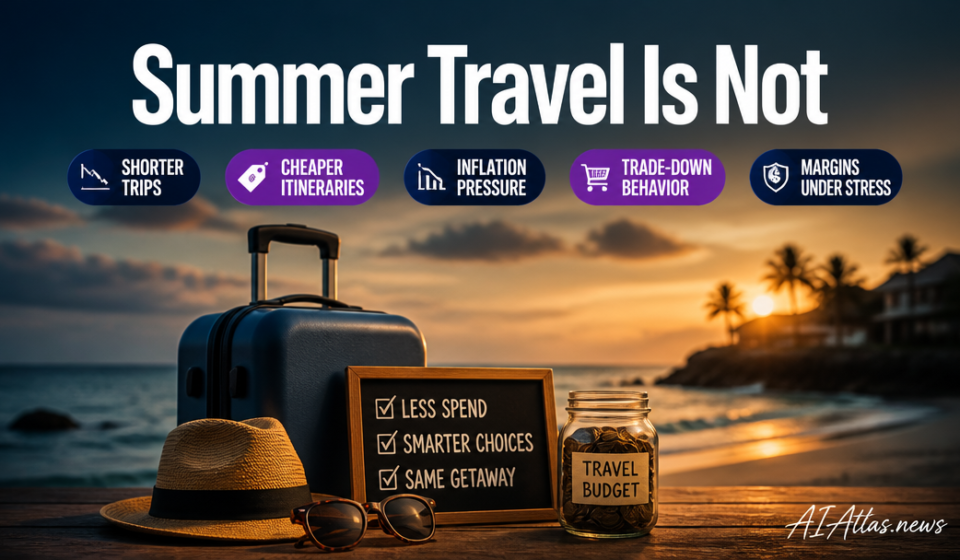
Summer Travel Is Not a Consumer Strength Signal — It Is a Pricing Stress Test
We’ve been watching travel like a stock chart: occupancy up, bookings up, headlines bullish. Yet an expert from Florida State University’s hospitality community is asking a far more operator-relevant question: up compared to what? Her blunt read is that the summer tourism “boom” is masking consumer financial strain. People are still travelling, but they’re trimming the expensive parts—opting for shorter, lower-cost domestic trips rather than longer, higher-priced holidays abroad or at premium resorts. Inflation and high interest rates aren’t killing demand; they’re forcing a spend-shape change.
In our experience, this is where markets misprice risk. Strong top-line demand can coexist with collapsing margins—especially for travel operators, hospitality brands, consumer startups, and the AI companies selling “revenue optimisation” tools that measure the wrong thing. Let’s deconstruct the commercial trade-offs hiding behind the summer glow.
The Contrarian Thesis
The contrarian point isn’t that travel is weakening. It’s that the consumer unit economics behind travel are deteriorating while the volume looks fine. If households are reallocating budgets away from long-haul, full-board, and high season packages, then the market may still record healthy trip counts—but operators will feel it in less obvious places: average daily rate pressure, heavier promotion, and higher distribution costs per booking.
What the FSU hospitality expert is warning us about is a classic mismatch between headline demand and underlying financial health. When consumers shorten duration and downgrade trip types, the operator’s cost base doesn’t fall proportionally. Marketing doesn’t get cheaper. Staff rosters don’t get slimmer. Energy and maintenance don’t negotiate with your revenue curve. The result is margin compression disguised as growth.
Flaws in Current Market Assumptions
Most market narratives about consumer resilience lean on what’s easy to see: passenger numbers, hotel occupancy, website traffic, search trends. We’re not denying those signals. We’re saying they’re incomplete. A summer surge can be “real” and still be commercially fragile if it’s driven by substitution—domestic trips replacing international ones, quick getaways replacing longer holidays, value offers replacing premium intent.
The other failure mode is time-window thinking. Investors and founders often ask, “Are bookings up this month?” without asking, “How much of that booking volume is being purchased with discounts, and what does that do to future willingness-to-pay?” High interest rates change decision-making. Consumers become more selective, and their travel becomes more incremental—meaning your conversion rate may hold, but your price integrity erodes. That’s how you end up with demand that looks stable while cash generation weakens.
The Structural Shift
The structural change here is behavioural, not just financial. When household budgets tighten, travellers don’t stop experiencing travel—they repackage it. Shorter stays and cheaper domestic itineraries are a form of risk management. People are trying to preserve the emotional benefit (a break, a family trip, a change of scenery) while limiting financial exposure. That forces operators into a less favourable equilibrium: higher churn in preference, lower margin per booking, and more volatility from day-to-day pricing.
For travel and hospitality businesses, the “mix shift” becomes a profit problem in three ways. First, lower-cost trips usually come with lower ancillary spend—fewer upgrades, less dining spend, fewer add-ons. Second, domestic demand can be more price elastic, particularly when consumers see competing offers within the same geography. Third, shortened lead times—common during cost-conscious periods—reduces planning flexibility and increases the odds you’ll discount late to fill rooms.
Decision Framework for Capital Allocation
In our experience, the smart response isn’t to abandon growth; it’s to fund the right kind of growth. We recommend a capital allocation framework that treats demand quality as a measurable asset.
Use the following operator-grade lens before you scale spend, hire aggressively, or invest in new distribution or tech:
- Contribution margin, not revenue: Track the full unit economics of a booking—after discounts, distribution fees, refunds, and incremental service costs.
- Lead-time and elasticity scoring: Segment performance by booking window (e.g., <14 days vs 14–30 vs 30+). If the business increasingly relies on short-lead discounts, you’re buying volume at risk.
- Length-of-stay pressure test: Model what happens when average nights per booking shrink by 5–15%. Many operators will “feel” demand, but only some will quantify the margin impact.
- Channel mix governance: Pressure often migrates to OTA and metasearch channels when direct pricing integrity softens. Capital should reduce that dependency.
- Cash conversion discipline: Verify how pricing actions affect collections timing, cancellations, and chargeback rates.
AI tool vendors should be judged by whether they improve these business outcomes—not by whether they produce prettier forecasts or higher “optimised revenue” outputs that ignore discount depth and margin leakage.
Risk Assessment Table
If you want a quick internal check, map your exposure. The point isn’t fear-mongering; it’s identifying where strong summer demand is likely to turn into weak profit.
| Area of Exposure | What Looks Good in Headlines | What Usually Breaks First | Leading Indicators to Monitor | Operator/Founder Mitigation |
|---|---|---|---|---|
| Room/Rate Optimisation | Higher occupancy | Average daily rate dilution | Discount depth by channel; ADR vs last-year mix | Constrain discounting; reprice by length-of-stay segments |
| Ancillary Monetisation | Stable booking counts | Lower add-on attach | Upgrade attach rate; dining/transport add-on revenue per guest | Bundle “value add” into short-stay packages |
| Distribution Strategy | Healthy conversions | Rising OTA and metasearch take rate | Channel mix drift; CAC by booking lead time | Improve direct conversion with pricing integrity + targeted offers |
| Staffing and Service Levels | Full hotels | Cost-to-serve creep | Labour hours per occupied room; customer complaint rates | Forecast schedules by stay-duration mix; tighten labour productivity |
| Consumer Startups (Travel Tech) | More transactions | Lower take rate and refund friction | Refund/cancellation rates; net revenue per booking | Optimise for net margin; tighten rules for low-intent inventory |
Visualised Impact Matrix
To make this intuitive for teams, we place market segments on a simple 2×2. The takeaway is uncomfortable: you can be in the “demand looks strong” region while simultaneously sitting in a high-margin-pressure zone.
+ Strong demand visibility
Short domestic breaks
with discount dependence
Typical outcome: profit volatility
+ Strong demand visibility
Brands with price integrity
and loyal repeat demand
Typical outcome: margin stability
+ Weak demand visibility
Late-filling operators
with thin cancellation buffers
Typical outcome: cash crunch risk
+ Weak demand visibility
Niche demand, diversified revenue
or subscription-style models
Typical outcome: manageable downside
Strategic Recommendations for Leaders
If you’re running a hotel group, OTA-adjacent brand, travel operator, or a consumer startup, the strategic question is not “How do we sell more?” It’s “How do we prevent volume from becoming a margin tax?” We are seeing teams default to promotional tactics because they work in the short run. But when inflation and rates keep biting, the customer’s bargain strategy intensifies. You’ll end up funding demand with discounts until the unit economics snap.
Here’s what we’d do differently. First, redesign offers around short-stay value without margin collapse: bundles that protect room rate integrity while monetising add-ons that fit compressed trip durations. Second, invest in channel governance—direct pricing controls, better email/SMS conversion rules, and tighter inventory allocation by channel. Third, align staffing and operations with the “length-of-stay mix”, not last year’s staffing model.
For AI product leaders selling revenue optimisation, this is where credibility is won. Stop optimising for gross booking volume. Start optimising for net contribution with constraints: cancellation likelihood, discount depth, channel take rates, and predicted ancillary attach. The best systems will flag when “more demand” is actually “more margin leakage”, and they’ll quantify the trade-off in plain language for commercial teams.
Future-Proofing the Business Model
The hard truth is that rate-driven household caution won’t vanish on a timetable that helps hospitality brands. So future-proofing means building resilience into pricing, product, and distribution—not just forecasting. Businesses that treat pricing as a static list price will keep getting surprised by mix shifts. Businesses that treat pricing as a managed portfolio of offers, tied to customer intent and booking lead time, will cope better when sentiment flips.
We also expect more emphasis on “operational intelligence”: tightening revenue-to-cost translation. If your automation stack can predict not only occupancy but also cost-to-serve (labour intensity, cleaning schedules, check-in throughput, refund likelihood), you can defend margin even when customers downshift. That’s the commercial link between AI advancement and the real-world trade-offs leaders must navigate.
Ultimately, the summer tourism headline is a partial story. The full story is about how households are rationing financial risk. Our recommendation is simple: measure what matters, protect pricing integrity, and demand that AI tools optimise for profit—not just sales momentum.
Frequently Asked Questions
- How can travel companies be “busy” and still be under margin pressure?
- Because mix shifts (shorter stays, lower-cost trips, more discounting) can keep occupancy up while reducing ADR and ancillary spend. Add channel fee pressure and late-filling costs and the profit curve can fall even when demand looks healthy.
- What should leaders prioritise first when interest rates stay high?
- Prioritise net contribution margin controls: discount depth, channel mix, and lead-time dependent pricing. Then re-plan staffing and operations using the expected length-of-stay distribution, not historical averages.
- What should investors demand from revenue optimisation startups?
- Demand evidence of margin-safe optimisation: improvements in net revenue after take rates, refunds, and discount leakage. Roadmaps should show how models incorporate elasticity, cancellation risk, and offer-level economics—not only forecast accuracy.