
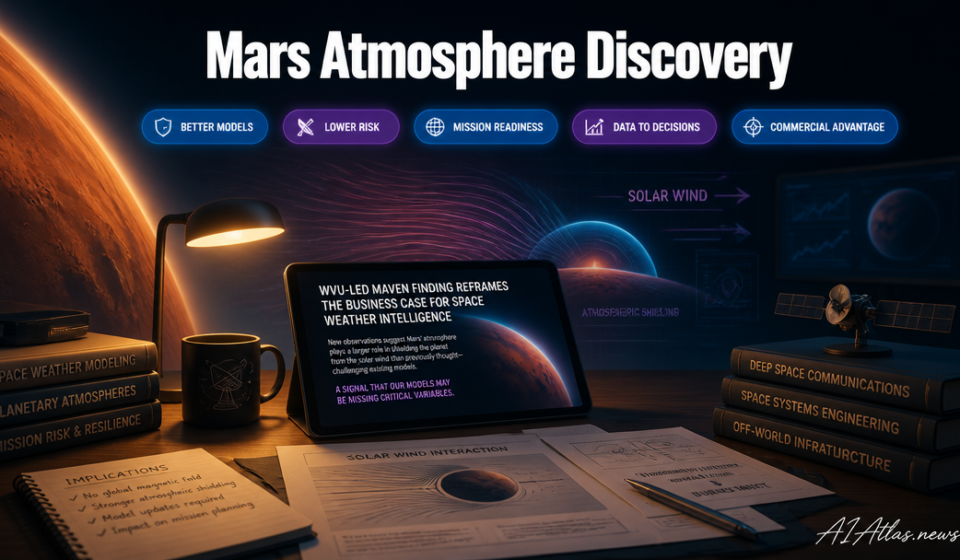
Mars Atmosphere Discovery Reframes the Business Case for Space Weather Intelligence
The Contrarian Thesis
We have a tendency in the space sector to treat space weather as a “near-Earth weather” problem: magnetospheres, plasma dynamics, forecasting pipelines. Our contrarian view is that the next commercial leap won’t come from better dashboards for Earth alone. It will come from admitting that, for many mission classes, atmospheric physics is not a footnote—it is part of the protection story.
Christopher Fowler’s WVU-led work, using NASA’s MAVEN spacecraft data, provides an early nudge in exactly that direction. Evidence that the Zwan-Wolf effect can occur in Mars’ atmosphere—despite Mars lacking a strong global magnetic field—should force a re-think of how we model shielding and how we underwrite operational risk. In our experience, the winners won’t be the teams with the most impressive visualisations; they’ll be the teams whose models correctly represent what actually blocks (or amplifies) space-environment effects.
Flaws in Current Market Assumptions
Most space weather products still implicitly assume a relatively clean separation: solar wind drives magnetospheric behaviour, magnetospheric behaviour drives risk. That framing is convenient for engineering, and it sells well because it feels universal. But the commercial flaw is subtle: if your risk model’s physics is scoped to the wrong boundary conditions, you don’t just get a slightly worse forecast—you price the wrong uncertainty.
This MAVEN result matters commercially because it challenges an earlier assumption that the protective interaction giving rise to the Zwan-Wolf effect is confined to planetary magnetospheres. When physics can extend into ionospheres and atmospheres without strong global fields, “generic” models become a liability. We are seeing the market reward vendors who standardise; the next contracts will reward vendors who parameterise by world, altitude, and coupling regime.
Below is how we think the market should reframe the problem:
| Common modelling stance | What Fowler/MAVEN implies | Commercial risk | Most likely buyer | Data requirement |
|---|---|---|---|---|
| Zwan-Wolf effect only in magnetospheres | Atmospheric settings can show analogous behaviour | Systematic underestimation of shielding uncertainty | Mission assurance teams | Ion/neutral coupling proxies, altitude profiles |
| Single-environment risk heuristics | World-specific boundary conditions are material | Overconfident ops decisions | Space infrastructure operators | Multi-world calibration datasets |
| Forecast outputs without calibrated uncertainty | New regime increases model variance | Bad insurance and bad scheduling | Defence-adjacent planners | Uncertainty quantification runs |
| Instrument-specific learnings stay siloed | Cross-mission physics constraints are feasible | Vendor lock-in and slow iteration cycles | Aerospace founders | Shared validation harness |
| Physics abstraction hides atmospheric effects | Atmosphere can be a first-order actor | Integration failures during mission phase changes | Space operations teams | Operational-level altitude/ephemeris metadata |
The Structural Shift
Let’s be blunt: this isn’t a narrow planetary science curiosity if you sell anything that touches operational planning under solar forcing. The commercial takeaway is that space weather models may need to include atmospheric shielding effects, even for worlds without strong global magnetic fields. That expands the modelling surface area from “plasma around a field” to “plasma interacting with an atmosphere.”
Once you widen the surface area, you widen the procurement logic. We expect atmospheric coupling modules to become a standard input across: space operations risk modelling; mission planning for communications and power budgets; and the emerging market for software that translates physical regimes into decision-grade risk narratives. The most credible offerings will not merely predict; they will justify. They will show the sensitivity of outcomes to assumptions about atmospheric shielding and coupling strength.
Decision Framework for Capital Allocation
When capital chases “space weather” narratives, we’ve seen too many teams fund the interface layer and underfund the physics-and-validation layer. Our framework starts earlier: decide what exposure you actually have, then decide which coupling regime you must model well enough to be contract-ready.
Here’s a practical sequence we use with founders and investors:
1) Map exposure: Identify the operational lever you’re protecting (link margin, onboard charging, thruster degradation, radiation risk, thermal stability).
2) Locate the boundary: Determine whether your environment behaves like “magnetosphere-dominant” or “atmosphere-coupled.” Mars-like cases suggest the latter can’t be ignored.
3) Decide model depth: For assurance-grade work, physics-informed baselines plus learned correction terms tend to beat purely data-driven shortcuts.
4) Budget uncertainty: Require calibration/coverage tests that show not only accuracy, but when the model knows it’s uncertain.
5) Validate with integration: If you can’t demonstrate performance in the workflow your customer uses, you’re not ready for underwriting-level decisions.
Risk Assessment Table
The moment atmospheric shielding becomes a first-class modelling variable, risk changes form. The good news is that it becomes more defensible. The bad news is that shallow models will show their seams quickly—especially in regulated or mission-assurance contexts.
| Risk | Likelihood | Impact | Mitigation |
|---|---|---|---|
| Model misspecification in atmosphere-coupled regimes | Medium | High | Physics-informed priors + regime-labelled validation |
| Underpriced uncertainty leads to bad operational decisions | High | High | Calibrated uncertainty outputs and decision thresholds |
| Data access bottlenecks slow model iteration | Medium | Medium | Partnerships with mission teams; shared pipelines |
| Integration risk with existing mission/ops tooling | Medium | High | Early workflow pilots; measurable acceptance criteria |
| Procurement trust gap (black-box scepticism) | Low to Medium | High | Explainability tied to physical drivers and uncertainty |
Visualised Impact Matrix (div)
To make this investable, we use a simple 2×2: commercial certainty against implementation urgency. The Fowler/MAVEN signal pushes several use cases upward—not because they’re trendy, but because physics correctness will decide contract outcomes.
Mission assurance risk updates for atmosphere-coupled environments
Operational planning under regime-sensitive shielding assumptions
Model validation for multi-mission archives and post-hoc audits
Toolchain hardening and documentation for repeatability
Early deployments where data coverage is thin
Rapid prototyping without acceptance-grade uncertainty
Long-horizon research platforms without near-term procurement path
Marketing-led “one-size-fits-all” forecasting products
If your product doesn’t explain, test, and calibrate across atmosphere-coupled regimes, it will struggle to survive procurement scrutiny—especially for mission-assurance and high-consequence ops.
Strategic Recommendations for Leaders
We’d prioritise work that turns this physics signal into a commercial edge. That means building or buying modelling components that explicitly account for atmospheric interactions, and then validating them in ways that procurement teams can sign off on.
Concretely, we recommend four moves:
Invest in regime-aware model design: encode which assumptions apply when the magnetic field is weak and atmospheric coupling dominates.
Run uncertainty-first evaluations: customers don’t just need a number; they need a credible envelope for worst-case planning.
Partner with scientific data producers: MAVEN and similar datasets are not “nice-to-have”; they’re your calibration spine.
Productise decision outputs: translate physics to the operational language customers purchase—margins, scheduling buffers, and assurance artefacts.
Future-Proofing the Business Model
This is where most founders get tempted to chase scale too early. The more correct the physics becomes, the more valuable the vendor relationship—because updates, recalibration, and validation become ongoing obligations. A static forecast platform won’t hold pricing power; a continuously validated risk service will.
We expect a durable business model to look like: (1) subscription for validated risk workflows, (2) periodic retraining or recalibration tied to new data and regime definitions, and (3) assurance-grade documentation packaged for regulators, insurers, and mission boards. Teams that treat space weather as a living model—anchored in atmospheric shielding realities—will be better placed to win the next generation of space infrastructure and mission programmes.
Frequently Asked Questions
- What does the Zwan-Wolf effect evidence actually change for business?
- It suggests that protective solar wind interaction phenomena may appear in atmospheres even when global magnetic fields are weak. Commercially, that means risk models must include atmosphere-coupled shielding assumptions to avoid underpricing uncertainty.
- Where will buyers feel this first—Earth or Mars?
- Earth still matters, but atmosphere-coupled modelling will hit earliest where operations resemble weak-field, atmosphere-dominant environments. That includes Mars missions and any forward-looking space architecture that needs regime-aware planning.
- How should AI-related teams respond without turning this into a black box?
- Use physics-informed structure and validate uncertainty against regime-labelled data. Package outputs as decision-grade envelopes with explainable drivers, so procurement and assurance teams can trust the model’s scope.