
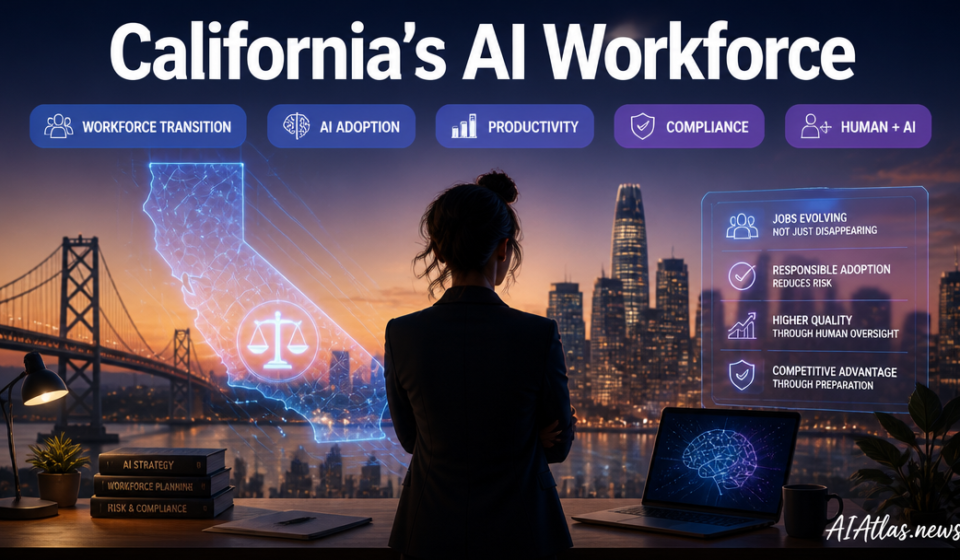
California’s AI Workforce Order Is a Warning Shot for Every Employer Using Automation
The Contrarian Thesis
We read Governor Gavin Newsom’s executive order less as a labour-policy headline and more as an early signal: AI adoption is stepping out of the private productivity lab and into the public arena of regulated workforce transition. In our experience, this is where the money stops being “just cost-out” and starts being “cost-out plus liability, process, and proof”.
The commercial story is not mass job loss; it’s the emerging deal between employers, states, and workers about what changes when automation accelerates. Severance standards, employment insurance, retraining, and transition support are not philanthropic add-ons. They are the beginnings of a compliance perimeter that will shape procurement, deployment pace, and the real unit economics of enterprise AI.
Flaws in Current Market Assumptions
Across boardrooms and investor calls, we keep hearing the same assumptions: first, that labour policy will lag adoption; second, that workforce disruption is an HR afterthought; and third, that automation savings are “clean” because decisions happen behind the firewall of enterprise operations. Those beliefs break down once regulation starts treating workforce impact as a measurable output.
We also think many founders underestimate how quickly state-level rules cascade into national enterprise behaviour. Multi-state operators will not run separate ethics programmes for each geography. They’ll run one system designed to withstand the strictest scrutiny—meaning governance features become table stakes, not differentiators.
Five policy instruments in the order map to distinct commercial effects. Here’s how we would pressure-test them against enterprise reality and startup opportunity.
| Policy lever (signal from the order) | What it means for employers | Where the pressure is likely to land | Commercial impact (cost + speed) | Startup opportunity |
|---|---|---|---|---|
| Severance standards | More consistent, audited severance planning; less discretion during role change | Large employers and automation-heavy functions first | Higher upfront planning costs, slower restructuring decisions | Policy-aware workforce transition planning; finance/legal workflow tooling |
| Employment insurance | Potential triggers for income support during AI-driven displacement | Policy pilots, then procurement requirements via insurers and platforms | Uncertainty premium on automation ROI; incentives to prevent churn | Insurance brokerage models; claims forecasting; transition “risk scoring” |
| Retraining and reskilling | Retraining becomes evidence-based, not “best efforts” | Jobs with volatile skill demand and measurable productivity shifts | Budget reallocation from capex to programmes; new KPIs for outcomes | Skills-mapping, course-to-competency matching, cohort outcome tracking |
| Transition support | Placement support and mobility pathways may be expected, not optional | Internal transfer workflows; external partner ecosystems | Operational complexity, but lower litigation and attrition risk | Internal mobility marketplaces; vendor networks; job-matching engines |
| Ongoing labour-market impact assessment | Documentation, monitoring, and accountability become part of deployment discipline | Procurement gating for enterprise AI implementations | Governance headcount or tooling needed; fewer “deploy first, explain later” cycles | AI governance, audit trails, workforce impact reporting, model-to-role mapping |
The Structural Shift
We’re seeing a structural shift from “AI as a productivity experiment” to “AI as a workforce intervention with measurable obligations.” That changes how leaders should think about risk. It’s not solely model accuracy and security anymore; it’s labour outcomes, documentation standards, and the ability to show you anticipated impact.
Enterprises built their automation cases on a specific timeline: deploy the system, realise savings, then manage downstream friction quietly. State-level signals like this order compress the timeline for accountability. The commercial winners will be those who treat workforce transition as part of the deployment lifecycle—designed, instrumented, and financed—rather than addressed after the press cycle arrives.
Decision Framework for Capital Allocation
If you’re allocating capital in this environment, we recommend separating three buckets: deployment value, workforce-transition cost, and governance friction. Most companies are still funding bucket one and hoping buckets two and three remain manageable. The point of Newsom’s order is that those hopes will be tested.
In our experience, the best decisions come from forcing a “counterfactual workforce plan” before you scale. Ask: if this AI reduces demand for certain tasks, what happens next week, next quarter, and next year? Then fund the plan with the same seriousness you fund the model.
Practical allocation questions for leaders
- ROI with lag: Does the business case assume savings arrive faster than workforce obligations? If so, it’s a fragile model.
- Evidence readiness: Can you produce documentation for affected roles, training pathways, and transition outcomes?
- Vendor accountability: Are your AI vendors contractually responsible for impact reporting inputs and change-management data?
- Skills as infrastructure: Do you have a skills taxonomy and mapping that can survive audits and internal transfer workflows?
- State divergence: Are you designing for the strictest state first, or building a patchwork that will slow rollouts?
Risk Assessment Table
The immediate risk isn’t that AI stops working; it’s that AI deployment becomes a governed process with new pass/fail gates. In our view, this is why “automation-first” strategies will look increasingly brittle to investors: the path from innovation to sustainable unit economics now includes labour-transition capacity.
Use the table below as a working lens: it highlights where policy friction will show up in operations, and where startups can credibly monetise the gap between enterprise intent and regulatory expectation.
| Risk vector | What breaks | Who feels it first | Mitigation that scales | Where capital flows |
|---|---|---|---|---|
| Compliance time | Deployments slow because documentation and assessments lag implementation | Multi-site enterprises | Standardised impact assessment templates and tooling | Governance platforms; audit workflow startups |
| Change-management failure | Teams resist; productivity gains don’t materialise; attrition rises | HR-led functions | Skills mapping + retraining routing tied to performance outcomes | Skills intelligence; reskilling orchestration |
| Insurance and severance shocks | Unbudgeted costs erode ROI during restructuring | Automation-heavy sectors | Transition budgeting models; insurance forecasting | Insurtech and workforce risk analytics |
| Data fragmentation | Employers can’t show who was affected, how, and what support followed | Mid-market with weak HR data | Unified workforce-impact data layer | Integrations; HR data clean-up and mapping tools |
| Reputation and litigation exposure | Policy compliance isn’t enough; stakeholders demand transparency | Public-facing brands | Structured reporting and measurable transition outcomes | Reporting, monitoring, and assurance services |
Visualised Impact Matrix
To make this decision space concrete, we frame AI workforce transition opportunities as a 2×2 matrix: regulatory pressure versus commercial upside. We assume higher regulatory pressure increases the value of governance, transition instrumentation, and skills infrastructure.
Commercial upside: Low
“Automation-only” vendors, minimal governance
Likely outcome: procurement friction rises later
Commercial upside: High
Enterprise copilots with strong UX change control
Likely outcome: adoption continues, audits lightweight
Commercial upside: High
Skills mapping + retraining orchestration + audit trails
Likely outcome: measurable transition outcomes become a differentiator
Commercial upside: Low
Fast rollouts without workforce impact assessment
Likely outcome: delays, cost inflation, reputational risk
Commercially, this means investors should be cautious of “efficiency-only” narratives in sectors where AI rearranges task demand. The order’s most valuable lesson is that workforce impact will be treated as a measurable system output—so the data layer and auditability layer will matter as much as the model.
Strategic Recommendations for Leaders
We would not respond to this order with a “policy panic”. Instead, we would treat it as a procurement and deployment milestone. If you are rolling out AI that changes who does what, you need a transition operating model: roles mapped to skills, training plans tracked, outcomes measured, and costs budgeted.
Here’s our operator-level checklist for the next 90 days: build the minimum viable evidence set, redesign change-management around skills mobility, and stop treating retraining as a side programme. That’s how you keep deployment velocity while reducing the risk of costly reversals.
- Run a role-impact audit: identify tasks likely to be reallocated and which worker groups bear the change.
- Create a skills-to-training plan: use a skills taxonomy that supports both internal mobility and external certification pathways.
- Instrument outcomes: track completion, redeployment rates, and time-to-productivity—use the metrics to refine the AI workflow.
- Contract for responsibility: require vendors to provide deployment change data and support impact reporting requirements.
- Budget transition like engineering: treat retraining capacity and career support as part of the programme plan, not a contingency.
Future-Proofing the Business Model
Over the next few quarters, state-level labour policy will increasingly interact with AI governance, model monitoring, and HR data infrastructure. The enterprises that win will be those that build a consistent “workforce impact stack” alongside their AI systems: skills mapping, transition orchestration, audit trails, and measurable reporting.
For founders and investors, this is where opportunity is unusually tangible. Startups that can map AI-driven workflow changes to real skills demand—and then route training and mobility—will have a clearer path to enterprise adoption. The more you can turn workforce transition from a narrative into an operational capability, the less you’ll rely on goodwill when regulation tightens.
Frequently Asked Questions
- This order signals compliance coming faster than many enterprises expect, especially around documentation, severance planning, and measurable retraining outcomes.
- The biggest commercial risk is not immediate job loss; it’s ROI fragility when transition costs and governance friction are underestimated or delayed.
- Founders should prioritise skills-mapping, workforce impact reporting, and retraining orchestration because these create the evidence enterprises will be asked to produce.