




DeWalt’s 20V Atomic Extended Reach Ratchet Is Really a Workflow Bet, Not Just a Mechanic’s Gadget
The Contrarian Thesis
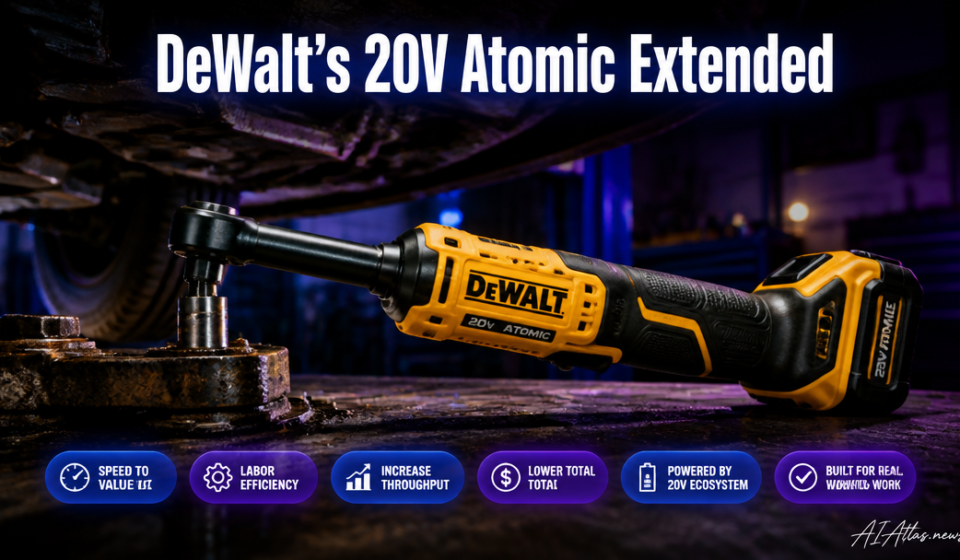
DeWalt’s 20V Atomic Extended Reach Ratchet has a tidy story: compact body, extended reach, cordless convenience for those fasteners you only ever find after you’ve disassembled half the job. But our experience in commercial tool adoption is that “more reach” is rarely the business outcome. The business outcome is reduced labour friction—less time swearing, repositioning, re-threading, and restarting—and whether that reduction survives real-world torque limits, battery swaps, and durability under daily use.
So we’re not reviewing this as a convenience upgrade. We’re treating it as a speed-to-value and total-cost-of-ownership (TCO) bet. The question for shop owners and mobile mechanics is whether DeWalt’s extended-reach design materially changes throughput in confined mechanical work enough to justify committing to yet another stop-and-start in your procurement cycle: another battery SKU, more chargers, more warranty claims, and more “which platform did we buy again?” at the jobsite.
Flaws in Current Market Assumptions
The first assumption we see is that access advantage automatically translates into time saved. Sometimes it does—but often the work shifts rather than shrinks. If an extended-reach head helps you reach the bolt, but the tool’s torque ceiling means you still need manual leverage, breaker bars, or a second attempt with a different tool, then the gain is diluted. In our experience, access and torque are a coupled system: remove one constraint and another becomes the bottleneck immediately.
The second assumption is ecosystem neutrality. Battery platforms are not neutral; they are switching-cost engines. Every new ratchet is also another dependency on chargers, pack compatibility, spare inventory, and tool-house organisation. That matters even more for facilities operators and trades businesses with standardised tool lists, because “one-off convenience” has a habit of becoming an informal standard—until your stockroom says otherwise.
The third assumption is durability optimism. A ratchet is not a drill. It lives in repeated load cycles, side loads, and awkward angles. If the mechanism, gear train, and clutch wear faster than expected, you don’t just lose uptime—you lose confidence, and confidence is the hidden cost of tool adoption. We’d rather see measurable job-time reduction and predictable failure modes than another marketing claim about “pro-grade” build.
The Structural Shift
What’s happening in tool markets—and what AI buyers often miss—is the structural similarity between power ecosystems and AI deployment stacks. In both, you’re not buying a single capability; you’re buying an operating model. A battery platform is your compute runtime: it determines what you can run, how fast you can swap, and how quickly you can scale across crews and shifts.
Meanwhile, the “extended reach” focus mirrors a common AI pattern: teams chase a narrow technical feature (better access, more context, faster inference) while underweighting the commercial constraints (cost per use, reliability under load, operational integration, and failure recovery). AI Atlas News readers have seen this movie with model providers and tooling wrappers; the lesson carries straight into mechanics. If DeWalt’s ratchet doesn’t change labour economics, it’s just a different way to spend money.
We’re also seeing a market move toward task-specific form factors—compact heads for confined spaces, slimmer profiles, and reach extensions. That’s smart engineering, but in business terms it’s only valuable when it reduces the number of distinct tools a job requires. If the workflow still demands a second ratchet, a different socket setup, or a manual backup, the “one tool” pitch doesn’t land.
Decision Framework for Capital Allocation
Before you buy, we’d run this like a micro-capex decision. Define a target job set (e.g., brake service, HVAC fan units, industrial gearbox covers, chassis fasteners in fleet maintenance), time baseline cycles, and then measure whether the ratchet removes steps. We mean measurable reductions in minutes-per-job, not anecdotal “it feels easier.”
Then score the tool against competitor ecosystems—not only the product features. In practice, we treat extended reach as a hypothesis: it should improve access at the exact locations where your crews lose time. If it does, you should see lower labour hours per job within a few weeks, even accounting for battery charging logistics.
| Tool / Platform | Access advantage | Torque ceiling (practical use) | Battery cost index* | Ecosystem fit | Durability under daily use** |
|---|---|---|---|---|---|
| DeWalt 20V Atomic Extended Reach Ratchet | High reach for confined clearances; best when fasteners sit deep or awkwardly angled | Likely tuned for small-to-mid fasteners; verify against your “worst day” loads | 3/5 (often mid-priced packs; depends on bundle strategy) | Strong if you already run DeWalt 20V; weaker if your fleet is multi-brand | 4/5 (expected competent reliability; validate clutch/gear wear cadence) |
| Milwaukee M12 Ratchet family | Good compact access; strengths depend on head design and clearance geometry | Typically reliable for routine service; verify breaker/over-torque tolerance | 4/5 (packs can add up if you start from zero) | Strong if M12 is your standard; otherwise adds operational complexity | 4/5 (shop use tends to be consistent; still check long-run wear) |
| Makita 18V compact ratchet range | Solid for access; may be less “reach-focused” than DeWalt’s extended approach | Often covers a broader fastener spread; confirm with your bolt sizes | 3/5 (pricing varies; ecosystem can be cost-effective at scale) | Strong where Makita 18V is standardised across teams | 4/5 (good perceived durability; monitor mechanism under side-load) |
| Bosch 18V ratchet options | Balanced compactness; access advantage may be “good” rather than “specialised” | Generally adequate for service work; limits show on stubborn corrosion | 3/5 (often competitive, but bundle-specific) | Best in Bosch-heavy tool houses; otherwise onboarding friction rises | 3/5 (durability acceptable; verify wear reports for daily rotations) |
| Ryobi 18V cordless ratchets | Access is workable but not always engineered for the deepest confinements | Performance can be inconsistent under repeated high-load cycles | 2/5 (lower entry cost; can help pilot without heavy commitment) | Good if you already standardise; risky if teams mix platforms | 3/5 (fine for light-to-medium use; daily pro duty needs caution) |
*Battery cost index is an operator-weighted relative scale (lower is cheaper to expand). **Durability under daily use is a qualitative index based on typical workshop expectations; your failure modes will depend on workload and maintenance discipline.
We’d only recommend DeWalt if your baseline work repeatedly encounters the exact constraint the “extended reach” design targets—and if your torque reality doesn’t force a fallback tool. Otherwise, you’re paying for access that doesn’t convert into labour time.
Risk Assessment Table
Tool launches look clean on spec sheets; the risks show up when you integrate the tool into the job flow. Below is a practical risk map we use for adoption decisions—focused on what actually breaks budgets: downtime, rework, and hidden labour carry cost.
In our experience, the highest-value measure is “minutes saved per completed job” after the first learning curve, adjusted for battery swaps and the share of jobs that truly benefit from extended reach.
| Risk | Why it hits TCO | First 30-day success signal | Mitigation |
|---|---|---|---|
| Torque mismatch | Access improves but bolts still need manual leverage; time shifts to a second method | Same-job completion rate rises without extra “second tool” steps | Trial on your stubborn fastener set; define max bolt size and corrosion band |
| Ecosystem lock-in cost | Battery expansion adds capex; charger and spares inflate stock complexity | Pack strategy covers shifts without emergency swaps | Standardise bundles; buy spares intentionally (not accidentally) |
| Durability wear under side-load | Ratchet mechanisms degrade; repairs/warranty consume both time and credibility | Operational incidents remain rare and failures are predictable | Train on correct angle use; keep a repair cadence and inspection checklist |
| Workflow friction (setup & sockets) | Extended reach can require specific socket/adapter geometry | Workers reach the target fastener without extra kit changes | Standardise socket kits for confined work; pre-validate in mock jobs |
| False confidence marketing effect | Teams assume the tool “handles it” and stretch beyond spec | Measured utilisation stays inside defined duty limits | Set guardrails: max torque proxy, max fastener class, and stop criteria |
Visualised Impact Matrix
The practical adoption move is to place the ratchet in a 2×2 matrix: high access advantage should only win if it also produces material labour savings after you factor in torque realities and operational costs. Here’s the model we’d use with a tool like DeWalt’s extended-reach ratchet.
We’d expect the extended-reach segment to be at least “Pilot” in any mixed tool house. The only way it graduates to “Adopt” is if your job mix repeatedly rewards reach and the tool completes the bolt cycle without pushing crews into manual workarounds. If not, you’re paying for a feature you’re not using often enough to amortise battery and operational overhead.
Strategic Recommendations for Leaders
Our advice is simple, and it’s operational: run a time-and-motion pilot with a defined fastener set and a defined duty boundary. Give the ratchet to the crews who do the confined work most often, but also track the “escape hatches”: how often they revert to another tool, switch sockets/adapters, or stop mid-job. If you don’t instrument that, you’ll measure comfort—not throughput.
Second, treat battery spend as an explicit line item in your adoption business case. For mobile mechanics and multi-site facilities, charger placement, pack rotation, and downtime from battery depletion are recurring costs. Even a modest reduction in minutes-per-fastener is only meaningful if it survives the charging reality on week two, not just the first week of enthusiasm.
Third, insist on an ecosystem audit. If your crews already run DeWalt 20V Atomic tools, the incremental load is lower; if you’re multi-platform, adoption friction increases. In our experience, the fastest path to value is standardising around one platform where practical, rather than sprinkling “best-in-class” tools across incompatible runtimes.
Future-Proofing the Business Model
We’re not convinced the right strategy is “more tool launches, more SKUs”. The future-proof move is building a procurement logic that rewards measurable workflow change, not feature novelty. That’s the same discipline AI leaders need: don’t buy every model refresh; buy the stack that reliably reduces total operational cost and improves failure recovery.
So we’d position DeWalt’s extended-reach ratchet as a candidate for standardisation only if your measured savings pass a threshold and your durability signals hold. If the tool earns a consistent role in confined mechanical work—without torque-driven rework—it becomes part of your operating system. If not, you park it, learn the constraint you’re actually facing, and redirect capital toward the tool category that truly removes labour friction.
Frequently Asked Questions
- How do we measure “labour savings” for a ratchet trial?
- Track minutes-per-job and count fallback events (second tool, manual leverage, extra socket/adapter changes) across your real fastener set, then compare against the baseline two-week average.
- What’s the biggest commercial risk with extended-reach tools?
- The access gain can be offset by torque limits or workflow constraints, so the job still requires a secondary method—erasing the TCO benefit.
- Should we buy the tool if we don’t already use the same battery platform?
- Only if you can justify battery/charger onboarding costs with either high utilisation or a clear standardisation plan; otherwise, the ecosystem friction will overwhelm marginal time savings.