





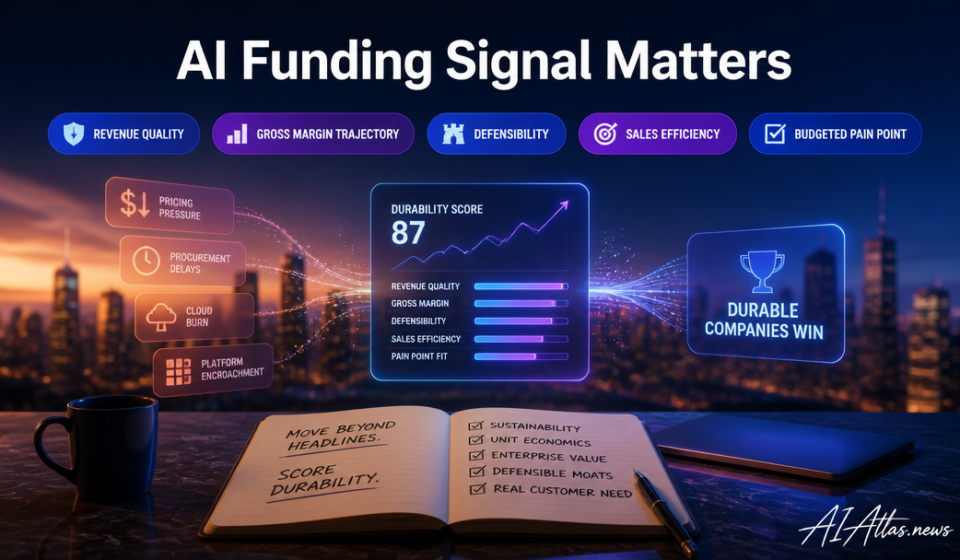
The AI Funding Signal That Matters When the Headlines Go Dark
We checked the usual signals and found nothing verifiable on new AI startup funding between 2026-06-10 and 2026-06-11. In our experience, that absence is rarely a neutral data point. It’s a signal that capital committees are tightening their definition of “durable” at precisely the moment pricing power is being tested by model cost curves, commodity inference, and platform-level bundling.
So this is our contrarian take: the most commercial story in AI right now isn’t who raised yesterday—it’s whether a startup can survive today’s margin math without becoming a bespoke services shop, or a feature inside someone else’s distribution channel.
The Contrarian Thesis
We believe the funding lens for AI startups is shifting from “trajectory” to “survivability”. Investors still ask about roadmap and product differentiation, but they now underwrite a narrower question: can the company keep paying for compute, people, and sales while customers still see enough value to stay at the price?
When funding headlines go quiet, the market isn’t just pausing—it’s re-pricing risk. That re-pricing tends to favour operators with burn rate discipline, defensible moats that reduce competitive cloning, and gross margins that can absorb the next wave of model and compute cost pressure.
Flaws in Current Market Assumptions
What we are seeing is a persistent habit of assuming that rapid technical progress automatically translates into enterprise revenue. In reality, adoption friction is the long pole: procurement cycles, data governance, security reviews, integration effort, and procurement’s preference for “known-good” references all slow down the path from demo to paid deployment.
Then there’s the economic fantasy. Many founders still plan as if inference costs will remain contained or will be magically offset by usage growth. But usage-based delivery can turn “land and expand” into a margin trap when the compute bill scales faster than contract value, especially as model pricing becomes more competitive and platforms start packaging capabilities.
The Structural Shift
The structural change is straightforward: distribution is consolidating around platform ecosystems, while value is fragmenting into workflows that buyers will pay for—only if the outcomes are measurable, the deployment is low-friction, and the unit economics hold under real load.
In that context, defensible moats look less like “we trained something clever” and more like practical barriers: proprietary workflow data, tight evaluation pipelines that reduce customer risk, switching costs from deep integration, contractual commitments that protect revenue, and sales efficiency that scales without corresponding burn.
Decision Framework for Capital Allocation
If we were allocating capital now, we’d start with the company’s ability to survive pricing pressure rather than its ability to impress in technical benchmarks. Specifically, we’d interrogate burn rate discipline, gross margin resilience under higher compute intensity, and enterprise readiness—then we’d test whether sales efficiency can keep up with the cost of acquisition.
We also treat platform exposure as a first-order risk. If the product’s core value can be replicated quickly inside a dominant ecosystem, the startup is effectively betting against the distribution owner’s roadmap and margin strategy. That’s not a minor concern; it often decides whether a company becomes a durable business or an acquisition target.
| Durability Dimension | What We Look For | Failure Mode If Absent | Operator-Grade Proof |
|---|---|---|---|
| Burn rate discipline | Clear runway linked to milestones, not optimism | Cash burn outruns revenue learning | Cohort retention improves while headcount grows slowly |
| Defensible moats | Switching costs via integration + workflow depth | Product commoditises as capabilities diffuse | Customers cite operational dependence, not “model choice” |
| Gross margin resilience | Cost-to-serve declines or stays bounded | Inference cost rises faster than contract value | Margin holds under peak usage and longer contexts |
| Enterprise adoption hurdles | Security + integration path pre-built, not improvised | Sales pipeline looks healthy, deployments stall | Shorter time-to-pilot and repeatable implementation playbooks |
| Exposure to platform competition | Value defended beyond “call the model” | Bundling collapses pricing and differentiation | Buyers pay despite platform-native alternatives |
Visualised Impact Matrix (div)
Let’s translate that into a practical operator view. We use a simple impact/effort grid: some risks hit hard immediately (high impact, low effort to diagnose), while others lurk behind “successful pilots” until contracts renew. The point is to force early clarity on what will matter at scale.
Below is a compact matrix showing where we expect durability to be most tested next, given the current investment quietness and the economics of model and compute costs.
Now (2026)
Quiet funding + pricing squeeze
Durability underwriting
Next (2026 H2)
Margin control becomes the sales story
Compute budgets tighten
Thereafter (2027)
Enterprise retention + proof cycles
Platform bundling pressure rises
Strategic Recommendations for Leaders
For founders and operators, we’d treat this moment like a stress test, not a communications challenge. First, run a brutal burn rate review: segment spend into “revenue learning”, “customer deployment”, and “product scalability”. If you can’t show which slice shortens time-to-repeatable revenue, you should cut or redesign it.
Second, pressure-test gross margins against real-world usage patterns. Model cost is only part of it—prompting overhead, retrieval complexity, latency targets, and operational tooling all matter. We recommend instrumenting cost-to-serve by customer cohort and use-case, then translating that into commercial packaging so customers feel the value without forcing you into unprofitable volume.
Third, fix enterprise adoption like a manufacturing process. Build security and integration artefacts early, standardise proof workflows, and avoid over-customisation during pilots. The sales team’s job is not to win a meeting—it’s to reduce the customer’s internal friction to the point where procurement can move.
Finally, confront platform competition head-on. Don’t just ask whether your product can be replaced; ask whether your customer’s operational workflow can be replaced. If the answer is “yes, easily”, you need deeper workflow entrenchment: evaluation, compliance evidence, continuous quality monitoring, and operational tooling that becomes part of how the enterprise runs.
Future-Proofing the Business Model
Future-proofing, in our view, is less about chasing the newest capability and more about designing an economic moat. That means pricing structures that align with value and cost-to-serve, contract terms that support stability, and retention metrics that prove you’re not selling a one-off experiment.
We also think leaders should plan for a world where model access becomes abundant and cheaper. When that happens, differentiation migrates to workflow ownership, data advantages, and the ability to prove outcomes under governance constraints. If your business model depends on exclusivity of intelligence, you’re vulnerable; if it depends on exclusive delivery of measurable outcomes, you have a better chance of surviving the next wave of commoditisation.
Frequently Asked Questions
- Does the absence of verified funding headlines necessarily mean demand is weak?
- Not always—sometimes it signals tighter underwriting and longer decision cycles, especially when unit economics are being scrutinised.
- What’s the fastest commercial metric to check for AI startup durability?
- We look at gross margin resilience under realistic usage, alongside CAC payback trajectory and retention cohorts—not vanity demos or short-term pipeline.
- How should founders defend against platform competition?
- Treat platform risk as a product-design constraint: build workflow entrenchment, evaluation evidence, and integration depth so buyers pay for outcomes, not just model access.