



The Enterprise AI Security Gap Is Now a Board-Level Execution Problem
The Contrarian Thesis
We have a problem of arithmetic masquerading as progress. Check Point’s 2026 Cloud Security Report says 77% of organisations have updated their security strategies for AI, yet only 26% can enforce those strategies. In our experience, that gap does not represent maturity—it represents governance debt with a rapidly compounding interest rate.
When Daylight expands Managed Detection and Response (MDR) to integrate with enterprise AI platforms including Claude Enterprise, it is tempting to frame this as “more coverage”. We think the more accurate framing is narrower and more commercial: AI-native workflows create blind spots that traditional telemetry and response playbooks were never built to manage, so enforcement now becomes the product—not the policy.
Flaws in Current Market Assumptions
Most vendors and many CIOs treat “strategy updates” as the milestone that proves readiness. The Check Point numbers tell us otherwise. Updating a document is cheap; wiring enforcement into identity, data paths, model access, and workflow telemetry is expensive—and slow enough that business units will quietly bypass it if they can.
What we are seeing is a familiar pattern: AI adoption accelerates through procurement and experimentation faster than security can operationalise controls. The result is an adoption curve without an operating model. That mismatch turns routine incidents—data leakage, unauthorised usage, and insufficient visibility—into board-level risk events, because they do not behave like classic malware outbreaks. They behave like process failures inside tools people consider “safe” by default.
The Structural Shift
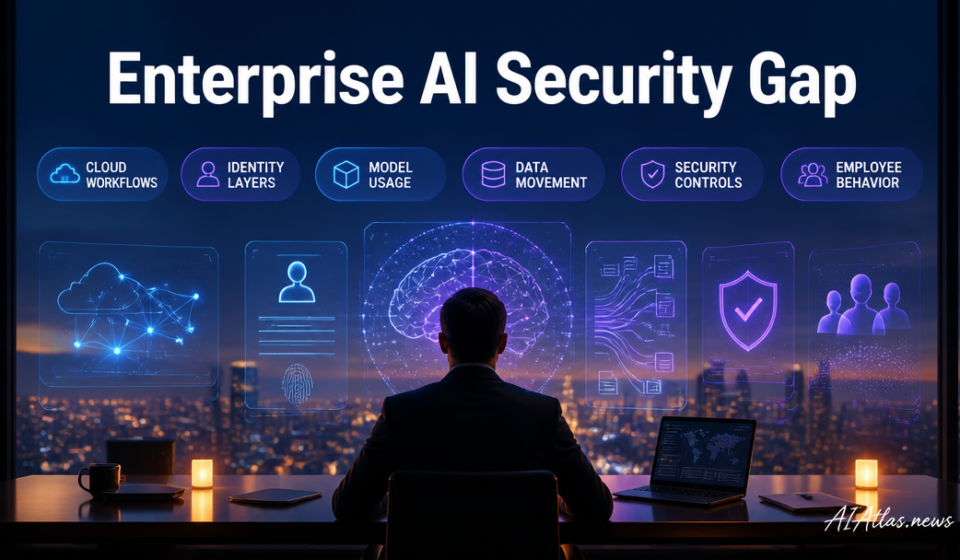
AI changes the security perimeter. In many enterprises, the new “edge” is not the network boundary; it is the conversation boundary—prompts, attachments, tool calls, retrieval contexts, and logs that may or may not exist in a usable form. If you cannot map those flows to a policy and then act on them, your strategy becomes an aspirational artefact.
Daylight’s positioning around AI-native blind spots—data leakage, unauthorised usage, and insufficient visibility across AI-enabled workflows—implicitly acknowledges the structural issue. The enforcement gap is widening because AI platforms introduce new states the security stack cannot currently observe end-to-end. MDR, when integrated properly, can act as the bridge: detecting what happened in AI workflows and responding with procedures that do not require a forensic team to stitch together evidence from fragmented logs.
Decision Framework for Capital Allocation
If you are an investor, founder, CISO, or CIO evaluating enterprise AI adoption or AI security MDR vendors, our recommendation is blunt: fund enforcement capability, not intentions. Your diligence should start with how quickly a vendor can translate policy into measurable control outcomes inside real workflows.
We use a simple four-part filter. First, telemetry: can the vendor observe AI interactions with sufficient fidelity to distinguish misuse from legitimate experimentation? Second, policy alignment: can it enforce “allowed prompts/data/users/workflows” rather than merely alert? Third, response depth: does MDR support containment actions that match AI incidents (revoking access, quarantining outputs, rolling back sessions, escalating with audit-grade evidence)? Fourth, time-to-value: how fast can you move from “integration works” to “alerts and actions reduce risk” without rewriting your whole security operating model.
Risk Assessment Table
Below is the comparison we apply to prioritise spend. It is not about fear; it is about which failure modes create the most expensive remediation loops—because enforcement gaps tend to multiply under audit pressure.
| Risk category (AI-adjacent) | Typical failure symptom | Business impact if unmanaged | Minimum enforcement capability to demand | Where MDR should add leverage |
|---|---|---|---|---|
| Data leakage | Sensitive content appears in AI outputs or logs with no containment path | Regulatory exposure, IP loss, contractual breach | Prompt/data classification + session-level controls | Detect exfil patterns and trigger quarantine/revocation with audit evidence |
| Unauthorised usage | Users or apps access model features outside approved workflows | Shadow AI procurement, internal policy violations | Identity-aware gating and workflow authorisation | Correlate identity + AI activity and enforce access changes during incidents |
| Visibility gaps | Teams can’t answer “what did the model see?” after the fact | Slow investigations, weak audit trails | End-to-end event capture across AI-enabled steps | Normalise AI workflow telemetry for consistent detection and reporting |
| Model/tool misuse | Tool calls or retrieval contexts expand risk beyond intended scope | Operational disruption; indirect data exposure | Guardrails on tool access and retrieval sources | Alert on anomalous tool usage and execute containment runbooks |
| Governance theatre | Policies exist, but controls do not map to enforceable actions | Board risk escalation during incident or audit | Measured enforcement outcomes (not documents) | Provide proof: detection-to-response metrics tied to policy objectives |
Visualised Impact Matrix (div)
To make this tangible, we map where most organisations land. The Check Point numbers—77% updated strategy, 26% can enforce—imply that many firms will have policy intent without operational control.
“Policy without control”
vs 26% enforceable
“Operational governance”
“Experiment sprawl risk”
“Surveillance without action”
Strategic Recommendations for Leaders
We would not buy “AI security” in the abstract. We would buy enforceable control outcomes with a measurable feedback loop. Ask how the vendor handles incidents where the evidence is partly conversational and partly contextual—where logs are incomplete by design and where users can generate risk faster than your tickets can route.
Concretely, we recommend three actions. First, run a control mapping exercise for your top 5 AI use cases: document what data can enter, what can leave, which identities can trigger actions, and which systems must produce audit-grade evidence. Second, demand pilot success criteria that reflect enforcement—time to contain, number of unauthorised sessions blocked, and quality of incident narratives for regulators and internal audit. Third, treat integrations (including with Claude Enterprise) as only the start: the real evaluation is whether detection and response operate across the workflow, not just within a single console.
Future-Proofing the Business Model
For MDR vendors and founders, the commercial lesson from this enforcement gap is simple: the market is moving from monitoring to governance execution. If you sell dashboards, you will be compared to cheaper analytics. If you sell policy-to-response execution inside AI workflows—with evidence and containment—buyers will pay for operational certainty.
For enterprises, future-proofing means redesigning the operating model around AI states. That includes revisiting incident response runbooks, redefining what constitutes “data exposure” in conversational systems, and aligning ownership between IT, security, and business teams that actually run the workflows. The winners will be the organisations—and vendors—who can prove that updated strategies translate into enforced outcomes faster than AI adoption translates into new risk.
Frequently Asked Questions
- How should we interpret “77% updated AI security strategy” if only 26% can enforce it?
- We treat it as evidence that many organisations are operating at a policy layer without the controls layer. In practice, that means risk can still leak through workflows even when the strategy looks robust.
- What should we ask an MDR vendor integrating with enterprise AI platforms like Claude Enterprise?
- Ask how they detect and contain AI-specific incidents: session-level enforcement, audit-grade evidence, and workflow-wide visibility. Your goal is to confirm detection-to-action coverage, not just log ingestion.
- Which metrics best validate that AI security spend is buying enforcement outcomes?
- Track containment time, blocked unauthorised sessions, reduction in repeat incidents, and quality of incident narratives for audit and regulators. If you can’t measure those, you’re buying activity rather than risk reduction.