
Prompt Engineering Isn’t Dead — It Has Become Production Engineering
The Strategic Objective
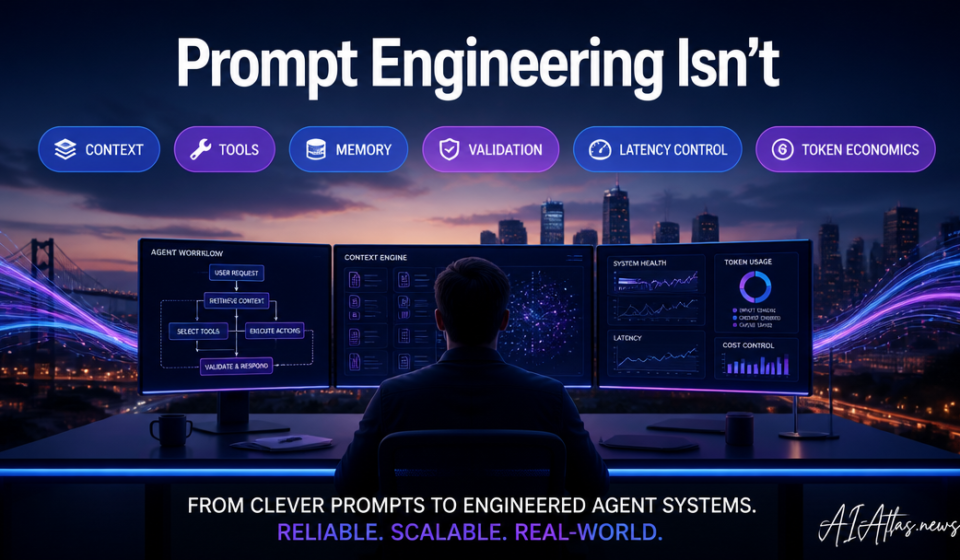
We keep hearing “prompt engineering is dead”. In our experience, that isn’t a funeral—it’s a market correction. The value isn’t evaporating; it’s relocating. Builders who treated prompts as the whole system are simply being outcompeted by teams who design the environment around the model: curated context windows, retrieval pipelines, tool access, memory, validation checks, and the boring-but-decisive disciplines of latency control, token economics, and observability.
What we are seeing in boardrooms is blunt: investors and enterprise buyers now ask whether an agent deployment can be repeated under real constraints. Not whether it can impress once. Production AI advantage is increasingly a systems engineering problem—measured in cost per resolved task, output consistency, incident rate, and time-to-repair—not in the elegance of a single prompt.
Prerequisite Checklist
If you’re serious about agents, don’t start with prompt craft. Start by building the minimum reliable operating system that makes the model’s behaviour measurable and governable.
Before you write Step One, confirm you have the following in place (or a credible plan to obtain it):
- Use-case boundaries: exact inputs/outputs, failure tolerance, and escalation paths.
- Context sourcing: curated documents, schemas, and a defined context window strategy.
- Retrieval pipeline: indexing method, ranking approach, freshness rules, and fallbacks.
- Tool access model: what tools exist, permissions, and side-effect controls.
- Memory policy: what is stored, for how long, and when it is retrieved.
- Validation + guardrails: deterministic checks, policy filters, and schema validation.
- Instrumentation: logging, tracing, cost tracking, and evaluation harness.
- Latency and budget targets: tokens, time budgets, and cut-off rules.
Sequence of Operations
When founders ask for “the agent prompt”, our response is to flip the order: design the loop first, then specify what the model can do within it. Below is the five-step workflow we’ve seen produce repeatable performance without burning cash.
Think of this as engineered context + harness engineering, not prompt artistry.
- Define the contract: specify task success criteria, required fields, acceptable uncertainty, and what “no answer” looks like.
- Engineer the environment: build the context window strategy (curation + retrieval), attach the right tools with permissions, and define memory scope.
- Implement the agent loop: plan → retrieve → act/tool → verify → respond. Force structured intermediate outputs so downstream validation is possible.
- Add validation checks early: schema enforcement, citation/grounding rules, tool result verification, and policy guardrails before the agent scales.
- Run an evaluation harness with budgets: measure cost per resolved task, latency percentiles, and consistency across realistic scenarios; only then expand coverage.
Common Failure Points
The fastest way to waste money is to treat agent work like prompt experiments. We’re seeing teams iterate on wording while ignoring the components that actually drive reliability: retrieval quality, tool-side effects, validation logic, and instrumentation.
Here are the failures that most reliably burn runway:
- Single-shot prompts in production: no loop, no verification, no escalation. The model fills gaps with plausible nonsense.
- Unbounded context: stuffing everything “just in case” until token costs and latency quietly explode.
- Tool access without permissions: the agent can do more than you intended, or it cannot do enough to finish tasks.
- No memory discipline: storing irrelevant history, causing drift, or violating compliance expectations.
- Blind rollout: launching without an evaluation harness, so you discover failure modes after customers have already experienced them.
- Observability gaps: when something breaks, you can’t tell whether it was retrieval, tool output, validation, or the model response.
DIY vs Outsource
We look at this decision as risk allocation, not preference. DIY can be a serious advantage when you need tight control over retrieval, instrumentation, and continuous evaluation. Outsource makes sense when you can pay for speed while still owning the system design and evaluation outcomes.
| Criterion (5 key factors) | DIY build | Outsource build |
|---|---|---|
| Speed to first prototype | Fast if team has agent experience; slow if you’re starting from scratch | Often quicker early; may stall when requirements get specific |
| Cost control (tokens + latency) | Better when you own budgets and instrumentation end-to-end | May require renegotiation to optimise costs after pilot scope changes |
| Quality consistency | Strong if you build an evaluation harness and validation pipeline | Strong if they deliver measurable tests—not just demos |
| Risk & compliance | Higher upfront effort; you control guardrails and data handling | Depends on vendor maturity; ensure auditability and access controls |
| Long-term ownership | Best: you can iterate on context, tools, memory, and thresholds | Risky unless you require knowledge transfer and maintain system hooks |
Our rule of thumb: outsource the first scaffold, but never outsource the evaluation harness. If you can’t measure performance and cost in-house, you can’t steer the roadmap—only react to surprises.
Visualised Workflow Roadmap
Here’s the shape of an agent system that doesn’t rely on heroic prompting. The goal is a repeatable loop with explicit inputs, bounded context, verifiable actions, and logged outcomes.
We use this roadmap when advising founders on what to build first—and what to postpone until the system proves itself.
Verification & Success Metrics
Agents succeed or fail on evidence. We advise teams to treat evaluation like a product feature, not a one-off pre-launch activity.
X-axis: Observability & latency budgets: High
Do you have instrumentation to scale?
Ship with evidence and guardrails.
Optimise checks before expansion.
Unbounded failure under load.
Track metrics that map directly to business cost and trust. We care less about “accuracy” posters and more about: resolution rate per task type, grounded answer rate, tool-error rate, time-to-repair, and cost per resolved outcome. If those numbers aren’t trending favourably, your agent system design is not finished.
- Cost per resolved task: tokens + retries + tool calls, not average prompt length.
- Latency percentiles: p50/p95/p99 with clear cut-offs.
- Consistency: variance of structured outputs against a gold set.
- Grounding/validation pass rate: schema-compliant and policy-compliant responses.
- Observability coverage: % of runs with full trace + failure reason classification.
The Long-Term Maintenance Plan
Agents don’t “set and forget”. The systems degrade when your context shifts, tools change, policies evolve, and retrieval quality drifts. The winners plan maintenance the way they plan sales: as an ongoing activity with budgets and owners.
We recommend a maintenance cadence that keeps your agent in the production-ready quadrant of the matrix. Assign explicit responsibilities for each component—retrieval, validation, tool integrations, and evaluation—and run scheduled “drift checks” tied to cost and failure modes.
- Weekly: review evaluation failures, update retrieval/index, adjust thresholds.
- Monthly: re-baseline cost/latency, update guardrails, refresh memory rules.
- Quarterly: tool audit, permission review, compliance regression tests, architecture refactors where needed.
FAQ
Below are the questions we hear most from founders and enterprise operators trying to decide how to invest in agent systems without funding an expensive experiment.
Frequently Asked Questions
- Is prompt engineering really obsolete?
- Prompts still matter, but they are no longer the primary lever for production reliability. In our experience, performance is dominated by context design, retrieval quality, tool harnessing, and validation.
- What should we build first for an agent rollout?
- Start with a task contract and a measurable loop: retrieve, act, validate, and log. If you can’t evaluate and observe it early, you won’t control cost or consistency later.
- How do we prevent agent deployments from becoming too expensive?
- Set latency and token budgets, implement cut-offs and fallbacks, and track cost per resolved task from day one. Then tune retrieval and verification so you reduce retries rather than “spend more tokens”.