
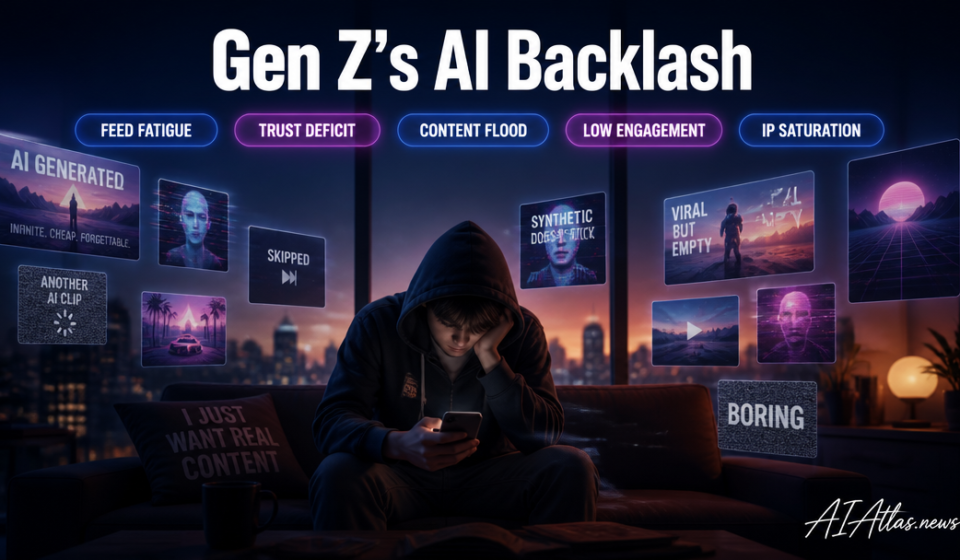
Gen Z’s AI Backlash Is a Warning Shot for Entertainment Platforms
The Contrarian Thesis
We keep hearing that Gen Z “doesn’t get it” when AI content disappoints. Our read is tougher: the decline in excitement toward AI entertainment is not a taste story—it’s an early signal that low-cost generation is colliding with the economics of attention, trust, and media brand value.
Gallup’s polling, as cited in the research cluster, shows optimism falling by 14 points between 2025 and 2026, while anger rises to 31% and is associated with growing exposure to low-quality AI-generated entertainment on social media. That anger matters commercially because it doesn’t just reduce engagement; it degrades the feed experience that keeps people returning in the first place.
Flaws in Current Market Assumptions
In our experience, the market’s default assumption has been “more output beats better output”. It looks rational in spreadsheets: cheap compute, rapid iteration, infinite variants, and distribution at near-zero marginal cost. But attention isn’t infinite, and neither is tolerance for repetitive, untrustworthy, or mechanically produced entertainment.
The second flawed assumption is that consumer sentiment behaves like a lagging indicator of product quality. What we are seeing suggests sentiment is acting like a leading indicator of distribution ceiling. Once users perceive feed degradation, they switch from “try one more” to “tune out” or actively seek exclusion tools (mute filters, verified-only feeds, subscription walls). That is a distribution constraint, not a creative constraint.
The Structural Shift
Cheap generation changes the cost structure of content creation—yet it does not reduce the cost structure of consumption. Platforms and audiences still pay in cognitive attention, time, and emotional tolerance. When AI generation floods discovery channels, the consumer is forced into more “evaluation work” to identify what’s worth watching, reading, or sharing. If that work feels pointless, trust erodes.
This is where the commercial collision happens. Low-cost production can depress the value of each individual piece (because there’s too much of it), while the downside of poor quality rises (because it contaminates the perceived whole). Media brands have known this for decades—now the pattern is hitting AI-native entertainment at scale.
Decision Framework for Capital Allocation
If you’re an entrepreneur, investor, or media operator, the key question is not “Can we generate content cheaply?” It’s “Can we protect user trust while preserving unit economics at distribution scale?” We treat optimism decline as a capital allocation warning: funding should flow to mechanisms that control perceived feed quality, not just content throughput.
Here’s the framework we use when underwriting AI-driven content bets. We score each initiative on (1) retention economics, (2) trust safeguards, (3) brand recoverability, (4) IP monetisation pathways, and (5) moderation/QA operating cost curves as volume increases.
- Retention economics: Are we improving long-session return or just harvesting short spikes?
- Trust safeguards: What prevents low-quality outputs from contaminating the feed?
- Brand recoverability: If quality slips, how quickly can we roll back and prevent reputational drift?
- IP monetisation pathways: Does the model create defensible rights and licensing value, not just content volume?
- Operating-cost curves: Does QA cost flatten with scale, or do we discover hidden “attention waste” costs?
Risk Assessment Table
The risk isn’t that AI-generated entertainment fails technically. The risk is that it succeeds commercially in production while failing commercially in distribution—triggering churn, backlash, and platform-level friction. The table below compares five strategies by their likely trust impact and the metrics that catch problems before sentiment turns into account-level or brand-level damage.
| Strategy | Upside | Trust Impact | Metric to Watch | Failure Mode |
|---|---|---|---|---|
| Infinite generation with broad posting | Rapid test cycles; high content volume | High risk of feed contamination | Feed satisfaction / mute rate | Anger rises; retention falls |
| Curation + throttling by quality gates | More consistent user experience | Lower risk; improves trust over time | Return rate after exposure | Costs rise if gates are manual |
| Verified creator partnerships (human-in-the-loop) | Credibility; community loyalty | Generally positive; clearer accountability | Creator-to-audience conversion | Supply bottlenecks; slower iteration |
| User-controlled remix with provenance labels | Personalisation; perceived agency | Improves transparency; reduces confusion | Provenance acceptance rate | Complex UX; drop-off in discovery |
| Brand-safeguarded licensing + audit trails | Defensible IP monetisation | Strong governance; reduces reputational risk | Complaint rate per 1k impressions | Legal/ops overhead; slower scale |
Visualised Impact Matrix
We think the market is forming around one idea: consumers will forgive “imperfect”, but they won’t forgive “uncertain and everywhere”. The matrix below maps initiatives by two pressures we’re seeing in the field: feed friction (how much evaluation effort users must spend) and brand trust (how much confidence users have that what they see is worth their attention).
Strategic Recommendations for Leaders
We would not bet the next funding round on the ability to crank out entertainment faster. We would bet on the ability to prevent feed degradation while still scaling distribution. That means treating moderation, evaluation, and provenance as product primitives—not cost centres deferred until after launch.
Actionable moves we’re seeing work with serious operators:
- Institute quality gates tied to retention, not only model metrics. If a release improves completion rate but harms later return, it’s a long-tail threat.
- Separate experimentation from the default feed. Use sandboxes, limited rollouts, and audience segmentation so poor outputs don’t pollute discovery.
- Label provenance and account for uncertainty. Trust is rebuilt through transparency, not silence.
- Build rollback and quarantine tooling. When anger spikes, you need to stop the bleed within hours, not weeks.
- Monetise around creators and rights, not raw output volume. IP licensing and verified creator supply create durable value in a saturated market.
Future-Proofing the Business Model
Our core thesis is simple: the value of infinite generation has been overestimated because the consumer’s patience becomes the binding constraint. You can scale production indefinitely; you cannot scale trust indefinitely. When optimism collapses and anger rises (31% tied to low-quality AI entertainment exposure), the market is telling you that distribution economics are tightening.
So future-proofing means rebalancing the unit economics across the full attention loop. Yes, reduce generation cost—but also invest in the systems that protect brand perception: curation, QA automation with human escalation, provenance, and licensing structures that reward the people and organisations customers believe they’re engaging with. The winners will not be those with the biggest content factories; they’ll be those with the best content stewardship.
Frequently Asked Questions
- FAQ 1: Is this just a Gen Z backlash against “bad content”?
- No. We see it as an early distribution ceiling: low-cost output is degrading perceived feed quality, which then harms trust and retention beyond any single demographic.
- FAQ 2: What should investors ask beyond model capability?
- They should ask about retention-linked quality gates, rollback speed, provenance strategy, and how QA/moderation costs behave as volume increases.
- FAQ 3: Which business model is most resilient to feed degradation?
- In our view, models that pair scalable generation with accountable supply (verified creators, licensing, and audit trails) outperform “infinite generation” approaches when user sentiment turns.