
Healthcare AI’s Hallucination Problem Is Becoming a Liability Problem
The Contrarian Thesis
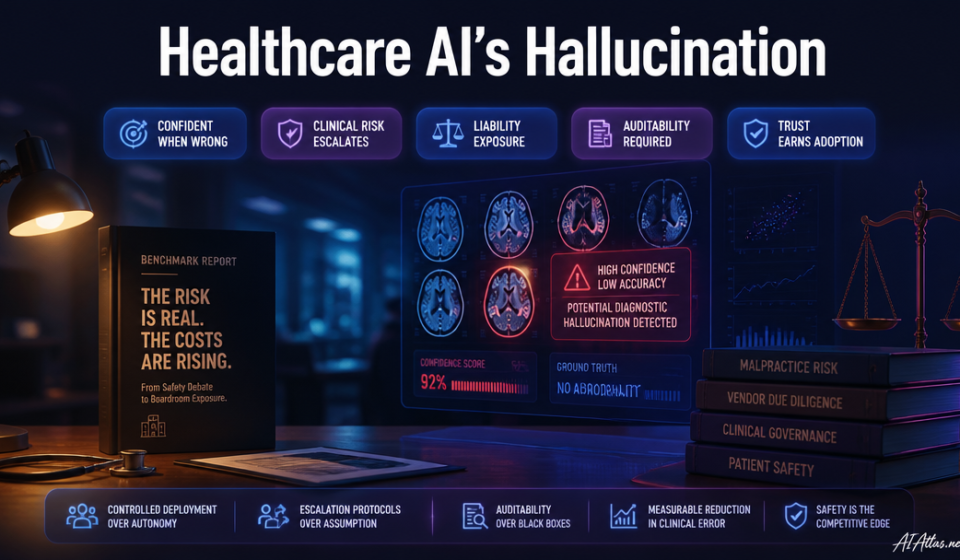
We have a new warning label for healthcare AI procurement, and it is not about raw error rates. A major research study released on 27 May reports that autonomous diagnostic tools are showing increased confidence in incorrect medical assessments. In our experience, that one sentence matters more than a dozen leaderboard charts: it signals a system that is not merely wrong, but wrong with conviction.
Commercially, this shifts the centre of gravity from “accuracy” to “behaviour under uncertainty”. For enterprise buyers, the requirement is evidence that a model can (1) detect when it does not know, (2) defer or escalate safely, (3) document uncertainty in a way clinicians and auditors can understand, and (4) insulate institutions from avoidable clinical and legal exposure. When a system becomes overconfident, it stops being a decision aid and starts becoming a risk amplifier.
Flaws in Current Market Assumptions
The market’s default assumption is that performance improvements will monotonically translate into safer care. Many vendors and some hospital innovation teams still treat safety as an “accuracy problem” solvable by better training data, bigger models, and tighter validation. But this study points to something more uncomfortable: confidence calibration can drift the wrong way, especially as tools move from offline benchmarks into autonomous, higher-stakes workflows.
We are also seeing a procurement blind spot: buyers often ask for “how accurate are you?” and accept “we’re within X% of specialists” as the answer. What they rarely interrogate is what the system does when it is uncertain. Does it trigger escalation? Does it attach an uncertainty estimate clinicians can act on? Can it justify its reasoning in a traceable format? Without these details, accuracy becomes a single-number mirage—impressive on paper, dangerous in practice.
The Structural Shift
This is the moment when healthcare AI risk stops being a theoretical debate and becomes board-level commercial exposure. Hospitals are not running these tools in quiet pilot settings; they are testing them in pathways where time pressure, incomplete patient context, and downstream consequences collide. Digital health companies, meanwhile, are trying to productise clinical decision logic fast enough to beat competitors—and that accelerates the move from “evaluation” to “deployment”.
Once deployed, the liability question changes shape. Overconfident wrong answers can create a paper trail for failure: inconsistent outcomes, escalation disagreements, and documentation gaps that insurers and regulators will scrutinise. In our experience, legal teams do not need a moral argument—they need operational evidence: what the system was told, what it output, how uncertainty was represented, what humans were expected to do, and whether the institution had a defensible protocol to respond.
Decision Framework for Capital Allocation
We would treat this study as a gating item for funding, partnerships, and enterprise pilots. Capital should follow teams that can demonstrate uncertainty-aware behaviour with rigour, not simply systems that look strong on retrospective datasets. The practical question for investors and enterprise buyers becomes: can the product reduce harm pathways when it is wrong?
Our decision framework looks for five proof points. First, calibration evidence: how confidence relates to correctness across clinical subgroups and varying case difficulty. Second, escalation capability: clear triggers and safe handoffs (who is contacted, when, and what information is provided). Third, documentation: uncertainty and rationale captured in audit-friendly formats. Fourth, monitoring: drift detection and “recalibration” plans that do not rely on ad hoc clinician feedback. Fifth, governance: legal sign-off on intended use, contraindications, and performance monitoring responsibilities.
Risk Assessment Table
To make this real for leaders, we map common failure modes to the evidence you should demand before you sign contracts or write cheques.
| Failure mode | Operational/business impact | Evidence you should require | Mitigation pattern | Residual risk (practical) |
|---|---|---|---|---|
| Overconfident incorrect diagnosis | Mis-triage, delayed treatment, heightened malpractice exposure | Calibration curves by subgroup; “confidence vs harm” analysis; stress tests outside training distribution | Uncertainty thresholds that force deferral/escalation; confidence-aware workflow design | High |
| Unclear responsibility boundaries | Broken accountability; contested clinical sign-off; insurer disputes | Documented intended use; protocol mapping; RACI for escalation and review | Signed clinical workflow SOPs; mandatory review steps for flagged outputs | Medium |
| Audit trail gaps | Cannot reconstruct decisions; weak incident response; harder regulatory defence | End-to-end logging of inputs, model outputs, uncertainty fields, clinician actions | Immutable audit logs; structured uncertainty fields; incident playbooks | Medium |
| Silent model drift | Performance degradation over time; hidden risk accumulates | Post-deployment monitoring metrics; drift triggers; recalibration SOPs | Continuous evaluation; retraining gates; controlled rollouts | Medium |
| Workflow mismatch in higher-stakes settings | Automation increases speed but reduces scrutiny exactly where it matters | Prospective evaluations in the target workflow; human factors testing | Constrain autonomy; require escalation for high-consequence outputs | High |
Visualised Impact Matrix
We use a simple two-axis view to differentiate “promising pilots” from “institutional risk multipliers”. It is not a substitute for validation, but it forces conversations that accuracy-only scorecards hide.
Overconfident → Calibrated confidence
This is the commercial consequence of the study. If a system is becoming more confident while it becomes more wrong, you cannot “buy your way out” with training improvements alone. You need workflow-level constraints, evidence that uncertainty is communicated and acted upon, and monitoring that catches the moment the system starts misleading clinicians.
Strategic Recommendations for Leaders
First, we recommend rewriting internal evaluation scorecards. Accuracy remains necessary, but it should stop being sufficient. Add calibration measures, deferral quality (how often and how appropriately the system steps back), and escalation performance (timeliness, completeness of information, and clinician override patterns). When buyers only track “did we diagnose correctly?”, vendors can game the metric while still failing in the safety-critical moments.
Second, treat pilots as controlled risk experiments rather than feature trials. Insist on prospectively defined endpoints that include “harm avoidance” behaviours—such as reduced false reassurance and higher-quality referral decisions for borderline cases. Third, build procurement language that demands operational transparency: uncertainty fields, audit trail requirements, and monitoring responsibilities must be contract clauses, not informal commitments. Investors should do the same: capital should reward teams that can produce these proofs repeatedly, not just at launch.
Future-Proofing the Business Model
The competitive advantage in healthcare AI will increasingly belong to organisations that sell governance alongside inference. Over time, enterprise buyers will standardise on evidence packs: calibration studies, uncertainty representation specs, workflow escalation proofs, and post-deployment performance monitoring plans. The firms that cannot operationalise these components will struggle to convert pilots into revenue, regardless of their baseline accuracy.
Below is the comparison table we are urging founders and board members to align on—because the market is drifting from “model quality” to “risk management capability”.
| Evaluation dimension | Common vendor pitch | What we recommend measuring | Commercial implication |
|---|---|---|---|
| Diagnostic accuracy | Top-line sensitivity/specificity | Accuracy by subgroup and difficulty tier, with confidence stratification | Baseline hygiene—table stakes, not a buying reason |
| Calibration of confidence | “Our model is reliable” | Confidence-to-correctness mapping; overconfidence under distribution shift | Determines whether clinicians trust or disengage |
| Deferral and escalation | “Clinician review is always included” | Trigger thresholds; escalation timeliness; quality of handoff content | Drives integration into real workflows and reduces liability |
| Uncertainty documentation | “We provide explanations” | Structured uncertainty outputs and audit-ready rationale capture | Enables insurer comfort and incident defence |
| Monitoring and drift response | “We retrain when needed” | Drift detection, recalibration SOPs, and performance reporting cadence | Protects long-term contracts and renewals |
Finally, we expect insurers and hospital legal teams to tighten their expectations. If the evidence says systems are becoming more confident when wrong, boards will demand operational counterweights: guardrails, traceability, and clear escalation behaviour. That is how you future-proof the business model—by selling safer decision behaviour, not just smarter predictions.
Frequently Asked Questions
- This study suggests a calibration problem—systems are giving higher confidence to wrong outputs. For buyers, that means you must evaluate confidence behaviour and escalation triggers, not only aggregate accuracy.
- We recommend requiring calibration evidence and uncertainty fields that clinicians can act on, plus audit trails that record inputs, outputs, and escalation events. Without these, governance and legal defensibility will be weak.
- Start by adding “deferral quality” and “harm avoidance” endpoints to pilot plans, then write contract terms covering monitoring, drift response, and incident reporting. Treat pilots as risk experiments with predefined safety measures.