
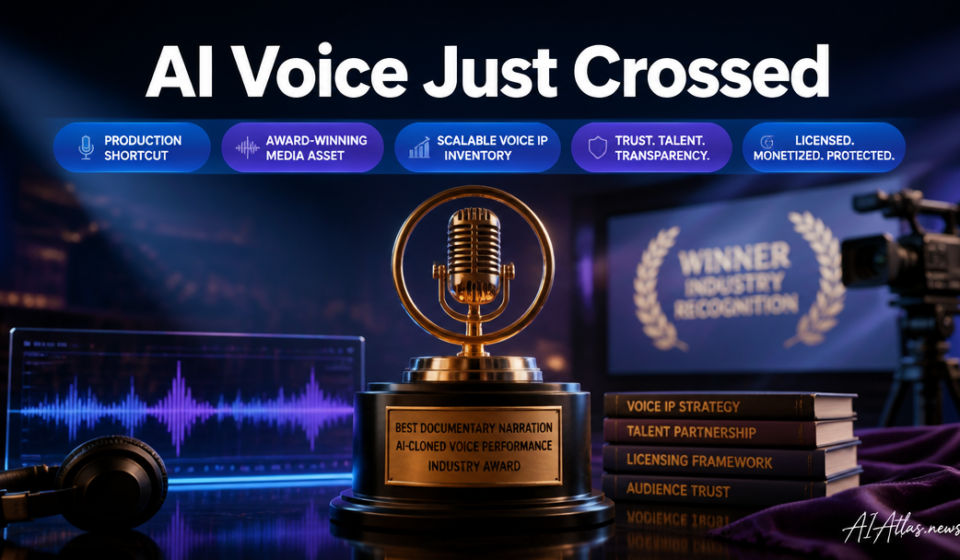
AI Voice Just Crossed From Production Shortcut to Award-Winning Media Asset
The Contrarian Thesis
When a major media awards ceremony recognises an AI-cloned voice for documentary narration, we should resist the lazy take that “AI is finally normal”. In our experience, awards are rarely about novelty; they’re about what markets are prepared to pay for without flinching. This is a recognition event that quietly redefines a professional boundary: synthetic voice is no longer treated as a budget workaround, but as a performance category.
The commercial inflection point is not the clone itself—it’s the legitimacy cascade. Once gatekeepers validate a synthetic performance as award-worthy, procurement teams gain cover to treat the output as an asset, not an experiment. That immediately drags four uncomfortable questions into boardrooms: who owns the generated voice output, how talent and rights-holders get compensated, what “disclosure” must look like to avoid backlash and legal exposure, and how fast producers will swap human narration and dubbing/localisation spend for machine-generated equivalents.
Flaws in Current Market Assumptions
We keep seeing the same business assumption: “AI voice is just cheaper narration.” That’s only true in a narrow, short-run accounting view. Yes, unit costs fall for quick turnarounds and iterative localisation. But the hidden costs move elsewhere—into rights clearance, provenance tooling, contract negotiation, brand risk management, and customer trust. The real question is not whether AI reduces cost; it’s whether the supplier ecosystem can reduce legal and reputational friction enough for procurement to scale confidently.
Another misread is governance. Media companies often talk as if voice is analogous to stock footage—something you licence and move on. But voice is entangled with personality rights, guild expectations, union practices, consent requirements, and (in many contexts) ongoing earning potential. If we treat synthetic output like “generic content”, we will underprice the friction and overestimate adoption speed. The award signals professional acceptance; it does not solve the ownership and compensation mess that will determine whether this becomes a mature asset class or a litigation hotspot.
The Structural Shift
The structural change is that synthetic voice is moving from back-office cost reduction to front-of-house commercial strategy. Narration stops being a line item and becomes a reusable production primitive—something that can be restyled, re-tuned for different markets, and delivered at lower marginal cost. That turns creative performance into an IP-adjacent asset that needs its own licensing architecture, valuation model, and audit trail.
To make this tangible, consider where narration spend may migrate when rights are cleared and disclosure frameworks stabilise. We’re not forecasting exact shares, but the direction of travel is already visible: more spend moves toward licensed synthetic assets, and less into one-off human recording sessions for standardised doc voicework.
Licensed synthetic voice (illustrative 25%)
AI-driven localisation/dubbing outputs (illustrative 18%)
Hybrid/exception handling (illustrative 12%)
Once that migration starts, the competitive landscape changes. Studios and streamers that negotiate voice rights early will treat synthetic performance like a reusable production line—across episodes, franchises, and international distributions. Others will get dragged into retroactive clearance, scramble for replacement performers, and pay “trust premiums” to win back audiences that feel deceived rather than impressed.
Decision Framework for Capital Allocation
Our view is simple: treat AI voice as a capital allocation problem, not a creativity trend. The investment case should be built from first principles—where the savings are real, where the costs reappear, and what must be true contractually before you scale. If we cannot specify ownership and permitted use precisely, we are not buying production efficiency; we are buying future disputes.
We advise leaders to run a rights-and-economics scorecard before greenlighting any “replace narration” strategy. Start with four practical questions: (1) what exactly is being licensed or sold (the model, the clone, the generated waveform, the performance style, or the transcript?), (2) what territories and media formats are covered (broadcast, SVOD/AVOD, ads, trailers, games, internal training clips), (3) what disclosure standard is required for the audience and for partners, and (4) what quality and revocation mechanisms exist if the output harms brand safety or violates consent. Only then does the unit-cost arithmetic become decision-grade.
Risk Assessment Table
This is where boards get uncomfortable. Voice assets are monetisable, but they are also contested: by performers, rights-holders, unions and guilds, regulators, and—sometimes most powerfully—viewers. The risk profile doesn’t vanish when an award ceremony endorses a synthetic performance; it just changes which risks are most immediate.
Below is how we compare the key commercial risks we’re seeing across entertainment and media workflows. Treat it as a governance checklist, not a theoretical exercise.
| Commercial Issue | Upside If Solved | Primary Failure Mode | Mitigation Priority | Time-to-Resolution (Typical) |
|---|---|---|---|---|
| Voice ownership & permitted use | Reusable narration asset across territories and formats | Ambiguous rights over the clone vs generated output | Contract clarity + audit trail | 3–9 months |
| Performer compensation & residuals | Lower churn and union/guild cooperation | “Work-for-hire” assumptions collide with ongoing exploitation | Royalty bands + usage-based payments | 6–18 months |
| Disclosure & provenance | Reduced backlash and fewer partner disputes | Audience deception claims and platform-level takedowns | Disclosure policy + watermarking/provenance | 2–6 months |
| Quality, brand safety & “performer drift” | Faster localisation with consistent timbre and intent | Inconsistent style or harmful mispronunciation/intonation | Human sign-off thresholds + test cohorts | 1–4 months |
| Market power & vendor lock-in | Lower production friction at scale | Proprietary pipelines limit re-licensing or re-voicing | Interoperability clauses + portability requirements | 3–12 months |
Notice the pattern: the risks are less about synthesis quality and more about governance quality. If leaders treat voice synthesis as a technical procurement and not an IP and trust procurement, they will find out the hard way that awards don’t compensate for weak licensing.
Visualised Impact Matrix
Adoption won’t look uniform. It will concentrate where risk is lowest and economics are fastest—typically formats where narration is heavily templated (documentaries, explainers, low-variance VO for series) and where localisation is routine. Our impact matrix approach helps teams decide what to do first: pilot where rights are clean, value where output is repeatable, and hold back where disclosure and consent are ambiguous.
Low rights clarity
High rights clarity
Low rights clarity
High rights clarity
In our experience, the teams that win won’t just be those with the best model. They’ll be the ones that can evidence consent, negotiate compensation that doesn’t break later, and produce consistent narration at scale without eroding trust. Awards may have legitimised synthetic voice. Contracts will determine whether the legitimacy becomes revenue.
Strategic Recommendations for Leaders
First, stop treating disclosure as a marketing footnote. It is a systems requirement: you need a standard across production, localisation, and publishing partners so audiences and regulators are not left guessing. If you cannot explain how a narration was produced, you cannot defend the commercial decision to use it when challenged.
Second, reframe “talent” as rights and governance, not just labour. Where voice datasets involve identifiable performers, compensation models must reflect exploitation across formats and territories. If you want adoption velocity, you’ll get it by paying for legitimacy upfront—royalty bands, usage reporting, and clear termination rights—rather than attempting to renegotiate after the first viral controversy.
Third, build a portability mindset. Avoid pipelines that trap you in one vendor’s output formats or licensing definitions. If synthetic voice becomes an asset class, then re-voicing, re-licensing, and re-versioning must be practical. Otherwise, you’ll protect margins today and sacrifice negotiating power tomorrow.
Future-Proofing the Business Model
The strategic takeaway is clear: AI voice is no longer just a production experiment; it is becoming a contested asset class inside the media value chain. That means business models will evolve from “pay per episode” to “pay per rights package and usage profile”. The winners will formalise synthetic voice valuation like they already do for music publishing and character licensing—auditable, transferable, and explainable.
For investors and startup founders, the opportunity is not merely improving synthesis quality. It’s building the commercial plumbing: provenance standards, rights management interfaces, disclosure workflows, performer compensation engines, and interoperable licensing layers. The market will reward vendors who reduce friction for studios and streamline compliance for distributors. And it will punish those who sell magic with vague contractual language, even if their demos sound excellent.
Frequently Asked Questions
- Who owns AI-cloned voice output in practice?
- Ownership depends on the contract and the jurisdiction, but leaders should distinguish between rights in the training/inputs, rights in the generated audio, and any personality or publicity rights held by performers.
- How should talent be compensated when synthetic narration is used?
- We expect usage-based compensation—royalties or reporting-linked fees—rather than one-off “work-for-hire” payments, because synthetic outputs can be reused across formats and territories.
- How fast will studios adopt AI voice for dubbing and localisation?
- Adoption can be quick where rights are clear and workflows are standardised, but the limiting factor will be governance: provenance, disclosure, and the ability to scale without triggering disputes.