
Beyond the Perimeter: Why Zero Trust is the Only Survival Strategy in an AI-Driven Threat Landscape
The Contrarian Thesis
We sit at a critical juncture in April 2026, observing an enterprise market collectively sleepwalking into a terminal trap. In our experience, the prevailing corporate consensus—that existing cybersecurity postures can stretch to accommodate vast, autonomous machine learning systems—is functionally and financially flawed. We argue that embedding Zero Trust directly into the initial development lifecycle is no longer merely a sensible administrative practice; it is the uncompromising baseline for commercial survival.
Enterprises that fail to internalise this reality will face compounding, catastrophic costs related to incident response and remediation. More damagingly, they will suffer an irreparable loss of competitive advantage as agile rivals pull ahead. What we are seeing is a stark market fracture: on one side, legacy operators continually patching obsolete perimeters; on the other, decisive enterprise founders and CISOs engineering scalable, threat-resilient infrastructure from the ground up.
Flaws in Current Market Assumptions
The core dysfunction within modern enterprise strategy stems from a fatal over-reliance on theoretical compliance. Boardrooms frequently conflate regulatory adherence with operational security, treating sophisticated data pipelines as static assets rather than dynamic attack vectors. We routinely assess infrastructure where executives believe basic encryption and role-based access controls offer sufficient protection against automated, algorithmic adversaries capable of real-time lateral movement.
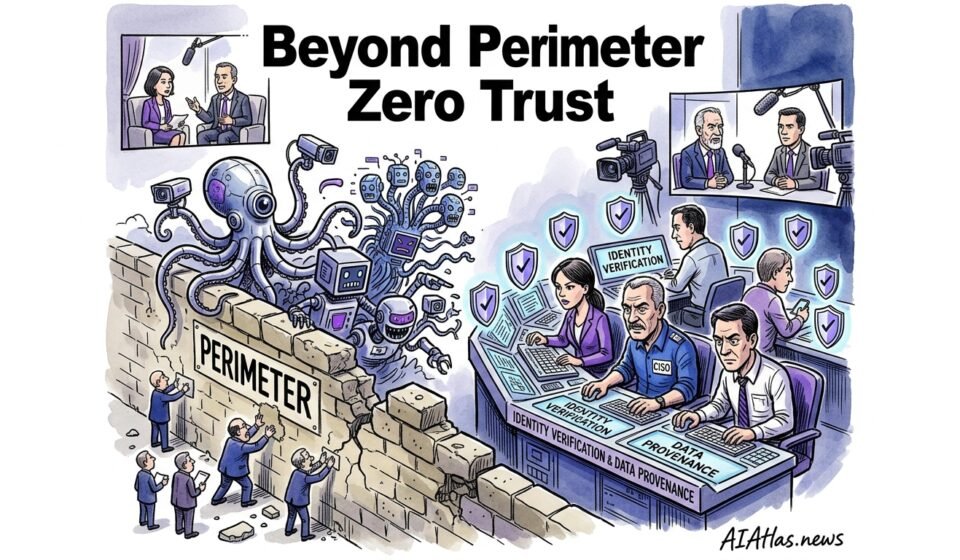
This compliance-first mentality entirely misses the reality of automated threats. The traditional network perimeter has evaporated. In an operator-led ecosystem, identity and data provenance are the only reliable defensive boundaries. Relying on outdated moat-and-castle architecture when the threat originates from within the training data itself is a fundamental misallocation of both capital and engineering bandwidth.
The Structural Shift
We are witnessing a mandatory transition from passive monitoring to an active, operator-led security model. This structural shift requires security protocols to move out of the infrastructure layer and directly into the cognitive supply chain. When an automated agent acts on behalf of a user, validating the exact provenance of the data it consumes and the strict identity constraints it operates under becomes a minute-by-minute operational necessity.
CTOs and CISOs must acknowledge that the cost of defending legacy architecture increases exponentially with each new intelligent deployment. By shifting to an embedded Zero Trust model, businesses transform security from an operational bottleneck into a commercial enabler. This allows product teams to deploy autonomous features faster and with greater confidence, directly impacting market share and top-line revenue.
Decision Framework for Capital Allocation
Allocating capital efficiently amidst rapid technological disruption requires a ruthless re-evaluation of existing vendor relationships. In our judgement, business leaders must immediately halt investments in bolt-on monitoring tools that attempt to secure autonomous models after they have reached production. Instead, capital must flow towards foundational data lineage tracking, continuous identity verification, and scalable infrastructure capable of cryptographic attestation at the model execution level.
Investors are already pricing this transition into startup valuations. Enterprise vendors pitching external firewalls for intelligent applications face heavy scrutiny, whereas startups demonstrating native, cryptographically secure data pipelines command premium multiples. We advise founders to orient their entire technical budget around this reality, ensuring every dollar spent reinforces the dual pillars of identity and provenance.
Evaluating Risk and Commercial Impact
To quantify the commercial trade-offs of various infrastructure approaches, we developed the following assessment matrix. It maps the operational posture against the ultimate financial consequence, demonstrating exactly where legacy models haemorrhage capital.
| Security Posture | Perimeter Focus | Data Provenance | Incident Cost Baseline | Competitive Velocity |
|---|---|---|---|---|
| Legacy Compliance | Network Firewalls | Untracked | Compounding & Severe | Stagnant |
| Reactive Bolt-On | API Gateways | Partial / Batch | High & Unpredictable | Delayed Releases |
| Segmented Hybrid | VLANs & Endpoints | Siloed Logging | Moderate | Average |
| Operator-Led Threat Hunting | Identity Access | Real-Time Tracing | Contained | Above Average |
| Embedded Zero Trust | Cryptographic Identity | Immutable Supply Chain | Negligible / Automated | Market Leading |
The data clearly illustrates that maintaining anything less than an embedded Zero Trust framework creates unacceptable commercial friction. Every hour engineers spend untangling opaque data pipelines during an active breach is an hour robbed from core product innovation.
Visualising the Threat and Resilience Trade-offs
To further contextualise this operational shift, we have mapped the proximity of automated threats against an organisation’s level of infrastructure resilience. The resulting 2×2 matrix serves as a strategic positioning tool for investors and technical leaders aiming to assess portfolio risk.
High Risk / Fragmented Security
Compounding Incident Costs
High Risk / Bolted-On Compliance
High Remediation Burden
Low Immediate Threat / Fragmented Focus
False Sense of Security
Low Risk / Embedded Zero Trust
Maximum Commercial Velocity
As this matrix highlights, remaining in the upper-left quadrant guarantees a slow bleed of resources. The path to the bottom-right quadrant requires deliberate architectural decisions, moving away from fragmented tools and insisting upon native integration within the development pipeline.
Strategic Recommendations for Leaders
To successfully execute this transition, we advise executive teams to immediately audit their continuous integration and continuous deployment pipelines. You must mandate that every algorithm deployed carries a verifiable cryptographic signature linking it to its training data. If your security operations centre cannot instantly verify the identity of the agent initiating a database query, you are already operating at a severe disadvantage.
Furthermore, CTOs must align their procurement strategies with this operator-led methodology. Consolidate vendor contracts, discard legacy firewalls that offer illusory protection, and invest heavily in platforms that natively support data provenance tracking. Prioritise hiring security practitioners who understand machine learning architecture, rather than network engineers attempting to retrofit outdated paradigms onto modern challenges.
Future-Proofing the Business Model
The decisions made today regarding infrastructure resilience will dictate market survival over the next thirty-six months. In our view, the most compelling commercial opportunities exist where founders recognise that robust, embedded defence mechanisms are a distinct product feature, highly sought after by enterprise buyers. Security is no longer an insurance policy; it is the core foundation upon which scalable technology companies are valued.
Ultimately, capital will ruthlessly abandon entities that cannot definitively prove their data is untainted and their algorithmic actors are tightly constrained by absolute identity verification. By taking an operator-led stance now, leaders can shield their balance sheets from inevitable incident costs while confidently accelerating their deployment timelines.
Frequently Asked Questions
Given the complexity of embedding these protocols, we constantly receive inquiries from founders and CISOs looking to clarify the execution strategy. The shift away from legacy postures generates significant internal friction, requiring leadership to articulate the commercial rationale clearly.
To assist in communicating these strategic adjustments to boards and engineering teams alike, we have distilled the most pressing operational concerns into three core responses. These insights bridge the gap between theoretical architecture and daily operational execution.
Frequently Asked Questions
- Why is data provenance specifically critical in defending against automated threats?
- Automated threats routinely target the integrity of the data pipeline rather than the application perimeter itself. If an enterprise cannot cryptographically prove the origin and purity of the information feeding its models, malicious inputs will silently compromise the output, rendering traditional access controls entirely useless.
- How does an operator-led model differ financially from compliance-driven security?
- Compliance-driven security incurs continuous, reactionary expenses through external audits and disconnected vendor tooling. An operator-led model internalises the defence within the engineering team, drastically lowering long-term incident response costs by ensuring threats are mitigated natively during the development lifecycle.
- What is the immediate first step for a startup CTO transitioning to embedded Zero Trust?
- The immediate step is enforcing rigid, cryptographic identity verification for every single microservice and machine learning agent within the deployment pipeline. Abandon network-level trust assumptions entirely and ensure no code reaches production without absolute, verifiable data lineage.