
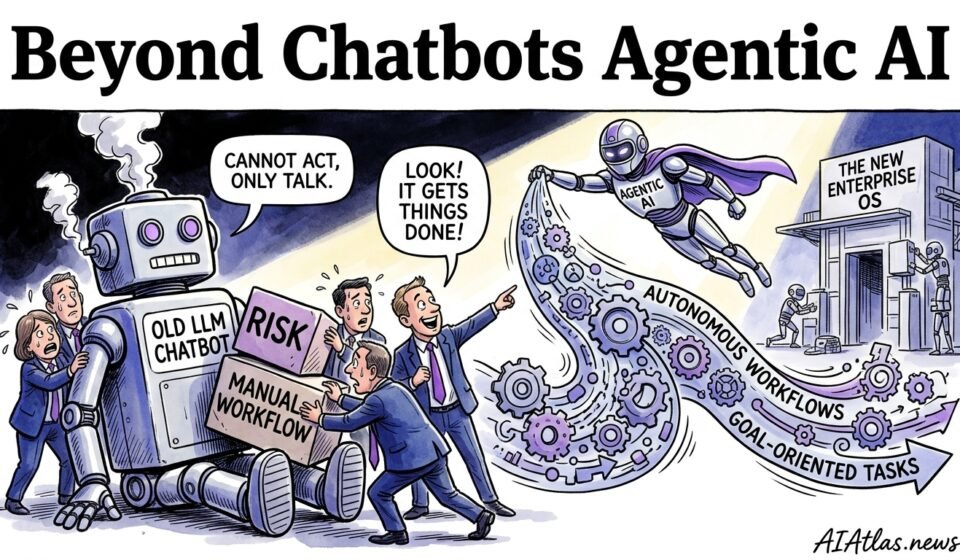
Beyond Chatbots: Why Agentic AI Is the New Enterprise Operating System
The Strategic Objective
Market shifts indicate a decisive pivot from passive language models to autonomous agents capable of multi-step task planning. We are synthesising reports from early enterprise adopters who have aggressively moved away from chat-based assistants. Instead, they are integrating active, goal-oriented agents directly into their SaaS stacks to execute complex sequences across CRM, ERP, and communication platforms.
This operational transition fundamentally alters enterprise risk profiles. When a system can independently formulate a plan, sequence API calls, and mutate data within live production environments, the financial blast radius of a hallucination expands exponentially. In our experience, startups and enterprise teams that treat these active agents merely as advanced search tools inevitably suffer severe data corruption and burn through capital attempting to reverse the damage. Success demands rigid operational boundaries.
Business Value →
High Value, Managed Risk
High Value, Critical Risk
Low Value, Low Risk
Low Value, High Risk
Prerequisite Checklist
Before authorising engineering teams to write a single line of orchestration code, founders and C-suite executives must aggressively audit their existing technical infrastructure. Too many organisations attempt to automate broken, undocumented workflows, falsely expecting an intelligent orchestration layer to patch structural inefficiencies.
In our experience, foundational readiness dictates the survivability of the project. Ensure your core infrastructure can withstand high-frequency, programmatic API calls and that access management protocols are explicitly defined before granting any entity autonomous read or write permissions.
- Role-Based Access Control (RBAC): Service accounts must be tightly scoped, granting agents the absolute minimum permissions required to complete a specified sequence.
- Idempotent API Design: Ensure that internal endpoints can handle duplicated requests safely, preventing duplicate charges or duplicate database records when an agent retries a failed operation.
- Comprehensive Audit Logging: Implement immutable logs that track the exact reasoning payload, prompt inputs, and API responses for every autonomous action.
- Hard Coded Rate Limits: Set strict budget and token limits on the agent’s execution loop to prevent infinite loops that drain API credits and inflate operational expenditure overnight.
Sequence of Operations
Executing a transition toward multi-step task planning requires a rigorous, phased rollout. Moving too fast guarantees massive resource bleed and critical security vulnerabilities that expose proprietary customer data. We strongly advise against deploying an unconstrained model directly into a production environment on day one.
We advocate a deliberate progression from read-only staging environments to fully scoped transactional capabilities. The operational phases detailed below reflect the most stable and commercially viable path we have observed in successful deployments, minimising both technical debt and executive anxiety.
Mapping the Enterprise Context
First, thoroughly map the specific business logic the system must navigate. Document the required inputs, expected outputs, and acceptable failure states for every SaaS integration. The model must be grounded in precise, deterministic rules regarding when to act and when to halt.
Defining Agent Logic and Boundaries
Write explicit system prompts and configuration files that define the agent’s persona, its available tools, and its absolute constraints. This involves configuring the specific API schemas (like OpenAPI specifications) the system will use to interface with external tools.
Read-Only Integration Testing
Deploy the agent in a purely read-only capacity. Allow it to ingest data from your CRM or database, formulate a plan, and generate a proposed response or summary. Monitor these read-only interactions meticulously to calibrate the reasoning engine without risking data mutation.
Human-in-the-Loop Transaction Approval
Introduce write capabilities, but suspend the execution until a human operator approves the payload. The agent prepares the API call, presents the intended action to a supervisor, and waits for a manual override or confirmation. This phase trains both the model and your operations team.
Full Autonomous Execution
Once the approval rate in the previous phase exceeds ninety-nine percent, remove the manual barrier for low-risk operations. Retain the human-in-the-loop requirement for destructive actions like deleting records or authorising large financial transactions.
Common Failure Points
Capital gets torched when engineering teams misunderstand the fundamental difference between probabilistic text generation and deterministic software execution. Assuming a language model will intuitively understand the bespoke edge cases in your internal databases is a rapid route to catastrophic system failure.
We repeatedly see startups fail to implement basic fallback mechanisms for their orchestration layers. When an external SaaS platform silently updates its API response format, the autonomous workflow must fail gracefully and alert a developer, rather than hallucinating a destructive workaround that corrupts subsequent data pipelines.
- Failure to implement execution timeouts, resulting in agents stuck in infinite “thinking” loops while billing per second.
- Providing monolithic system prompts rather than dynamic, context-aware tool descriptions, leading to tool selection errors.
- Neglecting to parse and validate the JSON outputs from the model before passing them into critical SaaS endpoints.
- Overestimating the reasoning capabilities of smaller models when dealing with highly nested, complex database schemas.
Execution Models: In-House Build Versus External Solutions
Deciding whether to build proprietary orchestration infrastructure or to purchase off-the-shelf management platforms dictates your capital expenditure and initial time to market. We evaluate this decision purely through the lens of strategic commercial differentiation.
If the autonomous workflow acts as your core, customer-facing product, building internally is effectively mandatory to retain intellectual property and margin control. However, if the system simply optimises back-office internal operations, purchasing an enterprise-grade platform drastically mitigates security risks and accelerates deployment.
| Evaluation Criteria | In-House Build (DIY) | Outsourced Vendor Platform |
|---|---|---|
| Initial Capital Expenditure | Extremely high engineering costs upfront. | Predictable, tier-based subscription fees. |
| Time to Market Deployment | Three to six months for stable alpha. | Operational within weeks. |
| Security and Data Control | Absolute control over data residency. | Reliant on vendor compliance and audits. |
| Ongoing Maintenance Burden | Requires dedicated internal ops team. | Vendor handles core updates and fixes. |
| Workflow Customisation | Infinite flexibility for bespoke logic. | Constrained by vendor API limitations. |
Visualised Workflow Roadmap
Translating strategy into an operational timeline prevents scope creep. The deployment architecture must transition smoothly from initial tool discovery through to iterative production monitoring, ensuring every technical milestone is backed by commercial validation.
We have structured the visual roadmap below to highlight exactly where engineering teams should concentrate their efforts. Emphasising middle-tier middleware development acts as a critical safety buffer between the raw model outputs and your highly sensitive enterprise databases.
API Perimeter Hardening
Audit all internal endpoints. Implement strict rate limiting and RBAC for dedicated service accounts before connecting any external models.
Middleware Orchestration
Develop the translation layer. This tier validates JSON outputs, sanitises inputs, and manages the execution loops and memory states.
Supervised Execution
Deploy into staging with human-in-the-loop approvals. Gather failure logs to continuously refine system prompts and tool descriptions.
Verification and Success Metrics
Traditional software metrics do not adequately measure autonomous performance. Tracking server uptime or response latency is entirely irrelevant if the orchestration layer is autonomously executing the wrong commercial sequences at scale.
Executives must demand distinct operational metrics that quantify task completion accuracy, API token efficiency, and human intervention rates. A high intervention rate initially is completely acceptable, but it must decay logarithmically over the first quarter of deployment; otherwise, the automation is failing to deliver a return on investment.
The Long-Term Maintenance Plan
Deploying a goal-oriented sequence is not a singular event; it requires continuous behavioural tuning. As underlying language models evolve and SaaS API endpoints update, your orchestration layer will suffer from behavioural drift and integration decay.
Establish a dedicated technical operations team to monitor the audit logs weekly. Routine prompt engineering updates and strict version control for your agent tools will ensure the operational boundaries remain tightly intact over the complete lifecycle of the deployed product.
Frequently Asked Questions
Enterprise leaders frequently approach us with similar concerns regarding autonomous integration protocols. Clarifying these operational realities early prevents costly misalignments between technical engineering teams and board-level commercial expectations.
We have distilled the most pressing enquiries from recent advisory sessions. Address these points directly with your engineering leads before allocating any further budget to new autonomous system deployments.
Frequently Asked Questions
- How do we prevent agents from incurring massive cloud API costs?
- You must implement hard-coded budget caps at the middleware layer. Restrict the maximum number of execution steps per task to forcefully prevent infinite loops from draining your accounts.
- Should we fine-tune a model or rely on external API tool calling?
- For multi-step execution, rely on advanced tool calling with state-of-the-art base models. Fine-tuning is better suited for tone matching, whereas zero-shot tool calling provides superior logical routing.
- What happens when an external SaaS platform updates its endpoints?
- Your middleware must be designed to fail gracefully. The system should catch the schema error, halt the autonomous sequence instantly, and alert a human engineer to manually update the tool integration.