
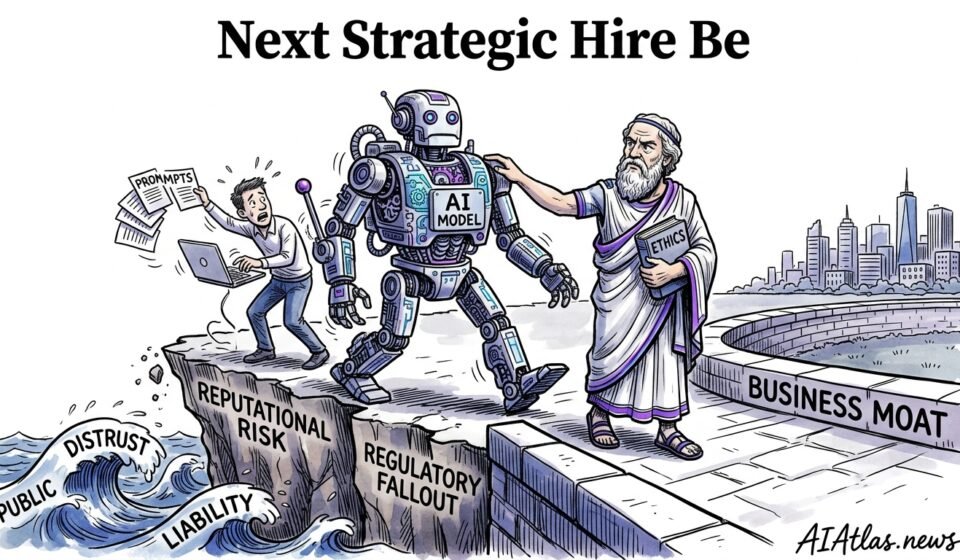
Why Your Next Strategic Hire Should Be a Philosopher, Not a Prompt Engineer
The Contrarian Thesis on AI Alignment
In our experience assessing the commercial viability of emerging foundation models, the market has fundamentally mispriced the role of ethics. Silicon Valley’s leading laboratories are quietly executing a profound pivot: aggressively hiring humanities experts—philosophers, sociologists, and linguists—to tackle the alignment problem. This is not corporate virtue signalling, nor is it an attempt to placate regulators ahead of public offerings. It is a hard technical shift.
What we are seeing is the transition of AI ethics from a public relations afterthought into a mission-critical engineering function. We argue that embedding humanities-led oversight into the core architecture of these systems is the ultimate business moat. For enterprise clients evaluating whether to integrate a specific model into their proprietary workflows, stability and reliability are paramount. A model that lacks deep, human-centric contextual grounding is an active liability, prone to erratic outputs that destroy brand equity in seconds.
Flaws in Current Market Assumptions
The prevailing narrative among venture capital circles and technical founders assumes that scaling laws will naturally resolve current deficiencies. There is a persistent, flawed belief that feeding larger datasets into expanding GPU clusters will organically eliminate hallucinations, bias, and toxic outputs. Purely quantitative engineering teams often view alignment as a final polish to be applied via automated reinforcement learning directly before deployment.
This mathematical fallacy leaves enterprises dangerously exposed. Optimising purely for loss functions without embedding semantic and cultural guardrails generates highly confident but commercially toxic outputs. When business leaders over-index on raw compute while starving alignment research, they systematically build products that fail at the enterprise level. Raw intelligence without behavioural reliability inevitably leads to catastrophic corporate embarrassments and severed vendor contracts.
The Structural Shift Towards Humanities
We are observing a structural reorganisation inside the industry’s most consequential companies. Ethics and alignment teams are being relocated from the legal and compliance departments directly into the product and engineering roadmap. Humanities experts are no longer serving as an external auditing committee; they are active architects drafting the constitutional frameworks that guide model training protocols from day one.
These experts translate abstract moral philosophy into quantifiable algorithmic constraints. They define the precise boundaries of acceptable operational behaviour, ensuring that models understand nuance, sarcasm, and cultural sensitivities that raw data ingestion cannot inherently grasp. By formalising these human elements into the training loop, companies are drastically reducing the costly post-launch patching that plagues reactive engineering cultures.
Decision Framework for Capital Allocation
For investors, chief executives, and heads of product, this evolution mandates a revised approach to capital allocation. Pouring vast sums of funding exclusively into infrastructure while neglecting the qualitative oversight required to tame that infrastructure is an irrational use of capital. Realising a return on investment in the AI sector now requires balancing rapid deployment capabilities with rigorous liability management.
We advise our clients to ring-fence a significant portion of their research and development budgets specifically for multi-disciplinary red-teaming and alignment R&D. The return on this expenditure is not measured in headline-grabbing benchmark scores, but in the avoidance of catastrophic failures. Securing lucrative, multi-year business-to-business contracts hinges entirely on proving to procurement teams that your model will not generate brand-destroying anomalies.
Commercial Risk Assessment Profile
To fully grasp the commercial stakes, leaders must evaluate the specific operational vulnerabilities associated with legacy AI development. The contrast between retrofitting safety measures and engineering alignment from inception defines the modern enterprise risk profile.
The following table outlines the primary risk categories we assess during technical due diligence, illustrating how a humanities-led approach actively insulates enterprise valuation compared to outdated compliance mindsets.
| Risk Category | Legacy Compliance Approach | Alignment-First Strategy | Enterprise Impact | Mitigation Horizon |
|---|---|---|---|---|
| Contextual Hallucination | Post-generation filtering | Pre-training semantic boundaries | Protects core operational data integrity | Long-term proactive |
| Cultural Misalignment | Reactive apologies and patching | Sociological dataset auditing | Prevents rapid brand equity erosion | Immediate foundational |
| Regulatory Breach | Legal defence preparation | Embedded jurisdictional logic | Secures ongoing market access | Continuous systemic |
| Output Toxicity | Keyword blocking | Philosophical RLHF tuning | Ensures safe end-user interactions | Iterative lifecycle |
| Copyright Infringement | Takedown compliance | Provenance tracking mechanisms | Averts crippling corporate litigation | Pre-deployment structural |
Visualised Enterprise Impact Matrix
Understanding exactly where to position your AI product requires navigating the tension between robust alignment oversight and raw enterprise utility. Founders frequently struggle to visualise how investing in humanities-driven safety actually improves market positioning rather than hindering it.
In our experience, positioning within this matrix dictates a firm’s trajectory toward either lucrative acquisitions or terminal churn. Products that successfully land in the optimal quadrant balance deep ethical grounding with high reliability, fundamentally outcompeting platforms that optimise solely for unconstrained capability.
High Alignment / Low Utility
Safe but commercially unviable
High Alignment / High Utility
Market leaders commanding premium pricing
Low Alignment / Low Utility
High churn, severe brand risk
Low Alignment / High Utility
Technically impressive, legally precarious
Strategic Recommendations for Leadership
Chief executives must fundamentally restructure their product development life cycles to reflect this new reality. Waiting until the final weeks before launch to conduct an ethics review is a critical operational failure. Alignment parameters, guided by non-engineering domain experts, must be integrated during the initial data curation and architectural design phases.
Furthermore, we strongly suggest altering internal reporting structures. The Head of Alignment should report directly to the chief executive, independent of the standard product management hierarchy. This governance structure ensures that safety and reliability metrics retain the authority to veto arbitrary deployment deadlines, prioritising long-term enterprise viability over short-term launch cycles.
Future-Proofing the Enterprise Model
The ultimate commercial value of an artificial intelligence deployment will be measured by its institutional stability, not merely its raw computational intelligence. Institutional stability is an intrinsically human-defined metric, requiring a deep understanding of corporate reputation, societal norms, and nuanced communication.
As regulatory frameworks harden across European and North American markets, possessing a deeply integrated, humanities-led alignment function will transition from a unique competitive advantage into a baseline legal prerequisite for survival. Businesses that recognise alignment as a core engineering feature today will dominate the enterprise software contracts of tomorrow.
Frequently Asked Questions
To further clarify the commercial implications of this operational pivot, we frequently field inquiries from institutional investors and founding teams navigating the complexities of AI scaling. Understanding these dynamics is essential for accurate risk modelling.
Below are the most common questions regarding the integration of humanities oversight into technical roadmaps, addressing the immediate concerns surrounding speed to market and venture valuation.
Frequently Asked Questions
- Why are engineering teams unable to solve alignment alone?
- Engineering teams excel at optimising quantifiable metrics and loss functions, but alignment requires defining abstract concepts like fairness and contextual safety. Humanities experts possess the academic frameworks necessary to translate societal norms into specific, workable boundaries for engineers.
- Does humanities-led oversight slow down product deployment?
- While it introduces friction during the initial design phase, embedded oversight significantly accelerates long-term market adoption. By preventing catastrophic failures and public relations crises, companies avoid the massive delays associated with rolling back products and repairing vendor trust.
- How do investors value alignment teams during due diligence?
- Sophisticated investors increasingly view deep alignment capabilities as a primary indicator of a startup’s maturity and readiness for enterprise contracts. A robust oversight function demonstrates that the founding team understands liability management, directly increasing the premium on their valuation.