
The $2.3B Reality Check: Why TCS’s AI Revenue Proof Matters for Your Roadmap
The Contrarian Thesis
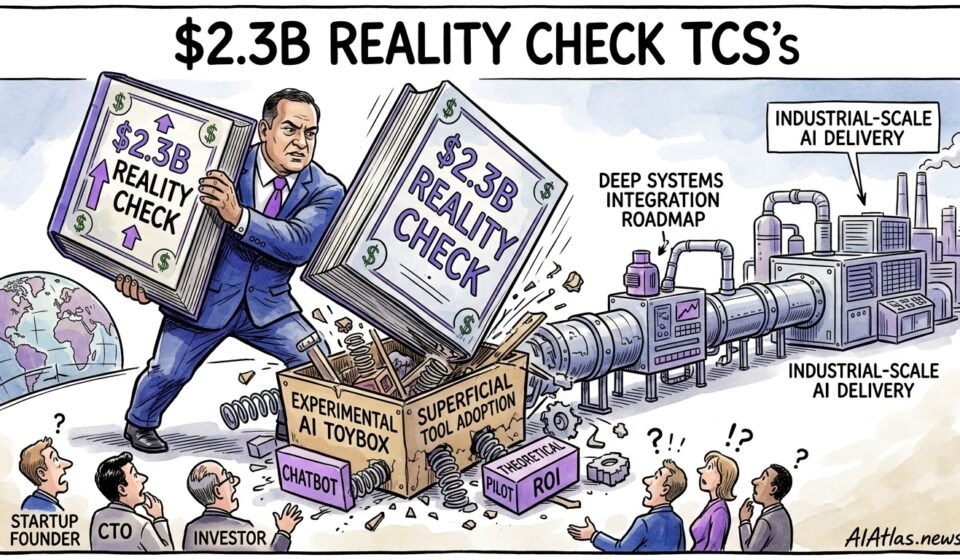
When Tata Consultancy Services recently reported surpassing $2.3 billion in annualised revenue tied directly to artificial intelligence, the broader financial press reacted with predictable enthusiasm. However, in our experience observing the deployment cycles of Fortune 500 companies, the sheer volume of this capital is far less interesting than the specific mechanics of how it is being captured. The headlines suggest an explosion of algorithmic magic; the reality on the ground points to a massive, unglamorous surge in heavy-duty enterprise plumbing. This revenue milestone does not represent the triumph of flashy consumer chatbots, but rather the death of the superficial application layer.
We argue that this $2.3 billion figure serves as a definitive market signal: the experimental phase is over, and the era of industrial-scale integration has commenced. Service providers are not generating these margins by selling clever prompt interfaces. They are doing it through brute-force systems integration and vast workforce upskilling programmes. The commercial moat in this sector no longer belongs to the creators of the most elegant foundational models, but to the entities capable of rewiring decade-old legacy architecture to safely ingest and process proprietary corporate data.
Flaws in Current Market Assumptions
We consistently observe startup founders and corporate boards operating under a perilous delusion regarding value creation. There is a pervasive assumption that simply bolting a large language model onto an existing software suite constitutes a defensible commercial strategy. Consequently, capital continues to flow towards teams building thin wrappers over third-party APIs, while the underlying data infrastructure remains disastrously neglected. This approach fundamentally misunderstands what enterprise clients are actually willing to pay for at scale.
This assumption ignores the immense friction inherent in commercial deployments. Off-the-shelf software tools routinely fail at the enterprise level because they cannot navigate the Byzantine complexities of legacy environments, fragmented databases, and rigorous compliance mandates. The market is drastically mispricing the difficulty of adoption. When executives assume that advanced capabilities can be purchased as a frictionless SaaS subscription, they severely underestimate the internal restructuring required to make those capabilities functional, secure, and compliant.
The Structural Shift
What we are currently witnessing is the rapid and necessary industrialisation of this technology. The TCS revenue breakdown reveals a structural shift away from pilot projects and towards foundational overhaul. Enterprises have realised that sophisticated algorithms are entirely useless if the data feeding them is trapped in siloed, on-premise servers. Therefore, the budgets have pivoted sharply towards data engineering, cloud infrastructure modernisation, and enterprise-grade security protocols.
Simultaneously, the emphasis on massive workforce training programmes highlights a critical operational reality: human capital remains the bottleneck for technical deployment. We see enterprise clients refusing to deploy autonomous agents until their internal teams are fully certified to audit, manage, and secure them. The shift is clear: growth is now driven by comprehensive transformation contracts that pair deep-stack technical integration with extensive employee education, ensuring that the organisation can actually operate the machinery it has purchased.
Decision Framework for Capital Allocation
For investors and chief technology officers, the commercial mandate has never been clearer. Capital must be aggressively reallocated away from surface-level applications and redirected towards the foundational infrastructure layers. We advise a strict prioritisation of budgets towards data pipeline engineering, vector database construction, and robust security architectures. If a project does not actively improve the structural integrity of the underlying enterprise data layer, it should be heavily scrutinised before receiving approval.
Furthermore, internal capital allocation must reflect the necessity of operational readiness. A deployment strategy that funds software licensing while starving employee training is guaranteed to fail. We recommend treating workforce upskilling not as an auxiliary human resources expense, but as a core capital expenditure vital to the success of the technical rollout. The threshold for advancing beyond the proof-of-concept stage must demand clear evidence of deep integration into existing workflows, rather than isolated, standalone functionality.
Risk Assessment and Operational Trade-Offs
Transitioning from experimental projects to deep-stack enterprise deployments introduces a distinct set of operational risks and trade-offs. Leaders must explicitly understand what they are sacrificing when they choose the slow, methodical path of structural overhaul versus the rapid deployment of superficial tools. In our analysis, the perceived safety of quick wins often masks a compounding accumulation of technical debt.
The following assessment table outlines the primary dimensions we track when evaluating enterprise transition strategies. It compares the immediate, experimental approach against the industrial-scale model validated by recent multi-billion dollar revenue shifts, highlighting where the true long-term value resides.
| Strategic Dimension | Superficial Deployment Model | Industrial Integration Model |
|---|---|---|
| Capital Outlay | Low initial cost, high recurring SaaS fees | Massive upfront CAPEX, intensive training costs |
| Time to Value | Days or weeks for initial proof-of-concept | Months to years for full operational capability |
| Security Posture | High risk of data leakage via public endpoints | Bespoke governance and ring-fenced private clouds |
| Technical Debt | Accumulates rapidly through disconnected silos | Resolves legacy issues through architectural overhaul |
| Competitive Moat | Non-existent; easily replicated by competitors | Deep structural advantage; highly defensible |
Visualising the Integration Impact
To conceptualise the current state of market maturity, we utilise an impact matrix to evaluate where active corporate projects sit on the spectrum of value creation versus deployment depth. This framework helps us quickly identify which initiatives are destined for commoditisation and which possess the potential to generate lasting structural alpha.
As the matrix illustrates, initiatives that remain in the low-integration quadrants are essentially tactical distractions. True commercial transformation occurs exclusively in the high-integration, high-value quadrant. This is the precise domain where massive service providers are securing their multi-year contracts, undertaking the heavy lifting required to fuse new capabilities directly into the core operating systems of their clients.
Tactical Workflow Automation
Core System Overhaul (The Industrial Model)
Superficial Wrappers & Pilots
Over-engineered Science Projects
Strategic Recommendations for Leaders
We strongly recommend that startup founders pivot their go-to-market strategies immediately towards the unglamorous, foundational layers of the enterprise stack. If your commercial offering involves facilitating secure legacy system migration, managing complex data ingestion pipelines, or ensuring compliance across federated systems, you are operating in a high-growth channel. The market appetite for tools that fix structural data problems drastically outweighs the appetite for yet another productivity assistant.
For enterprise executives, the overarching priority must be internal capability development. The most advanced systems are operational liabilities if your staff cannot maintain them. We advise leaders to emulate the service provider approach by investing aggressively in continuous internal training programmes. Ensuring your data engineers, security officers, and operational managers are deeply fluent in these new architectures is the only proven method to protect your infrastructure investment from rapid depreciation.
Future-Proofing the Business Model
As this technological cycle matures, we see a clear trajectory: the ultimate commercial advantage will belong entirely to organisations that own their infrastructure and possess the elite internal talent required to orchestrate it. Relying extensively on external vendors for core computational tasks or data processing introduces a severe strategic vulnerability. Future-proofing a business requires a deliberate move away from vendor lock-in and a corresponding investment in private infrastructure.
Ultimately, the organisations that will dominate their respective sectors over the next decade are those that recognise deep-stack integration as an ongoing operational discipline, not a one-off IT project. Building a resilient commercial model requires treating physical technical infrastructure and sophisticated employee education as a single, unified asset class. The $2.3 billion in revenue generated by market leaders proves that the heavy lifting has begun; those unwilling to modernise their foundations will simply be left behind.
Frequently Asked Questions
- What does the recent multi-billion dollar service revenue milestone signify for startup founders?
- It indicates that corporate budgets are aggressively shifting away from standalone applications and towards profound infrastructure overhauls. Founders must build robust tools that natively integrate into complex legacy environments rather than attempting to bypass them.
- Why is large-scale workforce training suddenly emerging as a primary growth driver?
- Advanced technical infrastructure is functionally useless without the internal talent to manage, secure, and iterate upon it. Enterprises are increasingly refusing to deploy systemic models until their internal teams are fully certified to oversee the associated compliance protocols.
- How should CTOs effectively evaluate new technical vendors in this mature market phase?
- Chief Technology Officers must prioritise vendors strictly based on data sovereignty, verifiable security posture, and the capacity to operate entirely within private clouds. Any vendor attempting to run enterprise-grade workloads over generic public API endpoints must be rejected.