The Enterprise AI Security Gap Is No Longer a Policy Problem — It’s an Execution Failure
The Contrarian Thesis
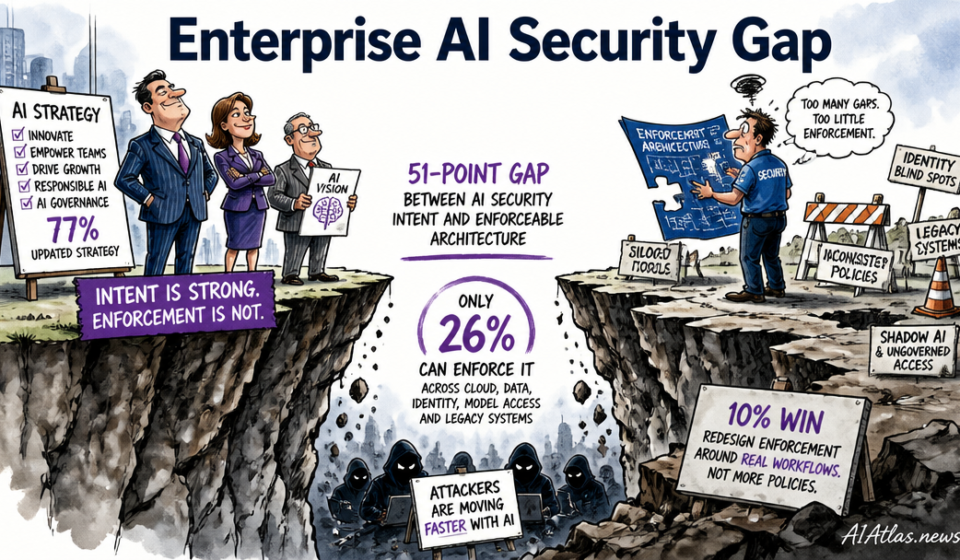
Check Point’s 2026 Cloud Security Report is being treated like another set of cloud security statistics. In our view, that would be a category error. The meaningful story is the 51-point gap between AI security intent and enforceable architecture. That gap is an operating signal: you can’t steer risk with declarations when the control plane can’t enforce policy at speed.
The same report also finds that 77% of organisations updated their cloud security strategy in response to AI adoption, but only 26% have the architecture to enforce those strategies effectively. Then comes the part boards should underline in red: 78% experienced confirmed or suspected AI-related security incidents in the past year. If your “intent” is broad, your “capability” is narrow, and incidents are already frequent, you are not behind on tooling—you are behind on system design.
Flaws in Current Market Assumptions
We keep seeing a familiar commercial narrative: “AI changes the threat model, therefore we need more security features.” That sounds sensible until you ask what actually changes in enterprises: the architecture of identity, governance, and workload permissions. Most security teams are still trying to bolt response controls onto environments that were never built to translate AI-era policies into enforceable decisions.
What’s broken is not strategy-writing. It’s the machinery that makes strategy real—policy-as-code, identity-aware enforcement, workload-level authorisation, continuous validation, and the operational loops that prove controls work. The 51-point gap tells us that many organisations have upgraded language (“we’ll secure AI workloads”) without upgrading enforcement (“we can continuously prevent, detect, and remediate unauthorised behaviour across dynamic AI workflows”).
The Structural Shift
AI adoption shifts the centre of gravity from “secure the perimeter” to “secure the decision boundary.” Models, agents, retrieval systems, and orchestration layers all create new decision points where data access, identity claims, and authorisation rules are interpreted in milliseconds—and often outside the classic perimeter view. When identity governance is weak, prompt and tool misuse becomes an access problem.
Commercially, this is why AI-driven threats are outpacing traditional models: many enterprises still rely on controls that assume relatively stable assets and predictable user behaviour. AI workflows are neither. They are dynamic, permission-sensitive, and frequently run under service identities that organisations do not continuously validate. Meanwhile, governance layers struggle with provenance, lineage, and policy drift—exactly where boards expect accountability.
Decision Framework for Capital Allocation
We treat the intent-to-capability gap as a capital allocation problem, not a procurement problem. When only 26% can enforce the strategy, the default question for leaders should be: “What percentage of our risk controls can we prove are continuously enforced across AI-relevant identity and cloud paths?” That reframes spend from “more products” to “higher enforceability per pound invested.”
Our framework is simple, and deliberately operational. First, map where AI expands blast radius: identity, data access, workload permissions, and governance decisioning. Second, score each control by enforceability (prevent vs detect vs respond), coverage (which workloads and identities), and proof (evidence of continuous operation). Third, fund the shortest path to reducing the gap—often by investing in policy enforcement and continuous control validation before broad feature rollouts.
For investors and startup founders, this has a direct go-to-market implication. Buyers aren’t just purchasing capabilities; they’re buying ways to close the architecture gap fast. That means security vendors must show measurable enforcement outcomes (coverage, latency, and audit-ready proof), not just compliance posture slides.
Risk Assessment Table
Below is how we see the gap materialise in real enterprise environments. Each row reflects a recurring failure mode where “strategy” exists, but enforcement cannot keep pace with AI-driven workflows.
| Control Gap (Intent Without Capability) | Where It Breaks | Business Impact | Common Enforcement Failure | Board-Grade Priority |
|---|---|---|---|---|
| Identity-aware authorisation for AI workflows | Cloud apps, workload identities, service accounts | Unauthorised data access, lateral movement | Static roles; no continuous validation; weak session controls | Very High |
| Policy-as-code across dynamic tools and agents | Orchestration layers, API gateways, agent runtimes | Policy drift; uncontrolled tool execution | Human approvals; inconsistent policy propagation | High |
| Governance for data provenance and lineage | RAG pipelines, ingestion, storage and retrieval | Regulatory exposure; reputational damage | Missing provenance checks; incomplete lineage evidence | High |
| Continuous detection tuned to AI-relevant telemetry | Cloud logs, identity events, query and tool traces | Slow containment; repeat exploitation | Telemetry gaps; alert fatigue; delayed correlation | Medium-High |
| Incident response playbooks specific to AI misuse | Credential abuse, prompt/tool misuse, data exfil paths | Recovery costs; operational disruption | Generic playbooks; no tabletop evidence for AI scenarios | Medium |
Notice the pattern: most of these gaps are architectural and governance-led, not merely detection-led. That’s why “updating strategy” won’t materially reduce risk if enforcement cannot be proven across AI workloads, identities, and policy decision paths.
Visualised Impact Matrix (div)
We use an impact matrix to decide where enforcement investment pays back quickest. High likelihood failures tend to sit at identity and authorisation boundaries; high impact failures cluster around data provenance, tool misuse, and governance drift.
The matrix matters because it points to an investment sequencing logic. If 78% of organisations have seen AI-related incidents, you don’t start with “best practice hardening.” You start by eliminating the highest-likelihood enforcement failures—usually identity and policy decision boundaries—then expand coverage with evidence and automation.
Intent + enforceable architecture: 26%
Updated strategy, no enforceability: 51%
No evidence of updated strategy: 23%
Strategic Recommendations for Leaders
We recommend a deliberate shift in how leaders think about security spend: from “feature coverage” to “enforceable control coverage.” Start by demanding proof that your identity and authorisation layers can enforce AI-relevant policy decisions consistently across dynamic workflows. If you can’t show it, you don’t have a control—you have a plan.
Second, treat AI-related security as an enterprise capability that spans cloud, identity, governance, and operations. That means building ownership and escalation paths that include platform teams, not only security teams. In our experience, the organisations that reduce the 51-point gap fastest are the ones that align responsibility for enforcement with the teams that actually deploy AI workloads.
Third, revise vendor selection criteria. Ask vendors to demonstrate how their controls reduce time-to-enforce and time-to-prove. The winner will not simply integrate with your stack; it will operationalise policies with measurable evidence—coverage, latency, and audit-ready outputs—so board reporting becomes fact, not narrative.
Future-Proofing the Business Model
AI advancement won’t slow down, but the commercial impact can be managed. Enterprises that treat the architecture gap as an ongoing cost centre will keep paying in incident-driven disruption. Enterprises that treat enforcement capability as core infrastructure will convert security spend into measurable resilience—reducing downtime, regulatory risk, and vendor sprawl.
For operators, this means designing a repeatable loop: define policy, implement enforcement, collect telemetry, validate effectiveness, and remediate drift. For founders and investors, it means product-market fit increasingly depends on “enforceability,” not “visibility” alone. Visibility is cheap; enforceability is hard. The market will fund hard things because 78% of organisations already face AI-related incidents.
Ultimately, the trade-off behind rapid AI progress is straightforward: speed creates decision complexity, and decision complexity demands enforcement discipline. When boards internalise that, security stops being an expense to debate and becomes an infrastructure advantage to build.